Downtown, Bryan
Updated · 543 residents
Downtown Bryan serves as a vibrant cultural hub defined by its historic Victorian architecture and a concentration of local eateries, coffee shops, and arts venues. While the area offers a lively social atmosphere, residents should be aware of challenges such as limited sidewalk infrastructure and a significant risk of flooding.
Key Highlights
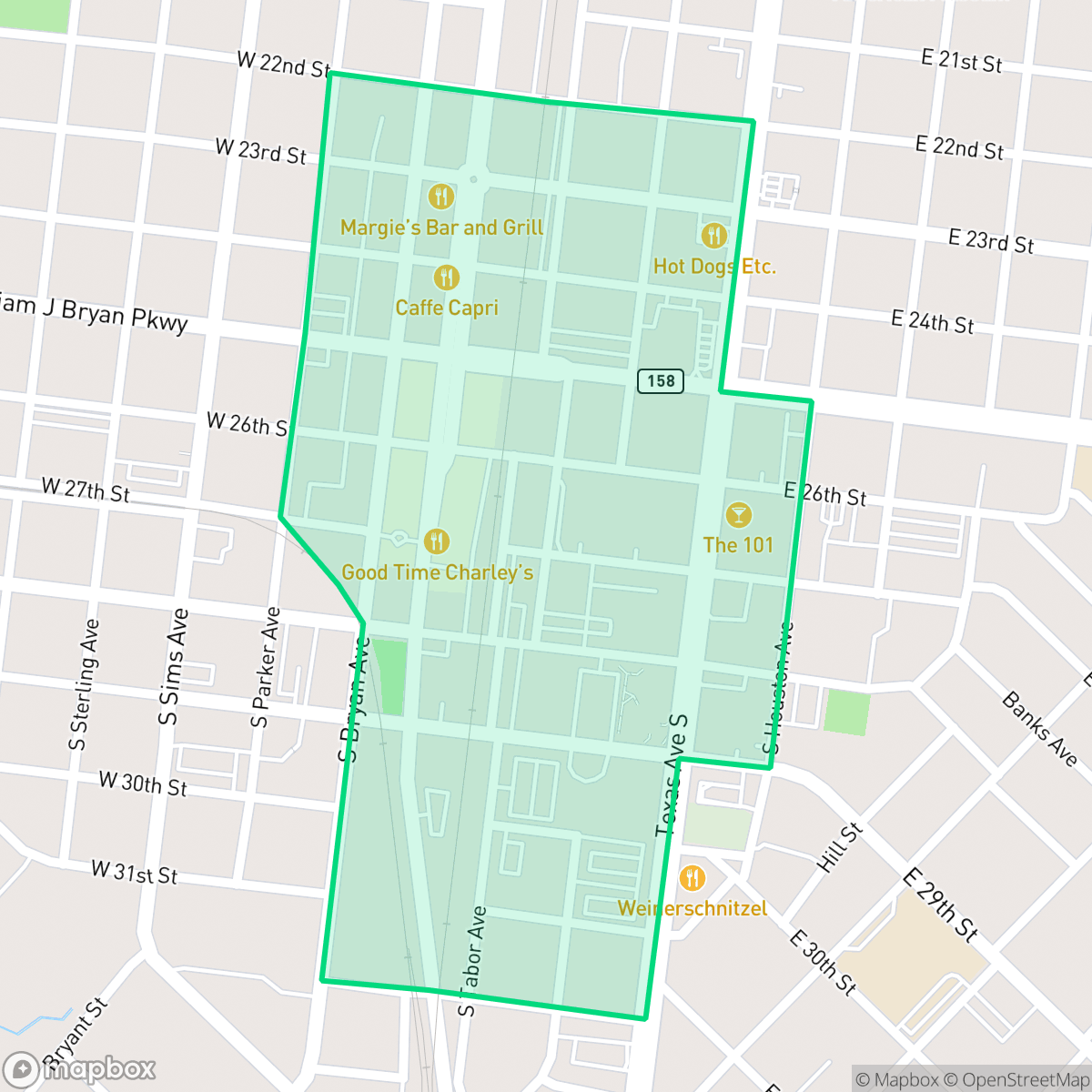
About Downtown
Downtown Bryan, established in 1866 as a strategic depot for the Houston and Texas Central Railway, evolved from a frontier railroad stop into a bustling commercial center. Following a devastating fire in 1885, the area was rebuilt with durable brick architecture, characterized by Victorian Commercial styles, decorative cornices, and arched windows. Today, the district is recognized on the National Register of Historic Places and as a Texas Cultural District. Notable landmarks include the 1939 Queen Theatre, the historic La Salle Hotel, and the Carnegie History Center, housed in a former library. After experiencing a decline during the mid-20th-century suburban shift, downtown underwent a significant revitalization beginning in the late 1990s, restoring its historic low-rise scale and mixed-use character to once again serve as a vibrant hub for the Brazos Valley.
The neighborhood functions as the historic heart of the city, characterized by its preserved brick storefronts and a distinct semi-rural feel that blends residential zones with small commercial pockets. As a recognized Texas Cultural District, the area maintains a lively social atmosphere driven by frequent community events, local galleries, and a diverse population mix. Residents enjoy access to unique amenities like the Queen Theatre and various local breweries, all set within an environment that maintains clean air quality and a sense of open space compared to more densely developed urban sectors.
Living in this area involves specific trade-offs, particularly regarding daily infrastructure and personal safety. While the core is a social destination, the lack of consistent sidewalk access makes the neighborhood notably car-dependent for most errands. The acoustic environment is often active due to traffic, and the area faces a high risk of flooding that requires careful consideration for property owners. Additionally, families should note that the local school district, while currently undergoing facility improvements, faces ongoing fiscal challenges and inconsistent academic performance across its campuses. Residents also experience lower-than-average access to health insurance, which is an important factor for prospective households to consider when evaluating the area's long-term livability.
Neighborhood Scores Across 15 Qualities
Residents will find a mix of building spacing and some buffer between neighbors, which is slightly lower than the Bryan average according to iHuus data.
Quiet streets allow for pedestrian movement, though the lack of sidewalks makes walking slightly less accessible than in other parts of Bryan. According to iHuus data, the infrastructure for pedestrians is below the city average.
Standard tract housing with modest yards characterizes this area, and the visual environment is less lush than the Bryan average according to iHuus data.
Access to public parks and green verges is relatively sparse in this area. According to iHuus data, dog friendliness is below the Bryan city average.
Open land and scattered structures provide a more semi-rural atmosphere than the more densely urbanized parts of Bryan. This mix of residential and small commercial zones creates a landscape with more greenery and space than the city average.
Frequent activity is driven by a notable concentration of local eateries, coffee shops, and cultural sites along the railway corridor. This area offers a significantly more vibrant atmosphere than the average Bryan neighborhood, though much of the area remains car-dependent.
Local traffic from nearby busy streets creates a steady hum. According to iHuus data, the acoustic environment is slightly more active than the average for Bryan.
Air quality remains consistently high and matches the city average, with rare instances of elevated readings. According to iHuus data, the atmosphere is mostly clean and suitable for outdoor activities.
Residential life here is largely undisturbed by heavy industry, though some light utility structures and a railway line are located along the eastern edge. This area features slightly more proximity to industrial elements than the Bryan city average, according to iHuus data.
Health insurance accessibility is notably lower in this area than the Bryan average. According to iHuus data, a significant portion of the resident population lacks coverage.
Political leanings in this area are significantly more liberal than the Bryan city average. According to iHuus data, the neighborhood maintains a liberal majority with a modest opposing presence.
A balanced range of age groups, including young adults, families, and seniors, resides here. This demographic spread is largely consistent with the broader Bryan area according to iHuus data.
Significant flood hazards exist in this area, which is much higher than the Bryan average. Residents should expect elevated insurance costs and potential property risks according to iHuus data.
Address-Level Insights for Downtown


iHuus Neighborhood Intelligence Insights
Get address-level neighborhood insights for Downtown
- Street-level scores — see how individual blocks compare, not just neighborhood averages
- Micro-zone boundaries — identify quiet pockets, flood boundaries, and walkable clusters before you visit
- 15 dimensions in full — walkability, noise, air quality, school quality, insurance coverage, population age profile, urban/rural index, and more
- Boundary risk alerts — know if your address sits near a block boundary where scores drop, the kind of detail no listing will ever mention
- School insights — individual school ratings and insights, not just district-level data
- Compare before you commit — side-by-side data across neighborhoods, down to block precision
No credit card required
Compare with Any Neighborhood
| Dimension | Downtown | Austin's Colony |
|---|---|---|
| 🚶 Walkabilityavg 6.09 | ||
| 🔊 Acoustic Comfortavg 4.28 | ||
| 🤫 Privacy Indexavg 6.22 | ||
| 🎨 Visual Appealavg 5.82 | ||
| 🐕 Dog Friendlinessavg 6.49 | ||
| 🗺️ Urban-Rural Indexavg 7.47 | ||
| ✨ Neighborhood Vibeavg 4.13 | ||
| 🏥 Health Insurance Coverageavg 5.88 | ||
| 🌿 Air Qualityavg 7.99 | ||
| 🏭 Industrial Proximityavg 8.3 | ||
| 🌊 Flood Safetyavg 4.22 | ||
| 🗳️ Ideological Leanavg 4.07 | ||
| 👥 Population Age Profileavg 4.46 | ||
| 🔥 Fire Safety | ||
| 🏫 School Quality |
Downtown Rankings
School Districts Serving Downtown
School Insights for Downtown
Below average outcomes; significant attendance and academic challenges.
School Insights
See what's really behind every school rating near Downtown
- Individual school ratings — each school's own score with outcome context, not just a district average
- Enrollment & class size data — student-to-teacher ratio and how it compares to the state average
- Full demographics breakdown — ethnicity and gender composition for every school in the enrollment zone
- Every school in the district — all schools within the enrollment boundary ranked by rating, not just the closest one
- Grade levels & benchmarks — elementary through high school, with below/above state-average flags
No credit card required