Carver-Kemp, Bryan
Updated · 3,074 residents
Carver-Kemp is a residential community located just west of downtown Bryan, characterized by a mix of mid-century bungalows and recent infill construction. The area offers moderate walkability and access to local dining, though residents should expect noticeable noise from nearby road traffic.
Key Highlights
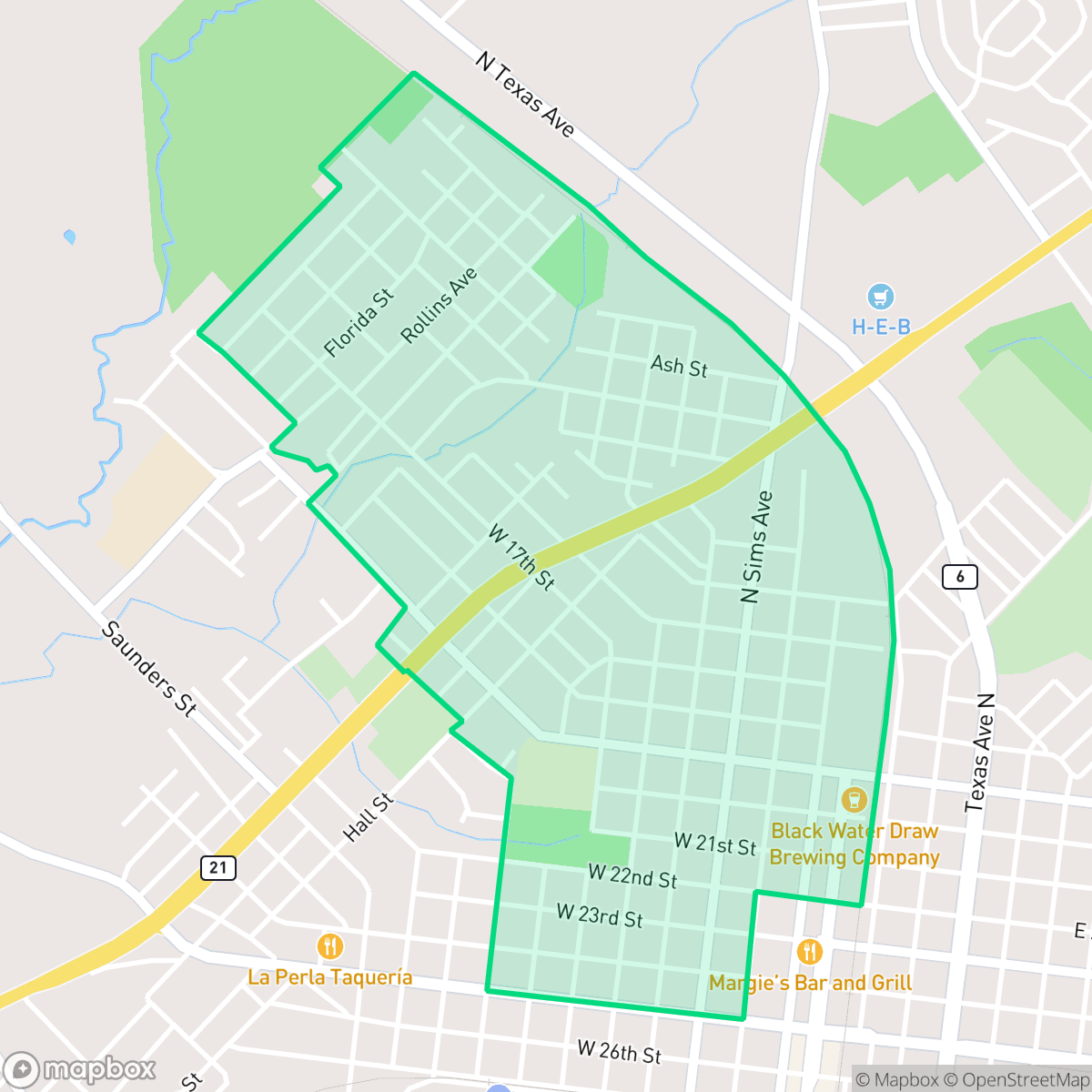
About Carver-Kemp
The Carver-Kemp neighborhood in Bryan, Texas, is a historically significant residential community situated just west of the city's historic downtown. The neighborhood’s identity is closely tied to local educational and community leaders, as reflected in the naming of the local Kemp-Carver Elementary school after longtime local principal E.A. Kemp and renowned scientist George Washington Carver. The neighborhood is home to Claude Scurry Park—originally established in the 1890s as Oak Grove Park, making it Bryan's oldest public park. To protect the area's residential integrity and support low-to-moderate-income families, local residents established the Carver-Kemp Neighborhood Association (CKNA) in 1989. Historically characterized by mid-century bungalows and single-family homes, the neighborhood has recently experienced a wave of revitalization, infill development, and new residential construction.
The neighborhood functions as a blend of residential streets and light commercial pockets, with a vibe that shifts from quiet suburban blocks to more active zones near the railway. Local amenities include popular spots such as Tavo Coffee Company and various taquerias, providing convenient options for residents despite the area's car-dependent nature. While the community maintains a consistent air quality index, the proximity to industrial sites and rail lines contributes to a measured noise level primarily driven by road traffic.
Prospective residents will find a diverse housing stock that continues to evolve through new development. While the area provides access to the well-regarded Neal Elementary, families should consider the broader district's academic performance and the lower rates of health insurance coverage in the region. It is best suited for those seeking proximity to the downtown core who prioritize established community associations and a mix of traditional and modern residential options.
Neighborhood Scores Across 15 Qualities
Residential spacing provides a balanced level of separation between properties, which is roughly in line with the Bryan average. According to iHuus data, the area features a mix of building densities that offer some buffer between neighbors.
Low traffic volumes make for a peaceful environment for pedestrians, though the lack of sidewalks distinguishes it from more walkable areas in Bryan. According to iHuus data, the absence of dedicated walkways means residents must navigate shared street spaces.
Standard tract housing with modest yards characterizes the area. This level of visual variety is lower than the Bryan city average.
Limited access to public parks and a lack of wide green verges make walking dogs more difficult here than in most other Bryan neighborhoods. According to iHuus data, pet owners may find fewer opportunities for outdoor exercise within the immediate vicinity.
Open land and scattered homes provide a more rural atmosphere than the more densely developed parts of Bryan. According to iHuus data, this area features a mix of residential grids, light industrial zones, and pockets of woodland.
A mix of lively suburban blocks and quiet rural pockets provides a higher level of activity and dining variety than the Bryan average. While various social hubs and eateries are accessible, most areas remain car-dependent due to the spacing of commercial units.
A steady hum of local traffic from a nearby busy street characterizes the area. This level of acoustic activity is slightly higher than the average for Bryan, according to iHuus data.
Air quality remains consistently clean with very few instances of elevated pollutants. This level of air purity is consistent with the average found throughout Bryan.
Light industrial elements and a nearby railway line introduce intermittent utility noise and truck traffic, which is more noticeable here than in many other parts of Bryan. Most of the area remains residential, though some edges feature warehouses and a local brewery.
Health insurance access is notably lower here than in the rest of Bryan, according to iHuus data. A small portion of the local population maintains active health coverage.
Political leanings in this area are significantly more liberal than the Bryan average. Residents will find a community with a distinct progressive majority.
Residents live alongside a balanced mix of young adults, families, and seniors. According to iHuus data, this age distribution is slightly more concentrated toward certain age groups than the average for Bryan.
Flood risk is elevated in this area as parts of the neighborhood fall within a designated floodplain. According to iHuus data, this risk is higher than the average for Bryan, and residents should anticipate that flood insurance may be a standard requirement.
Address-Level Insights for Carver-Kemp


iHuus Neighborhood Intelligence Insights
Get address-level neighborhood insights for Carver-Kemp
- Street-level scores — see how individual blocks compare, not just neighborhood averages
- Micro-zone boundaries — identify quiet pockets, flood boundaries, and walkable clusters before you visit
- 15 dimensions in full — walkability, noise, air quality, school quality, insurance coverage, population age profile, urban/rural index, and more
- Boundary risk alerts — know if your address sits near a block boundary where scores drop, the kind of detail no listing will ever mention
- School insights — individual school ratings and insights, not just district-level data
- Compare before you commit — side-by-side data across neighborhoods, down to block precision
No credit card required
Compare with Any Neighborhood
| Dimension | Carver-Kemp | Austin's Colony |
|---|---|---|
| 🚶 Walkabilityavg 6.09 | ||
| 🔊 Acoustic Comfortavg 4.28 | ||
| 🤫 Privacy Indexavg 6.22 | ||
| 🎨 Visual Appealavg 5.82 | ||
| 🐕 Dog Friendlinessavg 6.49 | ||
| 🗺️ Urban-Rural Indexavg 7.47 | ||
| ✨ Neighborhood Vibeavg 4.13 | ||
| 🏥 Health Insurance Coverageavg 5.88 | ||
| 🌿 Air Qualityavg 7.99 | ||
| 🏭 Industrial Proximityavg 8.3 | ||
| 🌊 Flood Safetyavg 4.22 | ||
| 🗳️ Ideological Leanavg 4.07 | ||
| 👥 Population Age Profileavg 4.46 | ||
| 🔥 Fire Safety | ||
| 🏫 School Quality |
Carver-Kemp Rankings
School Districts Serving Carver-Kemp
School Insights for Carver-Kemp
Below average outcomes; significant attendance and academic challenges.
School Insights
See what's really behind every school rating near Carver-Kemp
- Individual school ratings — each school's own score with outcome context, not just a district average
- Enrollment & class size data — student-to-teacher ratio and how it compares to the state average
- Full demographics breakdown — ethnicity and gender composition for every school in the enrollment zone
- Every school in the district — all schools within the enrollment boundary ranked by rating, not just the closest one
- Grade levels & benchmarks — elementary through high school, with below/above state-average flags
No credit card required