South Park, Beaumont
Updated · 13,896 residents
South Park is a quiet, historically significant community defined by its industrial roots and mid-century residential architecture. Residents enjoy a sense of privacy from larger lot sizes, though the area remains car-dependent with limited pedestrian infrastructure and a utilitarian aesthetic.
Key Highlights
About South Park
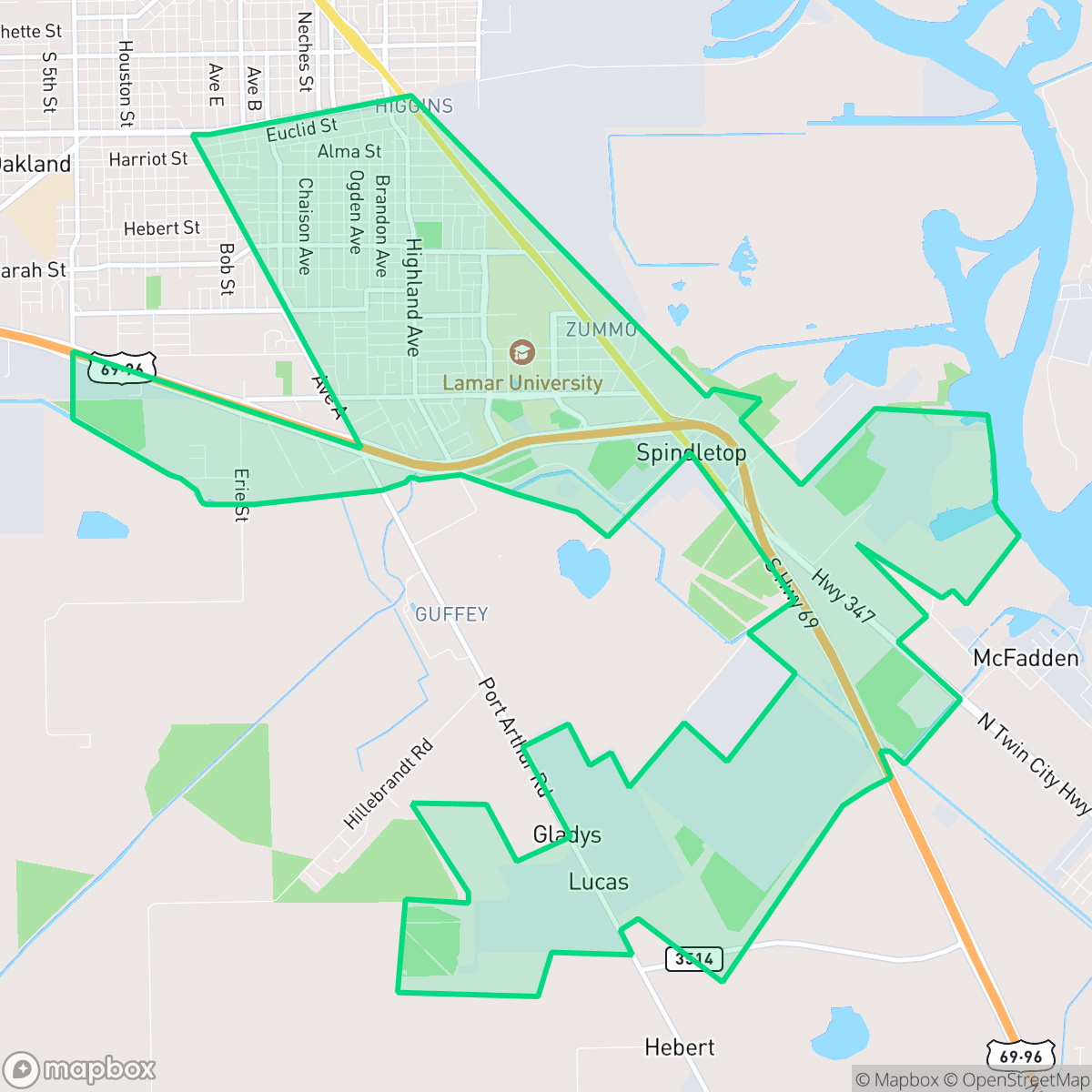
The South Park neighborhood in Beaumont, Texas, experienced rapid growth following the 1901 discovery of oil at nearby Spindletop. Historically defined by its own independent school district, the community was centered around South Park High School, which opened its first building in 1923 and served as the original home for South Park Junior College, the precursor to Lamar University. The neighborhood’s development was deeply tied to the local oil industry, which provided the tax base for its schools and infrastructure. Characterized by a strong sense of community identity and a mid-20th-century suburban aesthetic, the area features residential stock primarily built between 1940 and 1969. While the high school building—a site of significant local historical attachment—was demolished in 2011, the neighborhood remains a distinct residential enclave shaped by its industrial roots and educational legacy.
The area maintains a distinct identity as a residential enclave characterized by its proximity to industrial infrastructure and an atmosphere of quiet, steady living. The landscape is marked by a blend of low-density housing and open spaces, creating a semi-rural feel that is interspersed with utility substations and storage yards. While the visual environment is primarily functional, the neighborhood offers a higher degree of residential privacy than many other parts of the city due to its spacious lot layouts, according to iHuus data.
Prospective residents should note that the neighborhood is best suited for those who prefer a tranquil, car-dependent environment and value the privacy of larger residential plots. Daily life here is influenced by the surrounding industrial zones and the need for reliable transportation, as pedestrian access is limited by a lack of consistent sidewalks. Additionally, potential homeowners should account for the regional flood risk and the challenges currently facing the local school district as they evaluate the long-term livability of the area.
Neighborhood Scores Across 15 Qualities
Large lots with significant separation between homes provide a higher degree of privacy than the Beaumont average. According to iHuus data, residential structures generally follow a standard suburban density layout.
Low traffic volumes on residential streets allow for safe movement, though the lack of consistent sidewalks makes walking slightly less convenient than in other parts of Beaumont. According to iHuus data, the neighborhood offers a calm environment for pedestrians despite the missing infrastructure.
Dense housing layouts and modest lot sizes characterize this area, which offers less greenery and fewer private amenities than the Beaumont average. According to iHuus data, the visual environment is primarily composed of simple residential structures with limited landscape features.
Public green space for pets is somewhat limited, though several large school fields and open grassy lots provide some areas for outdoor activity. This level of dog friendliness falls below the Beaumont city average according to iHuus data.
Open woodlands and large industrial plots characterize this landscape, matching the broader Beaumont area in its blend of low-density residential pockets and vast green spaces. Residents will find a mix of scattered homes situated near significant industrial infrastructure and natural wetlands.
The area is characterized by a mix of heavy industrial zones and quiet residential pockets, offering a steady but subdued rhythm of life. While some blocks feature scattered local services and dining, much of the landscape consists of low-density, car-dependent settings that are comparable to the Beaumont average.
Steady sounds from nearby busy streets characterize the area. This level of acoustic activity is slightly higher than the typical experience found elsewhere in Beaumont.
Air quality remains consistently high with rare instances of elevated readings. This level of cleanliness is consistent with the average seen throughout Beaumont.
A combination of residential areas and light commercial units exists alongside more significant industrial features like utility substations and storage yards. This level of industrial proximity is notably lower than the city average for Beaumont.
Health insurance accessibility is notably lower in South Park than in the rest of Beaumont. According to iHuus data, a small portion of the resident population maintains medical coverage.
Political leanings in this area lean more liberal than the Beaumont average, according to iHuus data.
Residents live alongside a varied demographic of young adults, families, and seniors. According to iHuus data, the age distribution in South Park is slightly more concentrated toward certain age groups than the Beaumont average.
Residual flood risk exists within this area as it falls within a 500-year floodplain. According to iHuus data, the flood safety level in South Park is slightly lower than the Beaumont city average.
Address-Level Insights for South Park


iHuus Neighborhood Intelligence Insights
Get address-level neighborhood insights for South Park
- Street-level scores — see how individual blocks compare, not just neighborhood averages
- Micro-zone boundaries — identify quiet pockets, flood boundaries, and walkable clusters before you visit
- 15 dimensions in full — walkability, noise, air quality, school quality, insurance coverage, population age profile, urban/rural index, and more
- Boundary risk alerts — know if your address sits near a block boundary where scores drop, the kind of detail no listing will ever mention
- School insights — individual school ratings and insights, not just district-level data
- Compare before you commit — side-by-side data across neighborhoods, down to block precision
No credit card required
Compare with Any Neighborhood
| Dimension | South Park | Acorn |
|---|---|---|
| 🚶 Walkabilityavg 5.61 | ||
| 🔊 Acoustic Comfortavg 4.45 | ||
| 🤫 Privacy Indexavg 6.18 | ||
| 🎨 Visual Appealavg 5.53 | ||
| 🐕 Dog Friendlinessavg 5.08 | ||
| 🗺️ Urban-Rural Indexavg 7.3 | ||
| ✨ Neighborhood Vibeavg 4.21 | ||
| 🏥 Health Insurance Coverageavg 5.2 | ||
| 🌿 Air Qualityavg 8.01 | ||
| 🏭 Industrial Proximityavg 7.7 | ||
| 🌊 Flood Safetyavg 7.26 | ||
| 🗳️ Ideological Leanavg 7.25 | ||
| 👥 Population Age Profileavg 4.85 | ||
| 🔥 Fire Safety | ||
| 🏫 School Quality |
South Park Rankings
School Districts Serving South Park
School Insights for South Park
Below average outcomes; significant attendance and academic challenges.
School Insights
See what's really behind every school rating near South Park
- Individual school ratings — each school's own score with outcome context, not just a district average
- Enrollment & class size data — student-to-teacher ratio and how it compares to the state average
- Full demographics breakdown — ethnicity and gender composition for every school in the enrollment zone
- Every school in the district — all schools within the enrollment boundary ranked by rating, not just the closest one
- Grade levels & benchmarks — elementary through high school, with below/above state-average flags
No credit card required