Pear Orchard, Beaumont
Updated · 5,817 residents
Pear Orchard is a quiet, car-dependent neighborhood in South Beaumont characterized by a mix of residential streets, scattered light industrial warehouses, and significant green space. While the area offers a peaceful environment with relatively low noise levels, residents rely on personal vehicles to access daily services and local dining options.
Key Highlights
About Pear Orchard
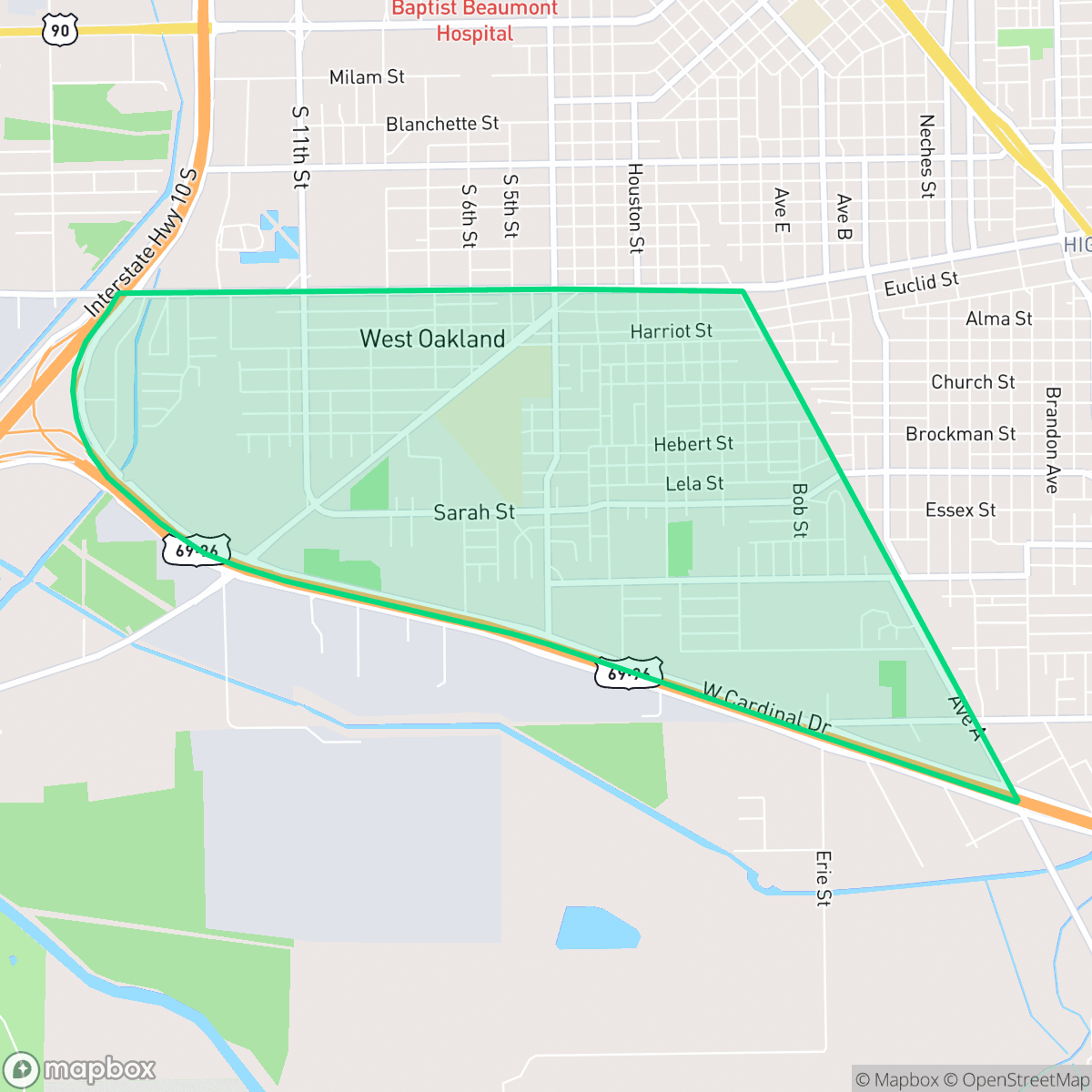
Located in South Beaumont, Texas, Pear Orchard is a historically Black neighborhood that developed after the 1901 Spindletop oil boom as oil field workers settled in the area. Prior to the boom, local African Americans primarily worked on nearby ranches and rice fields. Prominent local Black families, including the Blanchettes and Heberts, donated land to establish the neighborhood's historic Hebert High School in the early 20th century. A focal point of the community's heritage is the historic Pear Orchard Cemetery on Inca Street, which holds the graves of Buffalo Soldiers, educators, and doctors, and received a Historic Texas Cemetery marker in 2025. According to local oral history, the neighborhood's name originates from pear trees that once grew along the east side of the local railroad tracks.
The neighborhood functions as a low-density suburban enclave where residential clusters sit alongside freight corridors and logistics facilities. It maintains a distinct sense of separation from the city core, with a landscape defined by significant wooded patches and open green spaces. Local amenities are sparse, though residents have access to community staples like neighborhood churches, Liberia Park, and independent eateries such as Gerard's Barbecue Diner.
Living here requires a car, as the area lacks the density to support extensive pedestrian-friendly infrastructure. According to iHuus data, acoustic comfort is generally favorable, though proximity to major highways and industrial zones introduces some commercial traffic. While the neighborhood provides a more spacious setting compared to central Beaumont, prospective residents should note the academic challenges facing the local school district and the necessity of commuting for most commercial needs.
Neighborhood Scores Across 15 Qualities
Residential spacing is mixed, providing some buffer between neighbors. According to iHuus data, privacy levels in this area are roughly comparable to the Beaumont average.
Low traffic and quiet streets provide a pleasant environment for walking, though the lack of sidewalks makes pedestrian travel slightly less convenient than the Beaumont average.
Standard tract housing defines the area, characterized by modest yards and uniform rooflines. This level of visual variety is lower than the Beaumont average according to iHuus data.
Limited access to public parks and few wide green verges make walking dogs less convenient here than in other parts of Beaumont. According to iHuus data, the area offers fewer dedicated spaces for pets compared to the city average.
Low-density residential clusters and wooded patches blend with light industrial and commercial zones. This landscape is slightly less open than the Beaumont average, according to iHuus data.
Steady residential life and scattered dining options create a calm atmosphere that is consistent with the city average. While various local eateries and churches are present, the area is largely car-dependent and features significant industrial and warehouse corridors.
Local traffic from a nearby busy street creates a consistent ambient hum. According to iHuus data, acoustic levels in Pear Orchard are slightly higher than the Beaumont average.
Air quality remains consistently high with rare instances of elevated readings. This level of air cleanliness is consistent with the average found throughout Beaumont.
Residential streets remain largely free of heavy industry, though some areas near the southern boundary feature warehouses and light manufacturing. This level of industrial proximity is roughly in line with the Beaumont average, according to iHuus data.
Health insurance coverage is notably lower in Pear Orchard than in the rest of Beaumont. According to iHuus data, a small portion of the resident population has access to medical coverage.
Voting patterns and census indicators show a significantly more liberal leaning than the Beaumont average, according to iHuus data.
Residents live alongside a diverse range of age groups, including young adults, families, and older individuals. This demographic distribution is consistent with the broader Beaumont area according to iHuus data.
Residual flood risk exists within this area due to its location in the 500-year floodplain. According to iHuus data, the level of safety is slightly above the Beaumont city average.
Address-Level Insights for Pear Orchard


iHuus Neighborhood Intelligence Insights
Get address-level neighborhood insights for Pear Orchard
- Street-level scores — see how individual blocks compare, not just neighborhood averages
- Micro-zone boundaries — identify quiet pockets, flood boundaries, and walkable clusters before you visit
- 15 dimensions in full — walkability, noise, air quality, school quality, insurance coverage, population age profile, urban/rural index, and more
- Boundary risk alerts — know if your address sits near a block boundary where scores drop, the kind of detail no listing will ever mention
- School insights — individual school ratings and insights, not just district-level data
- Compare before you commit — side-by-side data across neighborhoods, down to block precision
No credit card required
Compare with Any Neighborhood
| Dimension | Pear Orchard | Acorn |
|---|---|---|
| 🚶 Walkabilityavg 5.61 | ||
| 🔊 Acoustic Comfortavg 4.45 | ||
| 🤫 Privacy Indexavg 6.18 | ||
| 🎨 Visual Appealavg 5.53 | ||
| 🐕 Dog Friendlinessavg 5.08 | ||
| 🗺️ Urban-Rural Indexavg 7.3 | ||
| ✨ Neighborhood Vibeavg 4.21 | ||
| 🏥 Health Insurance Coverageavg 5.2 | ||
| 🌿 Air Qualityavg 8.01 | ||
| 🏭 Industrial Proximityavg 7.7 | ||
| 🌊 Flood Safetyavg 7.26 | ||
| 🗳️ Ideological Leanavg 7.25 | ||
| 👥 Population Age Profileavg 4.85 | ||
| 🔥 Fire Safety | ||
| 🏫 School Quality |
Pear Orchard Rankings
School Districts Serving Pear Orchard
School Insights for Pear Orchard
Below average outcomes; significant attendance and academic challenges.
School Insights
See what's really behind every school rating near Pear Orchard
- Individual school ratings — each school's own score with outcome context, not just a district average
- Enrollment & class size data — student-to-teacher ratio and how it compares to the state average
- Full demographics breakdown — ethnicity and gender composition for every school in the enrollment zone
- Every school in the district — all schools within the enrollment boundary ranked by rating, not just the closest one
- Grade levels & benchmarks — elementary through high school, with below/above state-average flags
No credit card required