Old Town on the Oaks, Beaumont
Updated · 3,565 residents
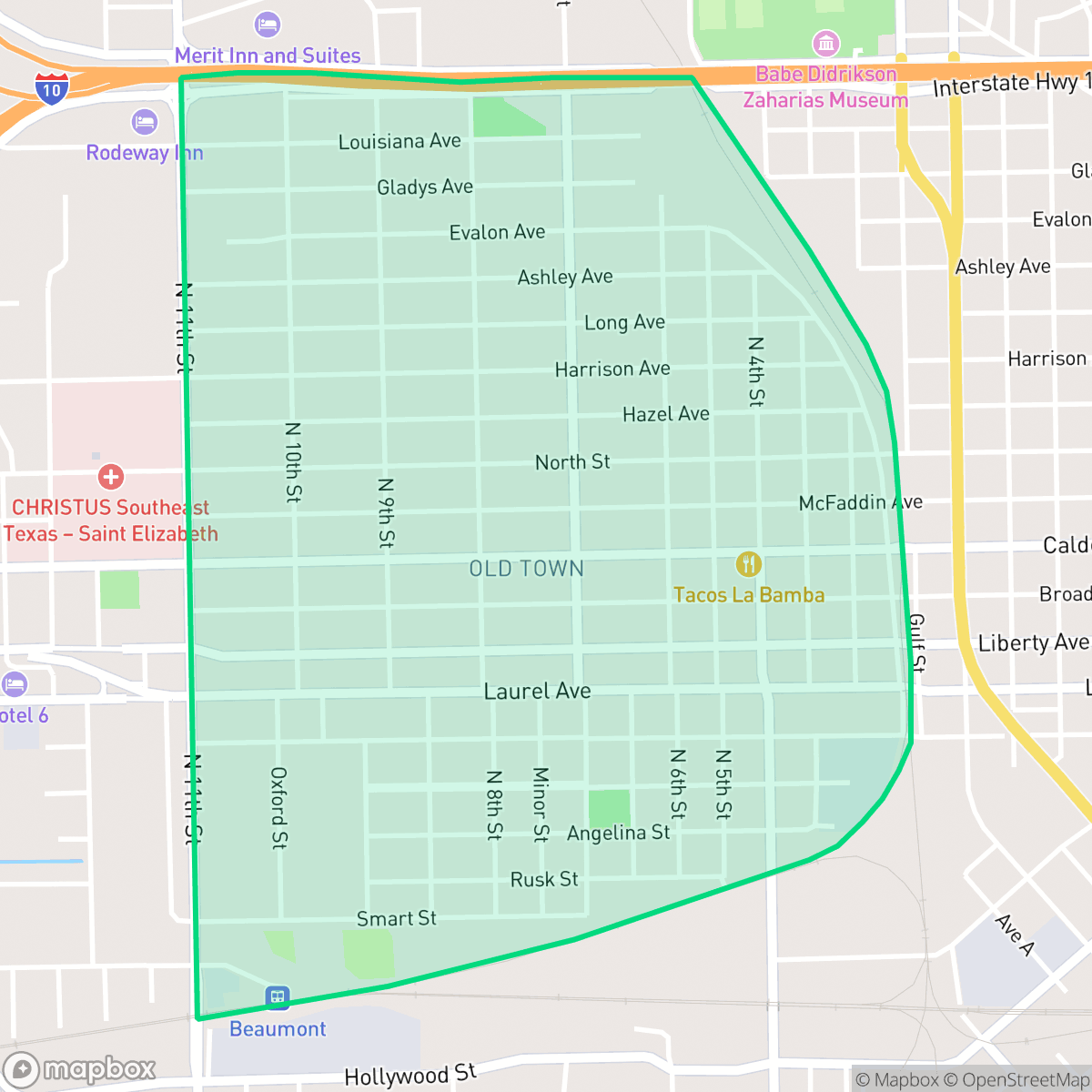
Old Town on the Oaks is a historic residential enclave defined by its early 20th-century architecture and proximity to major industrial corridors. While the area offers a vibrant selection of local dining and community hubs, residents should expect a car-dependent environment with notable noise levels from nearby road traffic.
Key Highlights
About Old Town on the Oaks
The neighborhood, widely known as the Oaks Historic District (or Old Town), developed starting in 1902 following the 1901 Spindletop oil boom. Built on former pastureland sold by the prominent McFaddin family, it became a premier residential enclave for oil-industry professionals, entrepreneurs, and attorneys. The area features a diverse array of early 20th-century architectural styles. Notable local landmarks defining its historic character include the grand 1906 McFaddin-Ward House and the Chambers House, both preserved as museums. Calder Avenue serves as the neighborhood's main historic thoroughfare.
The neighborhood functions as a dense, mixed-use environment where suburban residential blocks sit alongside light industrial zones and active rail infrastructure. According to iHuus data, the area maintains a lively social atmosphere, supported by popular local establishments like 1701 Barbecue, Tacos La Bamba, and Rao's Bakery. The streetscape is characterized by a blend of single-family homes and commercial units, creating a unique urban texture that relies heavily on personal vehicle transit for daily navigation.
Prospective residents should note that the area faces challenges regarding acoustic comfort, with average noise levels reaching 60 decibels primarily due to road traffic. While the air quality remains relatively high, the school district serving the area is currently under state oversight, which may influence relocation decisions for families. The neighborhood is best suited for those who prioritize proximity to local culinary staples and historic character over quiet, pedestrian-friendly streets or top-tier public education options.
Neighborhood Scores Across 15 Qualities
Neighboring properties feature mixed spacing with some buffers between homes, representing a level of privacy that is slightly lower than the Beaumont average.
Quiet streets allow for easy walking, though the lack of sidewalks makes the area slightly less walkable than the Beaumont average according to iHuus data.
Standard tract housing dominates the landscape, featuring boxy rooflines and small, tidy yards. According to iHuus data, the visual character of this area is slightly below the Beaumont average.
Access to public parks and wide green verges is below the Beaumont average, which may present challenges for regular dog walking. According to iHuus data, the area lacks significant nearby outdoor spaces for pets.
Open land and scattered homes create a more rural atmosphere than the more densely developed parts of Beaumont. According to iHuus data, this area features a lower level of urban density compared to the city average.
A varied mix of restaurants, social hubs, and green spaces makes this area more active than the Beaumont average. While dining and shopping options are plentiful, the presence of industrial corridors and highways necessitates a car for most trips.
Frequent noise from nearby railroad tracks and major thoroughfares is more prevalent here than in the rest of Beaumont. Residents may experience more consistent acoustic disturbances than the city average due to these transit corridors.
Air quality remains consistently good with infrequent periods of elevated readings, aligning with the average found throughout Beaumont.
Primarily residential in nature, this area experiences less industrial activity than the Beaumont average. Residents can expect mostly quiet streets with only occasional light commercial activity nearby.
Health insurance enrollment levels in this area are slightly higher than the Beaumont average. According to iHuus data, a significant portion of the population remains uninsured.
Political leanings in this area are notably more liberal than the Beaumont average, characterized by a liberal majority with some opposing presence.
A balanced mix of young adults, families, and seniors resides here, mirroring the general demographic spread found across Beaumont.
Residual flood risk exists within the 500-year floodplain, though safety levels are slightly above the Beaumont average according to iHuus data.
Address-Level Insights for Old Town on the Oaks


iHuus Neighborhood Intelligence Insights
Get address-level neighborhood insights for Old Town on the Oaks
- Street-level scores — see how individual blocks compare, not just neighborhood averages
- Micro-zone boundaries — identify quiet pockets, flood boundaries, and walkable clusters before you visit
- 15 dimensions in full — walkability, noise, air quality, school quality, insurance coverage, population age profile, urban/rural index, and more
- Boundary risk alerts — know if your address sits near a block boundary where scores drop, the kind of detail no listing will ever mention
- School insights — individual school ratings and insights, not just district-level data
- Compare before you commit — side-by-side data across neighborhoods, down to block precision
No credit card required
Compare with Any Neighborhood
| Dimension | Old Town on the Oaks | Acorn |
|---|---|---|
| 🚶 Walkabilityavg 5.61 | ||
| 🔊 Acoustic Comfortavg 4.45 | ||
| 🤫 Privacy Indexavg 6.18 | ||
| 🎨 Visual Appealavg 5.53 | ||
| 🐕 Dog Friendlinessavg 5.08 | ||
| 🗺️ Urban-Rural Indexavg 7.3 | ||
| ✨ Neighborhood Vibeavg 4.21 | ||
| 🏥 Health Insurance Coverageavg 5.2 | ||
| 🌿 Air Qualityavg 8.01 | ||
| 🏭 Industrial Proximityavg 7.7 | ||
| 🌊 Flood Safetyavg 7.26 | ||
| 🗳️ Ideological Leanavg 7.25 | ||
| 👥 Population Age Profileavg 4.85 | ||
| 🔥 Fire Safety | ||
| 🏫 School Quality |
Old Town on the Oaks Rankings
School Districts Serving Old Town on the Oaks
School Insights for Old Town on the Oaks
Below average outcomes; significant attendance and academic challenges.
School Insights
See what's really behind every school rating near Old Town on the Oaks
- Individual school ratings — each school's own score with outcome context, not just a district average
- Enrollment & class size data — student-to-teacher ratio and how it compares to the state average
- Full demographics breakdown — ethnicity and gender composition for every school in the enrollment zone
- Every school in the district — all schools within the enrollment boundary ranked by rating, not just the closest one
- Grade levels & benchmarks — elementary through high school, with below/above state-average flags
No credit card required