Martin Luther King, Beaumont
Updated · 777 residents
The Martin Luther King neighborhood is a low-density, car-dependent community in Beaumont characterized by a blend of residential blocks and light industrial infrastructure. While the area features local social hubs and religious institutions, residents should expect consistent road noise and proximity to active freight corridors.
Key Highlights
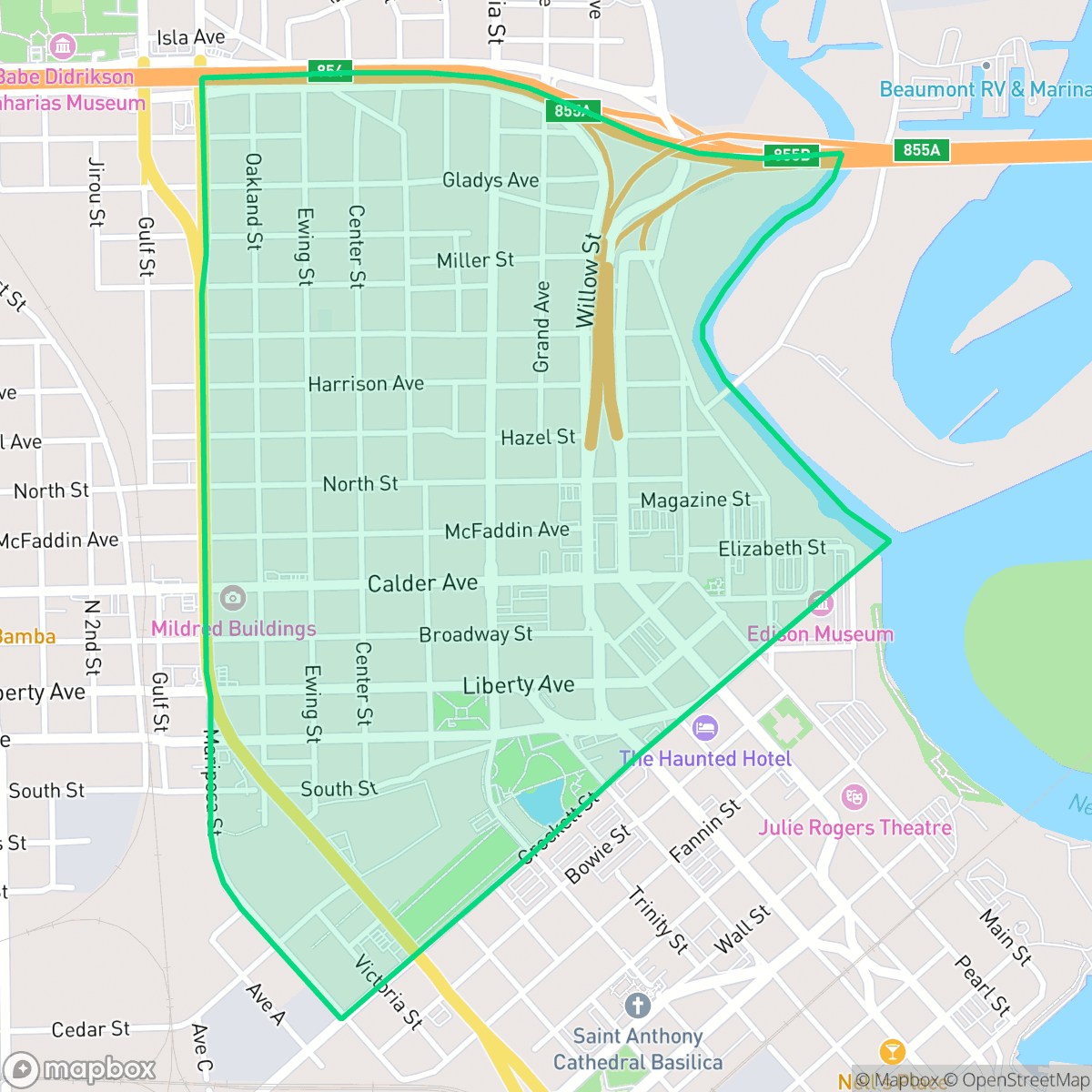
About Martin Luther King
The Martin Luther King neighborhood in Beaumont, Texas, is centered around Martin Luther King Jr. Parkway, which was historically known as Mariposa Street. During the early 20th century, this corridor developed as a close-knit community of African American domestic employees who worked for the prominent families living on nearby Calder Avenue. This residential base played a foundational role in paving the way for the development of the surrounding area. Today, the neighborhood maintains its deep connection to local Black history, situated near the historic Charlton-Pollard district and featuring the local Martin Luther King, Jr. Park, which serves as a quiet community space honoring the civil rights leader with a commemorative statue and a stone display wall inscribed with excerpts from his 'I Have a Dream' speech.
This area functions as a transitional urban fringe where suburban streets sit alongside warehouses and logistics facilities. The local landscape is defined by its industrial proximity, featuring active rail infrastructure and storage yards that contribute to a distinct, utilitarian character. Despite this, the neighborhood maintains a presence of community-focused establishments, including local cafes and various churches that serve as central gathering points for the local population.
Prospective residents should be aware of the trade-offs associated with this location, particularly regarding the high levels of road traffic noise and the surrounding industrial activity. The area relies on vehicle travel for daily errands, as walkability is limited. Furthermore, families should consider the current academic challenges within the Beaumont Independent School District, which is undergoing state-level intervention. The neighborhood is best suited for those who prioritize proximity to major transit routes and a quiet, if industrial-adjacent, residential setting.
Neighborhood Scores Across 15 Qualities
Residential spacing is mixed, offering some buffer between neighbors. This level of density is roughly comparable to the Beaumont average, according to iHuus data.
Low traffic volumes and calm streets make for pleasant walking, though the lack of sidewalks is worth noting. This level of walkability is consistent with the average found across Beaumont.
Standard tract housing with uniform rooflines and modest yards characterizes this area. The visual landscape is less varied than the Beaumont average, according to iHuus data.
Access to public parks and wide green verges for walking dogs is below the Beaumont average. Pet owners may find fewer dedicated recreational spaces within this specific neighborhood.
Scattered homes and open land create a more spacious environment than the denser urban core of Beaumont. According to iHuus data, the area features a mix of low-density residential blocks and significant industrial or warehouse presence.
A varied mix of restaurants, social hubs, and light industrial pockets creates a level of activity that is notably higher than the Beaumont average. While the area features diverse amenities, many destinations are best reached by car due to the suburban and industrial layout.
Steady noise from nearby busy streets characterizes the area, which is slightly higher than the Beaumont average according to iHuus data.
Air quality in this area is consistently good, matching the average levels found throughout Beaumont. According to iHuus data, residents can expect mostly clean air with only rare instances of elevated readings.
Residential areas share space with rail yards, logistics warehouses, and light manufacturing facilities. This presence of heavy machinery and truck traffic is more pronounced here than in the rest of Beaumont.
Health insurance coverage among residents is lower than the Beaumont average, according to iHuus data. This suggests that a smaller portion of the population has access to employer-sponsored or private health plans compared to other parts of the city.
Voting patterns and census indicators reflect a significantly more liberal political leaning than the Beaumont average, according to iHuus data.
Residents live alongside a balanced mix of young adults, families, and older generations. This demographic spread is consistent with the broader Beaumont area, according to iHuus data.
Residual flood risk exists within the area due to its location in the 500-year floodplain, though safety levels are slightly above the Beaumont average according to iHuus data.
Address-Level Insights for Martin Luther King


iHuus Neighborhood Intelligence Insights
Get address-level neighborhood insights for Martin Luther King
- Street-level scores — see how individual blocks compare, not just neighborhood averages
- Micro-zone boundaries — identify quiet pockets, flood boundaries, and walkable clusters before you visit
- 15 dimensions in full — walkability, noise, air quality, school quality, insurance coverage, population age profile, urban/rural index, and more
- Boundary risk alerts — know if your address sits near a block boundary where scores drop, the kind of detail no listing will ever mention
- School insights — individual school ratings and insights, not just district-level data
- Compare before you commit — side-by-side data across neighborhoods, down to block precision
No credit card required
Compare with Any Neighborhood
| Dimension | Martin Luther King | Acorn |
|---|---|---|
| 🚶 Walkabilityavg 5.61 | ||
| 🔊 Acoustic Comfortavg 4.45 | ||
| 🤫 Privacy Indexavg 6.18 | ||
| 🎨 Visual Appealavg 5.53 | ||
| 🐕 Dog Friendlinessavg 5.08 | ||
| 🗺️ Urban-Rural Indexavg 7.3 | ||
| ✨ Neighborhood Vibeavg 4.21 | ||
| 🏥 Health Insurance Coverageavg 5.2 | ||
| 🌿 Air Qualityavg 8.01 | ||
| 🏭 Industrial Proximityavg 7.7 | ||
| 🌊 Flood Safetyavg 7.26 | ||
| 🗳️ Ideological Leanavg 7.25 | ||
| 👥 Population Age Profileavg 4.85 | ||
| 🔥 Fire Safety | ||
| 🏫 School Quality |
Martin Luther King Rankings
School Districts Serving Martin Luther King
School Insights for Martin Luther King
Below average outcomes; significant attendance and academic challenges.
School Insights
See what's really behind every school rating near Martin Luther King
- Individual school ratings — each school's own score with outcome context, not just a district average
- Enrollment & class size data — student-to-teacher ratio and how it compares to the state average
- Full demographics breakdown — ethnicity and gender composition for every school in the enrollment zone
- Every school in the district — all schools within the enrollment boundary ranked by rating, not just the closest one
- Grade levels & benchmarks — elementary through high school, with below/above state-average flags
No credit card required