Brickyard, Beaumont
Updated · 366 residents
Brickyard is a quiet, industrial-adjacent neighborhood in Beaumont characterized by sparse residential clusters and proximity to active rail lines. While the area offers favorable air quality and flood safety, residents experience limited walkability and few neighborhood amenities.
Key Highlights
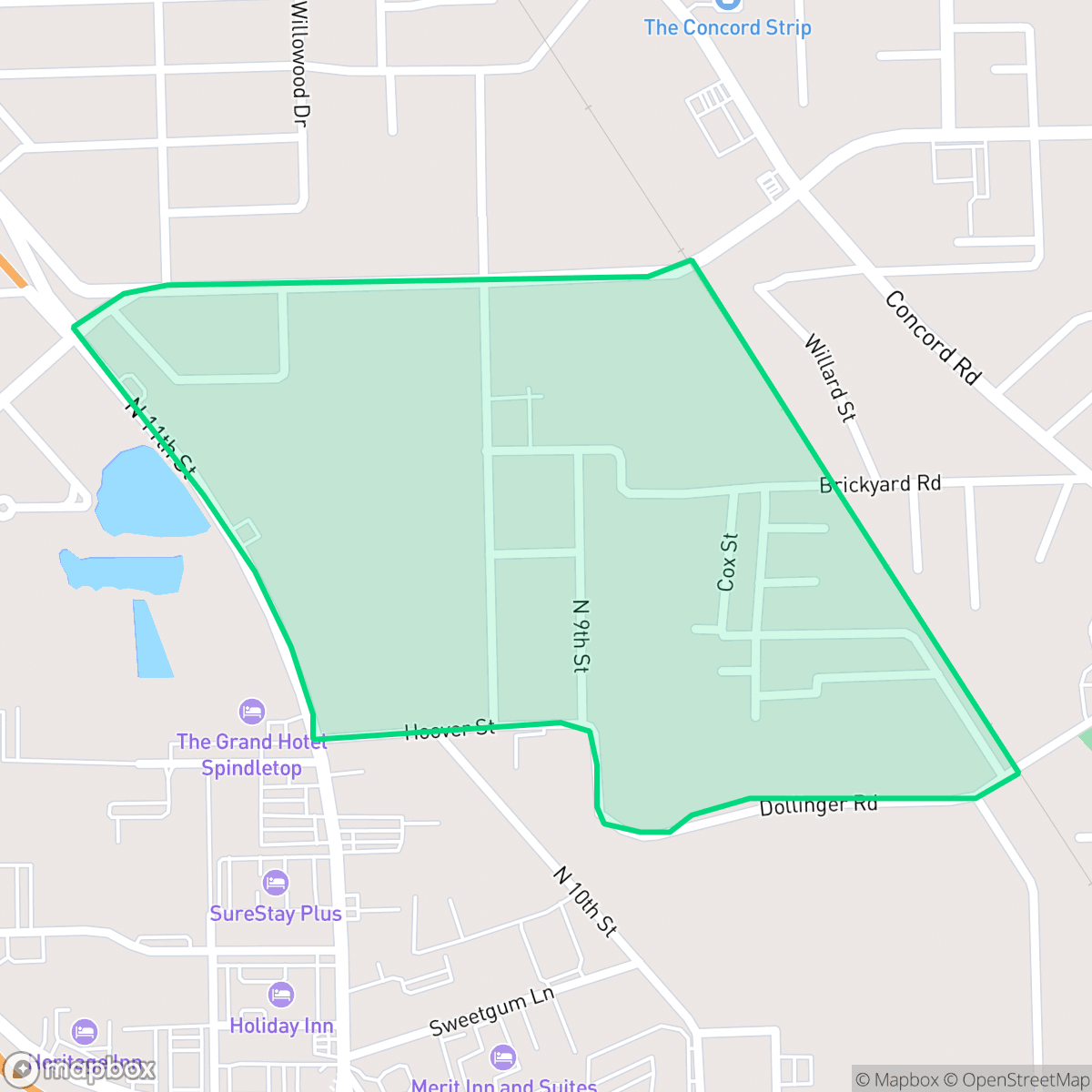
About Brickyard
The Brickyard neighborhood in Beaumont, Texas, originated as an early African American settlement in the 1880s. It developed around a local brickyard established north of the city's business district along the Texas and New Orleans Railroad. Many of the neighborhood's early residents and brickyard laborers were Black immigrants who relocated from Louisiana. Although the community was as historically established as Beaumont's lumber mill neighborhoods, it remained outside the city's official corporate limits for decades before finally being annexed around 1940.
The area maintains a low-density, industrial-suburban atmosphere, defined by its adjacency to railways and large-scale material stockpiles. While the neighborhood is relatively quiet, the landscape is heavily influenced by its industrial roots, resulting in limited aesthetic appeal and a lack of pedestrian infrastructure. Local dining options, such as Birdman Soul Food Kitchen and Crazy Cajun Beaumont, provide small pockets of activity, though most daily needs require travel by vehicle.
Prospective residents should note the significant trade-offs regarding infrastructure and public services. The neighborhood is served by the Beaumont Independent School District, which is currently navigating a period of academic and operational instability. Furthermore, data indicates low rates of health insurance coverage among the local population. While the area benefits from good air quality and a lower risk of flooding compared to other parts of the city, the combination of industrial proximity and limited local services makes it a specific choice for those prioritizing space over urban convenience.
Neighborhood Scores Across 15 Qualities
Residential spacing offers a balanced mix of proximity and buffer between neighbors; this level of privacy is roughly consistent with the Beaumont city average according to iHuus data.
Low traffic volumes make for calm walking conditions, though the lack of sidewalks means pedestrians must share the road with vehicles. This level of walkability is roughly in line with the Beaumont average, according to iHuus data.
Typical tract housing characterizes the area, featuring consistent rooflines and modest yard spaces. This level of visual variety is consistent with the Beaumont city average.
Opportunities for off-leash exercise or walking are sparse due to a lack of nearby public parks and green verges. According to iHuus data, dog-friendly features in this area are below the Beaumont average.
Open land and woodland are common throughout this area, which feels less dense than the Beaumont average. Residential clusters are interspersed with sparse industrial and suburban landscapes according to iHuus data.
Low levels of activity and a focus on industrial and suburban utility make this area less vibrant than the Beaumont average. Most dining and retail options are spread out, requiring a car for easy access to local businesses.
Local traffic from nearby busy streets creates a consistent level of ambient noise. According to iHuus data, acoustic comfort in this area is slightly higher than the Beaumont average.
Air quality remains consistently good with infrequent instances of elevated readings, matching the typical levels found throughout Beaumont.
Residential life remains largely undisturbed by heavy industry, though the area has slightly more industrial proximity than the Beaumont average. According to iHuus data, the neighborhood is primarily residential with only occasional light commercial activity.
Health insurance access is significantly lower here than the average for Beaumont. Residents may face challenges accessing medical services due to this lack of coverage, according to iHuus data.
Voting patterns and census indicators in Brickyard show a strong liberal lean that is notably higher than the Beaumont average, according to iHuus data.
Residents live alongside a balanced mix of young adults, families, and older populations. This demographic spread is consistent with the broader Beaumont area according to iHuus data.
Residual flood risk exists within this area due to its location in a 500-year floodplain; however, safety levels are slightly higher than the Beaumont average according to iHuus data.
Address-Level Insights for Brickyard


iHuus Neighborhood Intelligence Insights
Get address-level neighborhood insights for Brickyard
- Street-level scores — see how individual blocks compare, not just neighborhood averages
- Micro-zone boundaries — identify quiet pockets, flood boundaries, and walkable clusters before you visit
- 15 dimensions in full — walkability, noise, air quality, school quality, insurance coverage, population age profile, urban/rural index, and more
- Boundary risk alerts — know if your address sits near a block boundary where scores drop, the kind of detail no listing will ever mention
- School insights — individual school ratings and insights, not just district-level data
- Compare before you commit — side-by-side data across neighborhoods, down to block precision
No credit card required
Compare with Any Neighborhood
| Dimension | Brickyard | Acorn |
|---|---|---|
| 🚶 Walkabilityavg 5.61 | ||
| 🔊 Acoustic Comfortavg 4.45 | ||
| 🤫 Privacy Indexavg 6.18 | ||
| 🎨 Visual Appealavg 5.53 | ||
| 🐕 Dog Friendlinessavg 5.08 | ||
| 🗺️ Urban-Rural Indexavg 7.3 | ||
| ✨ Neighborhood Vibeavg 4.21 | ||
| 🏥 Health Insurance Coverageavg 5.2 | ||
| 🌿 Air Qualityavg 8.01 | ||
| 🏭 Industrial Proximityavg 7.7 | ||
| 🌊 Flood Safetyavg 7.26 | ||
| 🗳️ Ideological Leanavg 7.25 | ||
| 👥 Population Age Profileavg 4.85 | ||
| 🔥 Fire Safety | ||
| 🏫 School Quality |
Brickyard Rankings
School Districts Serving Brickyard
School Insights for Brickyard
Below average outcomes; significant attendance and academic challenges.
School Insights
See what's really behind every school rating near Brickyard
- Individual school ratings — each school's own score with outcome context, not just a district average
- Enrollment & class size data — student-to-teacher ratio and how it compares to the state average
- Full demographics breakdown — ethnicity and gender composition for every school in the enrollment zone
- Every school in the district — all schools within the enrollment boundary ranked by rating, not just the closest one
- Grade levels & benchmarks — elementary through high school, with below/above state-average flags
No credit card required