Southeast, Arlington
Updated · 100,758 residents
Southeast Arlington is a suburban community defined by its blend of historic pioneer roots and modern residential development. The neighborhood features a high level of walkability with continuous sidewalk networks and abundant green space, though the landscape remains primarily car-dependent. Residents enjoy a quiet atmosphere characterized by closely spaced single-family homes and access to high-performing schools.
Key Highlights
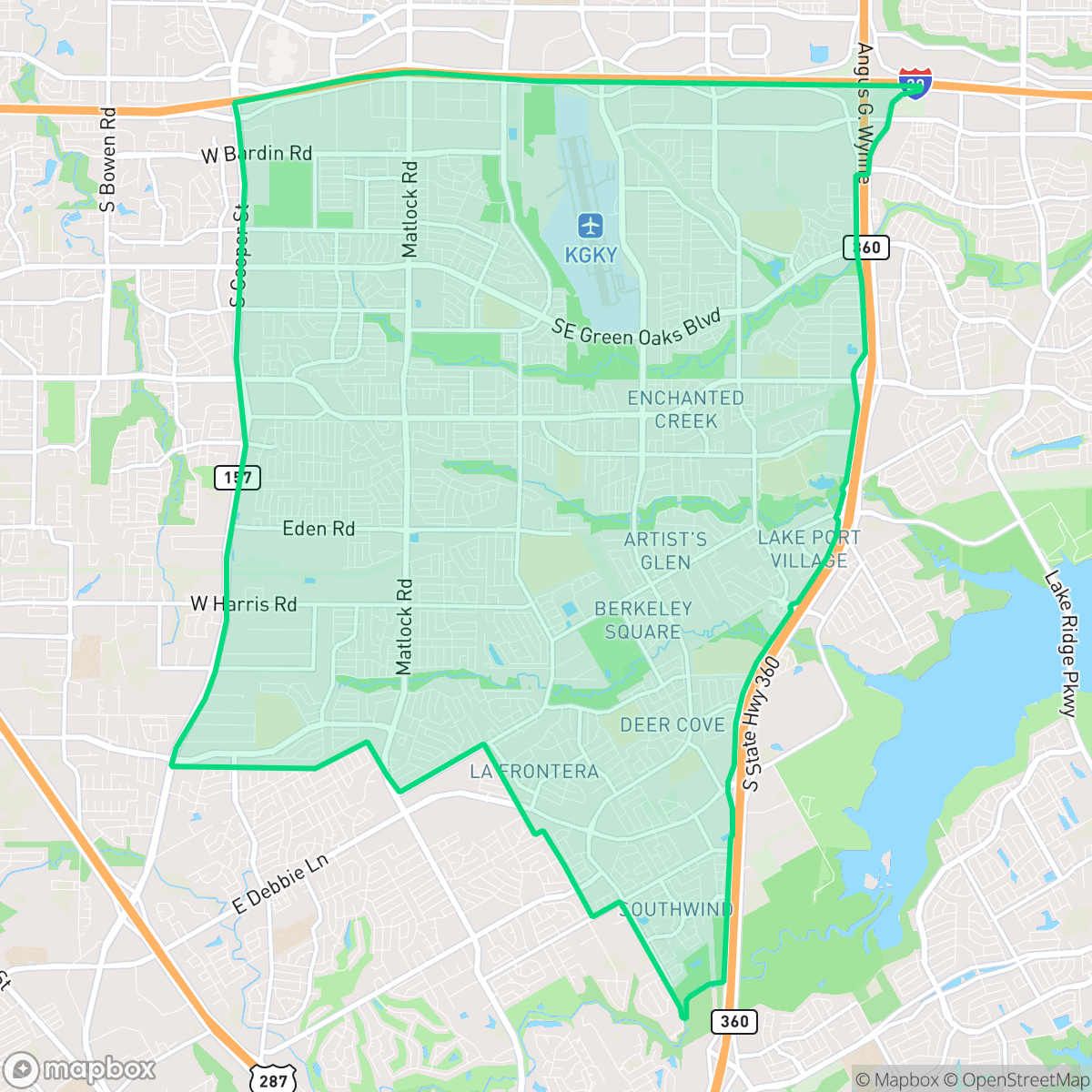
About Southeast
The history of Southeast Arlington is rooted in early agricultural settlements, most notably the historic farming community of Webb. Established in the 1880s around a general store and cotton gin built by pioneer Daniel Zuefeldt, Webb served as a vital agricultural hub in southeast Tarrant County. The community's social and cultural center was the Webb Community Baptist Church, constructed in 1907 in the Texas Vernacular style with a distinctive cruciform plan and slender belfry. Recognized as a City of Arlington Local Landmark, the building now serves as a Masonic Lodge. As Arlington expanded throughout the 20th century, Webb was annexed into the city. Today, Southeast Arlington has transitioned from rural farmland into a thriving suburban area, though its pioneer heritage is preserved through local landmarks, street names, and the nearby Tarrant County College Southeast Campus.
The area serves as a significant residential hub within the city, balancing dense suburban tracts with extensive recreational infrastructure. It is characterized by its consistent grid of sidewalks and dedicated pedestrian paths, which connect residential blocks to local parks and educational facilities. According to iHuus data, the housing stock consists largely of modern single-family homes, often featuring private backyard pools and multi-car garages, reflecting an established middle-class suburban identity. The neighborhood maintains a calm, residential rhythm, supported by a variety of greenbelts and community-focused public spaces.
Prospective residents should note that while the neighborhood offers a high degree of walkability for exercise and leisure, daily errands typically require a vehicle due to the limited concentration of local businesses. The area experiences moderate noise levels from road traffic, and the proximity to logistics warehouses in certain sectors can lead to increased heavy vehicle activity. It is well-suited for families seeking access to top-tier schools and a quiet, community-oriented environment with significant outdoor amenities.
Neighborhood Scores Across 15 Qualities
Homes in this area feature typical suburban spacing with detached structures and standard backyard buffers. This level of privacy is consistent with the city average for Arlington.
Extensive sidewalk networks on both sides of residential streets and dedicated park trails provide superior pedestrian connectivity compared to the Arlington average. Most areas feature clear crossings and safe paths through greenbelts, according to iHuus data.
Large homes with complex rooflines and frequent private backyard pools characterize this area, offering a visual appeal slightly above the Arlington average. Many properties feature well-maintained yards and expansive multi-car driveways according to iHuus data.
Extensive greenbelts, park systems, and wide grass verges provide ample space for walking dogs. According to iHuus data, these accessible nature trails and open fields offer better amenities for pet owners than the Arlington average.
Scattered homes and open land characterize this area, providing a landscape that is consistent with the city average for openness. Residents can expect a mix of residential pockets interspersed with fields and woodland.
A steady rhythm of residential life defines this area, where suburban blocks and green spaces are balanced by scattered light industrial units. While many streets offer walkable paths, most commercial dining and essential services remain car-dependent, matching the city average for liveliness.
Frequent noise from nearby highways and railroad tracks characterizes the area. According to iHuus data, acoustic comfort levels in this neighborhood are lower than the Arlington average.
Frequent unhealthy air quality levels pose a significant risk to sensitive groups. This area experiences lower air quality than the Arlington average, according to iHuus data.
Largely residential and light commercial in nature, this area remains very similar to the Arlington average regarding industrial proximity. While some sectors feature large logistics warehouses and airport-related activity, most of the neighborhood lacks heavy industrial hazards or significant factory presence.
Health insurance accessibility is notably higher in this area than the Arlington average, according to iHuus data.
Political leanings in this area trend more liberal than the Arlington average. According to iHuus data, the neighborhood maintains a liberal majority with a modest opposing presence.
Residents live alongside a balanced mix of young adults, families, and older generations. This demographic spread is roughly in line with the broader Arlington area, according to iHuus data.
Flood risk in this area is currently difficult to assess because FEMA has not completed a detailed study for this specific zone. According to iHuus data, the level of risk appears slightly higher than the Arlington average.
Address-Level Insights for Southeast


iHuus Neighborhood Intelligence Insights
Get address-level neighborhood insights for Southeast
- Street-level scores — see how individual blocks compare, not just neighborhood averages
- Micro-zone boundaries — identify quiet pockets, flood boundaries, and walkable clusters before you visit
- 15 dimensions in full — walkability, noise, air quality, school quality, insurance coverage, population age profile, urban/rural index, and more
- Boundary risk alerts — know if your address sits near a block boundary where scores drop, the kind of detail no listing will ever mention
- School insights — individual school ratings and insights, not just district-level data
- Compare before you commit — side-by-side data across neighborhoods, down to block precision
No credit card required
Compare with Any Neighborhood
| Dimension | Southeast | Central |
|---|---|---|
| 🚶 Walkabilityavg 7.59 | ||
| 🔊 Acoustic Comfortavg 4.22 | ||
| 🤫 Privacy Indexavg 5.65 | ||
| 🎨 Visual Appealavg 6.96 | ||
| 🐕 Dog Friendlinessavg 6.79 | ||
| 🗺️ Urban-Rural Indexavg 6.81 | ||
| ✨ Neighborhood Vibeavg 4.2 | ||
| 🏥 Health Insurance Coverageavg 6.04 | ||
| 🌿 Air Qualityavg 3.31 | ||
| 🏭 Industrial Proximityavg 8.17 | ||
| 🌊 Flood Safetyavg 3.77 | ||
| 🗳️ Ideological Leanavg 6.07 | ||
| 👥 Population Age Profileavg 4.59 | ||
| 🔥 Fire Safety | ||
| 🏫 School Quality |
Southeast Rankings
School Districts Serving Southeast
School Insights for Southeast
Below average outcomes; significant attendance and academic challenges.
School Insights
See what's really behind every school rating near Southeast
- Individual school ratings — each school's own score with outcome context, not just a district average
- Enrollment & class size data — student-to-teacher ratio and how it compares to the state average
- Full demographics breakdown — ethnicity and gender composition for every school in the enrollment zone
- Every school in the district — all schools within the enrollment boundary ranked by rating, not just the closest one
- Grade levels & benchmarks — elementary through high school, with below/above state-average flags
No credit card required