Southwest, West Palm Beach
Updated · 3,279 residents
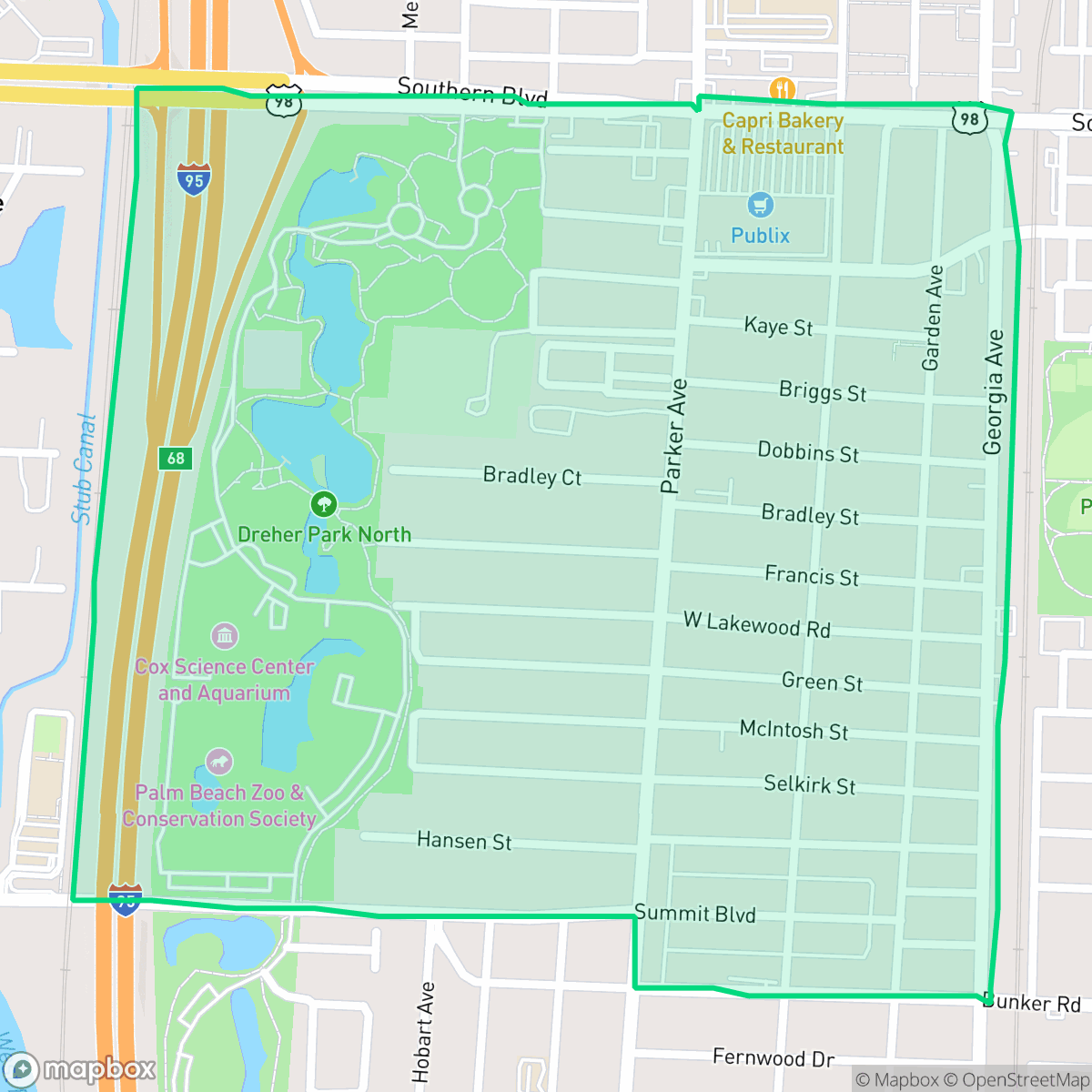
Southwest is a pedestrian-friendly neighborhood in West Palm Beach characterized by its semi-rural atmosphere and diverse residential layout. While residents benefit from extensive sidewalk networks and nearby green spaces, the area experiences notable noise from local rail and road traffic.
Key Highlights
About Southwest
The neighborhood features a landscape of modest tract housing and moderate residential density, offering a blend of suburban grids and pockets of woodland. Unlike more industrial parts of the city, this area maintains a residential focus with only minimal commercial activity near the central rail corridor. The environment is highly accessible for pedestrians, with safe sidewalk networks connecting residents to local parks and trails, making it a functional choice for those who prioritize walkability and outdoor access.
Prospective residents should consider the trade-offs of living in the area, particularly regarding acoustic comfort, as frequent noise from major roadways and railroads is a common occurrence. While the neighborhood offers a balanced demographic profile and access to the highly regarded Palm Beach County School District, health insurance coverage rates remain lower than the city average. According to iHuus data, the area is best suited for individuals who value a semi-rural aesthetic and pedestrian connectivity but are comfortable with the noise levels associated with proximity to major transit routes.
Neighborhood Scores Across 15 Qualities
Housing density is slightly higher than the West Palm Beach average, featuring a mix of suburban grids and tighter residential lots. According to iHuus data, some areas offer adequate buffers between neighbors while others have houses positioned closely together.
Extensive sidewalk networks and safe crosswalks make navigating the area on foot easy. According to iHuus data, the neighborhood offers significantly higher connectivity and pedestrian safety than the West Palm Beach average.
Modest yards and uniform rooflines characterize this area, which offers a slightly higher level of visual variety than the West Palm Beach average. According to iHuus data, the landscape consists primarily of high-density tract housing with infrequent private pools.
Extensive public parks and connected walking trails provide significantly more space for pet owners than the West Palm Beach average. Large green areas in the northwest quadrant offer safe, open environments away from heavy traffic.
Open land and scattered greenery are more prevalent here than in the rest of West Palm Beach. Residents will find a mix of low-density residential grids and pockets of woodland interspersed with suburban infrastructure.
Activity levels are notably higher than the city average, offering a balanced mix of residential life and accessible services. While some pockets remain quiet and suburban, other areas function as lively hubs with walkable access to dining, universities, and parks.
Frequent disturbances from nearby railroad tracks and major roadways characterize this area. Acoustic comfort is notably lower than the West Palm Beach average according to iHuus data.
Air quality levels in Southwest fluctuate between acceptable and unhealthy, though they remain slightly better than the West Palm Beach average. Sensitive groups should remain aware of occasional periods of concern according to iHuus data.
Residential areas dominate the landscape with only scattered light commercial strips and small warehouses present near the central rail corridor. This neighborhood experiences significantly less industrial presence than the West Palm Beach average, according to iHuus data.
Health insurance access among residents is slightly below the West Palm Beach average, according to iHuus data. This indicates a higher proportion of uninsured individuals compared to other parts of the city.
Political leanings in this area are split relatively evenly between conservative and liberal perspectives. This distribution is notably more balanced than the broader West Palm Beach average according to iHuus data.
Residents experience a balanced mix of young adults, families, and seniors. This age distribution is slightly more varied than the average found across West Palm Beach, according to iHuus data.
Flood risk in this area remains difficult to determine because a detailed federal study has not yet been completed. According to iHuus data, the level of vulnerability is roughly comparable to the West Palm Beach average.
Address-Level Insights for Southwest


iHuus Neighborhood Intelligence Insights
Get address-level neighborhood insights for Southwest
- Street-level scores — see how individual blocks compare, not just neighborhood averages
- Micro-zone boundaries — identify quiet pockets, flood boundaries, and walkable clusters before you visit
- 15 dimensions in full — walkability, noise, air quality, school quality, insurance coverage, population age profile, urban/rural index, and more
- Boundary risk alerts — know if your address sits near a block boundary where scores drop, the kind of detail no listing will ever mention
- School insights — individual school ratings and insights, not just district-level data
- Compare before you commit — side-by-side data across neighborhoods, down to block precision
No credit card required
Compare with Any Neighborhood
| Dimension | Southwest | Central Park |
|---|---|---|
| 🚶 Walkabilityavg 6.38 | ||
| 🔊 Acoustic Comfortavg 3.06 | ||
| 🤫 Privacy Indexavg 5.07 | ||
| 🎨 Visual Appealavg 6.11 | ||
| 🐕 Dog Friendlinessavg 5.75 | ||
| 🗺️ Urban-Rural Indexavg 6.16 | ||
| ✨ Neighborhood Vibeavg 2.94 | ||
| 🏥 Health Insurance Coverageavg 5.54 | ||
| 🌿 Air Qualityavg 3.65 | ||
| 🏭 Industrial Proximityavg 6.56 | ||
| 🌊 Flood Safetyavg 5.66 | ||
| 🗳️ Ideological Leanavg 5.34 | ||
| 👥 Population Age Profileavg 4.74 | ||
| 🔥 Fire Safety | ||
| 🏫 School Quality |
Southwest Rankings
School Districts Serving Southwest
School Insights for Southwest
Below average outcomes; significant attendance and academic challenges.
School Insights
See what's really behind every school rating near Southwest
- Individual school ratings — each school's own score with outcome context, not just a district average
- Enrollment & class size data — student-to-teacher ratio and how it compares to the state average
- Full demographics breakdown — ethnicity and gender composition for every school in the enrollment zone
- Every school in the district — all schools within the enrollment boundary ranked by rating, not just the closest one
- Grade levels & benchmarks — elementary through high school, with below/above state-average flags
No credit card required