Downtown, West Palm Beach
Updated · 2,395 residents
Downtown West Palm Beach serves as a high-energy urban core defined by its exceptional walkability and upscale waterfront aesthetic. Residents benefit from immediate access to a dense concentration of dining and nightlife, though the area is characterized by a mature demographic and limited privacy due to its high-rise density.
Key Highlights
About Downtown
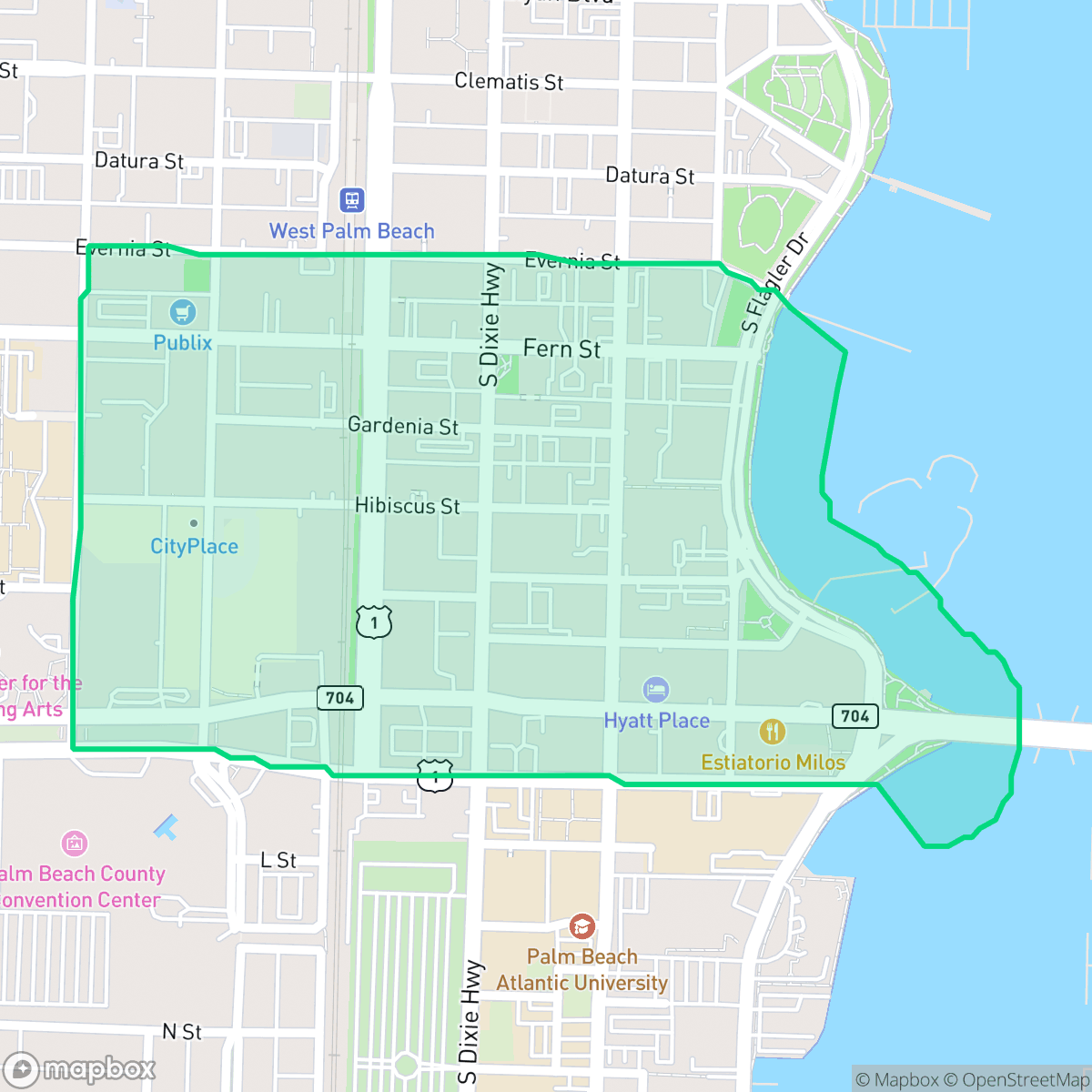
Founded in 1893 by Henry Flagler to support his nearby resort hotels, Downtown West Palm Beach was platted as a 48-block commercial and residential grid. Its early character was defined by the Florida East Coast Railroad and Clematis Street, which remains the neighborhood's historic main street. Following a period of suburban decline in the late 20th century, the area underwent significant urban renewal, including the 1984 creation of a Community Redevelopment Area and the 2000 opening of CityPlace. The neighborhood features a rich architectural stock, including 1920s-era Classical Revival and Mediterranean Revival buildings like the Comeau Building and the former First United Methodist Church, now the Harriet Himmel Theater. Today, the district serves as a vibrant cultural and business hub, anchored by the waterfront, the Kravis Center for the Performing Arts, and the historic Clematis Street commercial corridor.
Downtown West Palm Beach functions as a primary cultural and commercial hub, characterized by a dense, high-rise landscape that prioritizes pedestrian accessibility. The area maintains a sophisticated visual appeal, featuring well-maintained waterfront properties and a consistent street grid that supports a lively, active atmosphere throughout the day and night. According to iHuus data, the neighborhood attracts a more mature demographic, offering a lifestyle centered on convenience and proximity to major landmarks rather than suburban seclusion.
Prospective residents should account for the trade-offs inherent in a dense urban environment, such as limited acoustic comfort due to steady traffic noise and reduced physical privacy between neighboring units. While the area offers minimal industrial presence, residents may experience moderate air quality fluctuations and should be aware of the localized flood risk. Families in the area are served by the Palm Beach County School District, which holds a strong state rating and provides access to specialized academic programs and career academies.
Neighborhood Scores Across 15 Qualities
Dense urban layouts and closely packed multi-unit buildings result in limited separation between structures. According to iHuus data, this lack of physical distance from neighbors is notably lower than the West Palm Beach average.
Pedestrian-friendly infrastructure, including a consistent grid of wide sidewalks and clear crosswalks, makes navigating the area on foot easy. According to iHuus data, this level of walkability is significantly higher than the average for West Palm Beach.
High-rise luxury condos, marina views, and well-maintained waterfront properties create a visual environment that is notably more polished than the West Palm Beach average. According to iHuus data, the area features a blend of dense urban development and upscale amenities like yachts and shared pool complexes.
Limited green space and a dense urban grid make for narrow walking verges; however, the waterfront promenade and central public parks provide reliable routes for pet owners. According to iHuus data, access to open areas is slightly below the city average.
High-rise structures and large commercial blocks define this area, which features significantly more concrete coverage and multi-story buildings than the West Palm Beach average. According to iHuus data, the landscape is characterized by a dense urban environment with limited green space.
Constant movement and a dense concentration of dining, nightlife, and commercial landmarks create an atmosphere significantly more active than the West Palm Beach average. This coastal hub provides a highly walkable environment with frequent pedestrian activity throughout the day and night.
Steady traffic hum from nearby busy streets characterizes the area, though acoustic levels remain notably higher than the West Palm Beach average according to iHuus data.
Air quality in this area fluctuates between acceptable and unhealthy levels, though conditions remain slightly better than the West Palm Beach average according to iHuus data. Sensitive individuals may experience occasional concern during certain periods.
Industrial activity is significantly lower here than the city average, as the area primarily consists of residential, commercial, and marine uses. Some specific pockets near the airport or rail lines may experience occasional freight traffic and utility noise, but heavy industry is largely absent according to iHuus data.
Health insurance enrollment is exceptionally high among residents, significantly surpassing the West Palm Beach average according to iHuus data.
Political views in this area are evenly divided, representing a more balanced ideological split than the city average according to iHuus data.
Older adults comprise the majority of the population, representing a significantly more mature demographic than the West Palm Beach average. According to iHuus data, the area maintains a modest presence of younger residents alongside this established adult population.
Flood risk in this area is slightly above the West Palm Beach average; however, a detailed federal study for this specific zone has not yet been completed.
Address-Level Insights for Downtown


iHuus Neighborhood Intelligence Insights
Get address-level neighborhood insights for Downtown
- Street-level scores — see how individual blocks compare, not just neighborhood averages
- Micro-zone boundaries — identify quiet pockets, flood boundaries, and walkable clusters before you visit
- 15 dimensions in full — walkability, noise, air quality, school quality, insurance coverage, population age profile, urban/rural index, and more
- Boundary risk alerts — know if your address sits near a block boundary where scores drop, the kind of detail no listing will ever mention
- School insights — individual school ratings and insights, not just district-level data
- Compare before you commit — side-by-side data across neighborhoods, down to block precision
No credit card required
Compare with Any Neighborhood
| Dimension | Downtown | Central Park |
|---|---|---|
| 🚶 Walkabilityavg 6.38 | ||
| 🔊 Acoustic Comfortavg 3.06 | ||
| 🤫 Privacy Indexavg 5.07 | ||
| 🎨 Visual Appealavg 6.11 | ||
| 🐕 Dog Friendlinessavg 5.75 | ||
| 🗺️ Urban-Rural Indexavg 6.16 | ||
| ✨ Neighborhood Vibeavg 2.94 | ||
| 🏥 Health Insurance Coverageavg 5.54 | ||
| 🌿 Air Qualityavg 3.65 | ||
| 🏭 Industrial Proximityavg 6.56 | ||
| 🌊 Flood Safetyavg 5.66 | ||
| 🗳️ Ideological Leanavg 5.34 | ||
| 👥 Population Age Profileavg 4.74 | ||
| 🔥 Fire Safety | ||
| 🏫 School Quality |
Downtown Rankings
School Districts Serving Downtown
School Insights for Downtown
Below average outcomes; significant attendance and academic challenges.
School Insights
See what's really behind every school rating near Downtown
- Individual school ratings — each school's own score with outcome context, not just a district average
- Enrollment & class size data — student-to-teacher ratio and how it compares to the state average
- Full demographics breakdown — ethnicity and gender composition for every school in the enrollment zone
- Every school in the district — all schools within the enrollment boundary ranked by rating, not just the closest one
- Grade levels & benchmarks — elementary through high school, with below/above state-average flags
No credit card required