East Venice Ave, Venice
Updated · 2,670 residents
Key Highlights
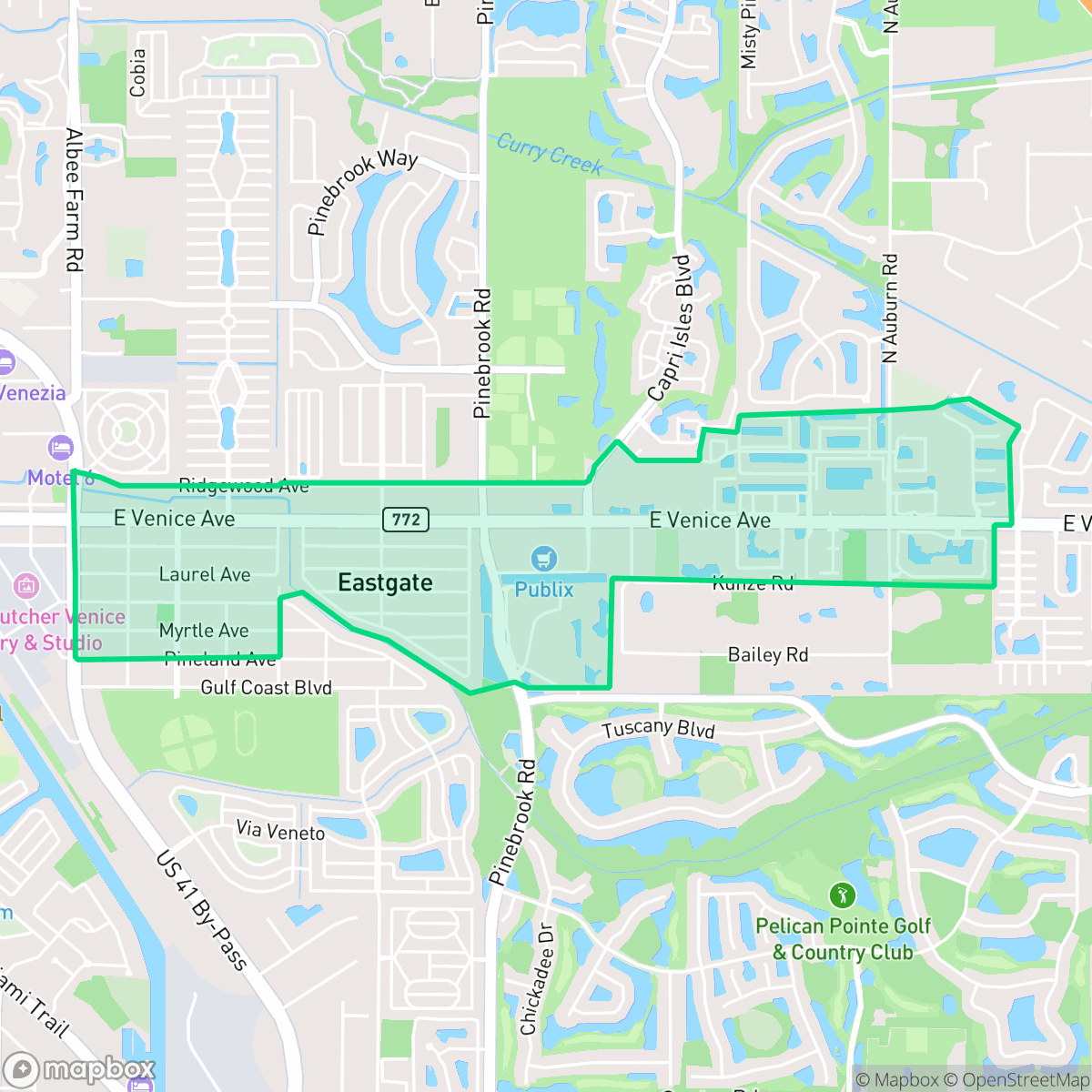
About East Venice Ave
East Venice Avenue serves as a primary axis within the Venice Historic District, which was master-planned in the mid-1920s by renowned city planner John Nolen. Developed by the Brotherhood of Locomotive Engineers, the area is defined by its distinctive Northern Italian Renaissance architectural style, characterized by low-pitched red tile roofs, stucco walls, and arched loggias. The corridor remains a central cultural hub, anchoring the city’s downtown with historic landmarks like the Venice Train Depot and preserved public parks that reflect the original vision of a planned garden city. This stretch of the avenue maintains its historical integrity as a key component of the city's early development, showcasing the deliberate urban design that distinguishes Venice from other Florida coastal municipalities.
Neighborhood Scores Across 15 Qualities
Residential spacing fluctuates throughout the area, offering more separation than the Venice average despite some dense clusters of mobile homes. Neighbors are separated by typical suburban buffers in most sections, according to iHuus data.
Sidewalks and safe crossings are available along much of the neighborhood, making it more walkable than the average Venice area. While the grid layout supports walking, residents should note that large arterial roads border the community.
Large homes and upscale amenities contribute to a visual appeal that is higher than the Venice average. This landscape includes a mix of spacious properties with private pools alongside high density mobile home parks.
Access to large sports complexes and nearby parks makes this area more dog friendly than the Venice average. While some residential streets lack wide grassy verges, the neighborhood offers connected green spaces and paths that are relatively safe from traffic.
Open land and scattered greenery provide a more semi-rural feel compared to the denser urban environment of Venice. This area features a mix of single-family homes and community facilities set amidst pockets of woodland and fields according to iHuus data.
Activity levels here are significantly higher than the Venice average, offering a diverse mix of independent dining and local retail. While some pockets remain quiet and residential, many parts of the neighborhood serve as active suburban destinations with a steady rhythm of community life.
Frequent auditory disturbances are present due to the proximity of heavy traffic and transit corridors; this level of acoustic disruption is consistent with the wider Venice area according to iHuus data.
Air quality remains consistently high with infrequent periods of poor ventilation, providing a cleaner environment than the Venice city average according to iHuus data.
Primarily residential streets and light commercial services define this area, with significantly less heavy industry than the Venice average. Residents can expect a quiet environment free from industrial hazards, though occasional utility buildings and small warehouses are located near the southern edge.
Health insurance enrollment levels in East Venice Ave are consistent with the broader Venice area. According to iHuus data, a significant portion of the resident population remains uninsured.
Conservative viewpoints represent the majority of the local population, which reflects a more conservative leaning than the average for Venice. According to iHuus data, there is also a modest presence of opposing political perspectives in the area.
Residents are primarily older adults, representing a more mature demographic than the average population found within Venice. According to iHuus data, there is a modest presence of younger individuals in this area.
Residual flood risk exists within this area due to its location in a 500-year floodplain, though safety levels remain higher than the Venice average according to iHuus data.
Address-Level Insights for East Venice Ave


iHuus Neighborhood Intelligence Insights
Get address-level neighborhood insights for East Venice Ave
- Street-level scores — see how individual blocks compare, not just neighborhood averages
- Micro-zone boundaries — identify quiet pockets, flood boundaries, and walkable clusters before you visit
- 15 dimensions in full — walkability, noise, air quality, school quality, insurance coverage, population age profile, urban/rural index, and more
- Boundary risk alerts — know if your address sits near a block boundary where scores drop, the kind of detail no listing will ever mention
- School insights — individual school ratings and insights, not just district-level data
- Compare before you commit — side-by-side data across neighborhoods, down to block precision
No credit card required
Compare with Any Neighborhood
| Dimension | East Venice Ave | Gateway/ Waterway |
|---|---|---|
| 🚶 Walkabilityavg 6.1 | ||
| 🔊 Acoustic Comfortavg 2.34 | ||
| 🤫 Privacy Indexavg 4.96 | ||
| 🎨 Visual Appealavg 6.19 | ||
| 🐕 Dog Friendlinessavg 5.6 | ||
| 🗺️ Urban-Rural Indexavg 6.29 | ||
| ✨ Neighborhood Vibeavg 2.61 | ||
| 🏥 Health Insurance Coverageavg 6.2 | ||
| 🌿 Air Qualityavg 6.83 | ||
| 🏭 Industrial Proximityavg 6.81 | ||
| 🌊 Flood Safetyavg 5.27 | ||
| 🗳️ Ideological Leanavg 2.06 | ||
| 👥 Population Age Profileavg 6.22 | ||
| 🔥 Fire Safety | ||
| 🏫 School Quality |
East Venice Ave Rankings
School Districts Serving East Venice Ave
School Insights for East Venice Ave
Below average outcomes; significant attendance and academic challenges.
School Insights
See what's really behind every school rating near East Venice Ave
- Individual school ratings — each school's own score with outcome context, not just a district average
- Enrollment & class size data — student-to-teacher ratio and how it compares to the state average
- Full demographics breakdown — ethnicity and gender composition for every school in the enrollment zone
- Every school in the district — all schools within the enrollment boundary ranked by rating, not just the closest one
- Grade levels & benchmarks — elementary through high school, with below/above state-average flags
No credit card required