Paradise Island, Treasure Island
Updated · 1,226 residents
Paradise Island is a quiet, man-made residential enclave in Treasure Island, Florida, featuring diverse architectural styles and private waterfront access. The area offers a mature, suburban atmosphere with moderate privacy and decent pedestrian accessibility, though residents should be aware of high flood risks and noise from nearby transit routes.
Key Highlights
About Paradise Island
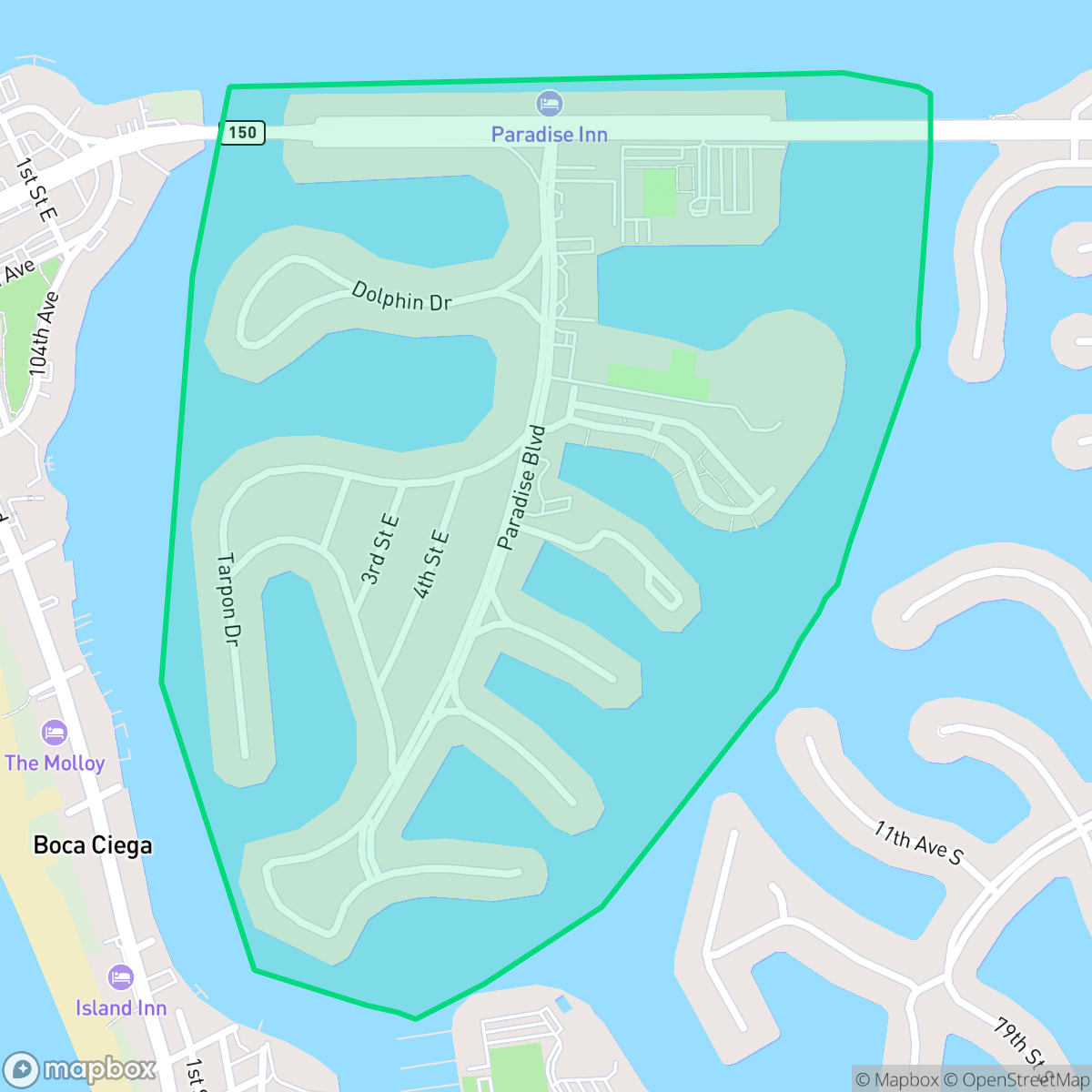
Paradise Island in Treasure Island, Florida, is a residential subdivision established during the mid-20th century as part of the city's post-World War II expansion. The neighborhood was created through significant landfill efforts in the surrounding Boca Ciega Bay, a development strategy used to increase waterfront land for luxury residential construction. Designed to provide convenient access to navigable waterways, the community features a diverse range of architectural styles, including classic Florida, Mediterranean, and Tuscan designs. Unlike the natural barrier island, Paradise Island is a man-made landmass specifically engineered for waterfront living, characterized by its private docks and boat access, which distinguishes it from the older, beach-oriented sections of Treasure Island.
This neighborhood is characterized by a quiet coastal suburban rhythm, with a mature resident base and a landscape defined by upscale homes. It maintains a peaceful residential environment, entirely free from industrial activity, which contributes to its appeal for those seeking a stable, low-key community. Residents enjoy high levels of health insurance coverage and a street layout that supports modest walkability, with sidewalks available on one side of most roads to facilitate safe movement throughout the area.
Living here involves balancing the benefits of waterfront access with specific environmental trade-offs. The area faces significant vulnerability to flooding, and according to iHuus data, it experiences higher noise levels due to its proximity to major transit corridors. Furthermore, those prioritizing pet-friendly infrastructure may find limited local options for off-leash exercise or shaded walking paths. The community is best suited for individuals who value a private, upscale coastal setting and are prepared to manage the realities of living in a designated floodplain.
Neighborhood Scores Across 15 Qualities
Housing density remains moderate with varied spacing between structures; this provides more separation from neighbors than the typical Treasure Island area, according to iHuus data.
Sidewalks are available on one side of the streets and crossings are considered safe. This level of pedestrian accessibility is roughly comparable to the average for Treasure Island.
Large residential properties and frequent upscale amenities define the landscape; this level of visual quality is nearly identical to the Treasure Island average.
Nearby public parks and green spaces are sparse, making this area slightly less dog friendly than the Treasure Island average. Residents may find fewer opportunities for off-leash exercise or shaded walking paths within the immediate neighborhood.
Open land and scattered homes characterize the landscape, matching the broader Treasure Island area in its mix of natural space and residential density.
Activity levels remain steady and comparable to the city average, ranging from subdued residential stretches to pockets of lively waterfront dining. Most areas feature a low-key suburban rhythm with sparse commercial density found away from localized coastal hubs.
Frequent noise disturbances from nearby major transit routes characterize this area, which experiences acoustic levels slightly higher than the Treasure Island average according to iHuus data.
Frequent unhealthy air quality levels pose significant risks to sensitive groups; according to iHuus data, this neighborhood shares the same low air quality standards seen across Treasure Island.
Industrial activity and heavy warehouses are absent from this area, offering a landscape of residential streets and light commercial services. This lack of industrial proximity is very similar to the broader Treasure Island area.
Health insurance enrollment is exceptionally high among residents, sitting slightly above the Treasure Island average according to iHuus data.
Conservative voters form the majority in this area, though there is a modest presence of opposing viewpoints. This political leaning is slightly more conservative than the Treasure Island average according to iHuus data.
Older adults represent the majority of the population, though there is a modest presence of younger residents. This age profile is largely consistent with the average seen across Treasure Island.
Located within a designated floodplain, this area faces significant vulnerability to rising waters. According to iHuus data, the flood risk in Paradise Island is consistent with the broader Treasure Island average.
Address-Level Insights for Paradise Island


iHuus Neighborhood Intelligence Insights
Get address-level neighborhood insights for Paradise Island
- Street-level scores — see how individual blocks compare, not just neighborhood averages
- Micro-zone boundaries — identify quiet pockets, flood boundaries, and walkable clusters before you visit
- 15 dimensions in full — walkability, noise, air quality, school quality, insurance coverage, population age profile, urban/rural index, and more
- Boundary risk alerts — know if your address sits near a block boundary where scores drop, the kind of detail no listing will ever mention
- School insights — individual school ratings and insights, not just district-level data
- Compare before you commit — side-by-side data across neighborhoods, down to block precision
No credit card required
Compare with Any Neighborhood
| Dimension | Paradise Island | Isle of Capri |
|---|---|---|
| 🚶 Walkabilityavg 7.62 | ||
| 🔊 Acoustic Comfortavg 2.86 | ||
| 🤫 Privacy Indexavg 5.43 | ||
| 🎨 Visual Appealavg 8.1 | ||
| 🐕 Dog Friendlinessavg 5.14 | ||
| 🗺️ Urban-Rural Indexavg 6.55 | ||
| ✨ Neighborhood Vibeavg 4.39 | ||
| 🏥 Health Insurance Coverageavg 8.97 | ||
| 🌿 Air Qualityavg 2 | ||
| 🏭 Industrial Proximityavg 9.33 | ||
| 🌊 Flood Safetyavg 2.59 | ||
| 🗳️ Ideological Leanavg 2.04 | ||
| 👥 Population Age Profileavg 6.6 | ||
| 🔥 Fire Safety | ||
| 🏫 School Quality |
Paradise Island Rankings
School Districts Serving Paradise Island
School Insights for Paradise Island
Below average outcomes; significant attendance and academic challenges.
School Insights
See what's really behind every school rating near Paradise Island
- Individual school ratings — each school's own score with outcome context, not just a district average
- Enrollment & class size data — student-to-teacher ratio and how it compares to the state average
- Full demographics breakdown — ethnicity and gender composition for every school in the enrollment zone
- Every school in the district — all schools within the enrollment boundary ranked by rating, not just the closest one
- Grade levels & benchmarks — elementary through high school, with below/above state-average flags
No credit card required