Isle of Palms, Treasure Island
Updated · 727 residents
Isle of Palms is a quiet, upscale waterfront community defined by its manicured properties and nautical character. While it offers accessible pedestrian paths, the area experiences notable noise from nearby transportation corridors and requires residents to manage significant flood risk.
Key Highlights
About Isle of Palms
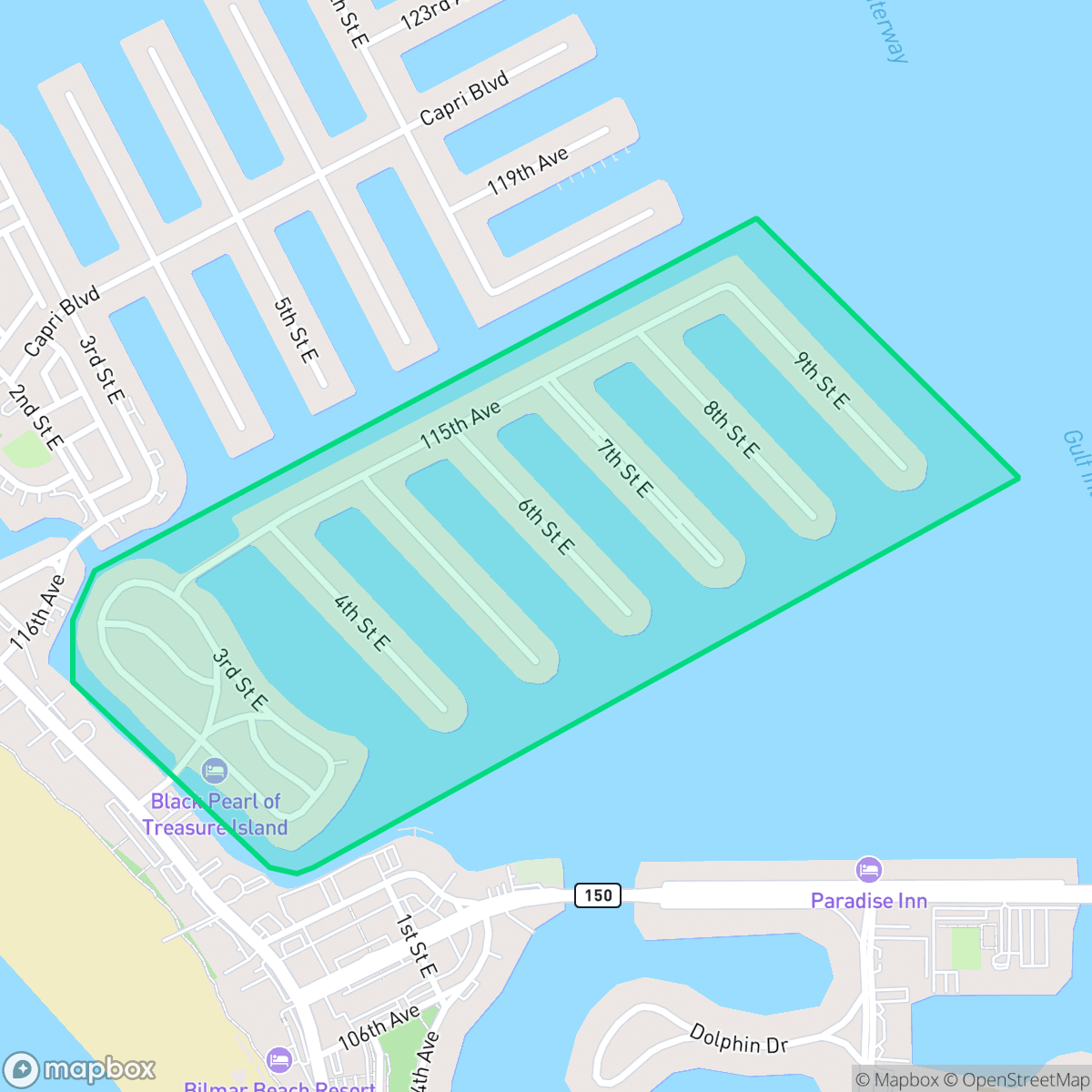
The Isle of Palms, a residential neighborhood in Treasure Island, Florida, traces its geographic origins to the 'Great Gale' of 1848, a powerful hurricane that carved out John’s Pass and effectively separated the area from the main barrier island. Long a series of mangrove islands, the neighborhood was transformed into its modern form during the mid-20th century through extensive land reclamation and landfill efforts in Boca Ciega Bay. This development helped facilitate the incorporation of the City of Treasure Island in 1955, when the Isle of Palms, Isle of Capri, and other local communities consolidated. Today, the neighborhood is characterized by its nautical identity and a residential landscape featuring well-established homes primarily constructed between the 1940s and 1960s, designed to provide convenient access to the surrounding waterways.
The neighborhood features a distinct residential landscape where spacious driveways and well-maintained homes create a polished, upscale aesthetic. Residents benefit from high levels of health insurance coverage and a complete absence of industrial activity, fostering a stable environment that appeals primarily to older homeowners. The area maintains a semi-rural feel with scattered greenery, though the quiet atmosphere is frequently interrupted by noise from surrounding transit routes. Prospective residents should consider that the neighborhood has limited pet-friendly amenities and faces persistent challenges with air quality. While the local sidewalks provide reliable options for walking, the proximity to water necessitates careful attention to flood insurance requirements. The community is served by the Pinellas County School District, which remains a stable institution despite recent efforts to consolidate campuses due to shifting local demographics.
Neighborhood Scores Across 15 Qualities
Residential spacing is mixed with some buffer between neighbors, representing a level of privacy that is roughly consistent with the Treasure Island average.
Sidewalks are available along one side of the streets with designated safe crossings. This level of walkability remains largely consistent with the average found throughout Treasure Island, according to iHuus data.
Large homes and frequent upscale amenities define the local landscape, which remains very similar to the broader Treasure Island area. According to iHuus data, the presence of spacious driveways and well-maintained properties contributes to a highly manicured visual environment.
Access to public parks and wide green verges for walking is somewhat restricted in this area. According to iHuus data, opportunities for outdoor pet activities are below the Treasure Island average.
Open land and scattered homes amidst greenery provide a semi-rural feel that is consistent with the Treasure Island average, according to iHuus data.
Vibrancy levels are slightly below the city average, as most of this area consists of low-key residential streets with sparse commercial activity. Some coastal pockets offer much higher energy and walkability due to a concentrated variety of local cafes, restaurants, and transit options.
Frequent disturbances from nearby transportation corridors characterize the area. According to iHuus data, acoustic comfort is significantly lower than the average for Treasure Island.
Frequent unhealthy air quality levels pose a significant risk to sensitive groups. According to iHuus data, this condition is consistent with the city average for Treasure Island.
Industrial activity is virtually non-existent in this area, as the neighborhood consists of residential streets and small-scale commercial amenities like coffee shops and hotels. According to iHuus data, there are no warehouses or heavy industrial facilities present, making the environment comparable to the city average for low industrial proximity.
Nearly all residents are covered by health insurance, a rate that sits slightly above the Treasure Island average according to iHuus data.
Conservative viewpoints hold a significant majority within this area, though a small presence of opposing perspectives exists. This political leaning is slightly more pronounced than the average found across Treasure Island.
Older adults make up the majority of the population, though a modest number of younger residents also live in the area. This age distribution is very similar to the typical profile found across Treasure Island.
Significant flood risk exists here due to being situated within a designated floodplain; residents should expect that flood insurance will likely be a requirement for properties in this area.
Address-Level Insights for Isle of Palms


iHuus Neighborhood Intelligence Insights
Get address-level neighborhood insights for Isle of Palms
- Street-level scores — see how individual blocks compare, not just neighborhood averages
- Micro-zone boundaries — identify quiet pockets, flood boundaries, and walkable clusters before you visit
- 15 dimensions in full — walkability, noise, air quality, school quality, insurance coverage, population age profile, urban/rural index, and more
- Boundary risk alerts — know if your address sits near a block boundary where scores drop, the kind of detail no listing will ever mention
- School insights — individual school ratings and insights, not just district-level data
- Compare before you commit — side-by-side data across neighborhoods, down to block precision
No credit card required
Compare with Any Neighborhood
| Dimension | Isle of Palms | Isle of Capri |
|---|---|---|
| 🚶 Walkabilityavg 7.62 | ||
| 🔊 Acoustic Comfortavg 2.86 | ||
| 🤫 Privacy Indexavg 5.43 | ||
| 🎨 Visual Appealavg 8.1 | ||
| 🐕 Dog Friendlinessavg 5.14 | ||
| 🗺️ Urban-Rural Indexavg 6.55 | ||
| ✨ Neighborhood Vibeavg 4.39 | ||
| 🏥 Health Insurance Coverageavg 8.97 | ||
| 🌿 Air Qualityavg 2 | ||
| 🏭 Industrial Proximityavg 9.33 | ||
| 🌊 Flood Safetyavg 2.59 | ||
| 🗳️ Ideological Leanavg 2.04 | ||
| 👥 Population Age Profileavg 6.6 | ||
| 🔥 Fire Safety | ||
| 🏫 School Quality |
Isle of Palms Rankings
School Districts Serving Isle of Palms
School Insights for Isle of Palms
Below average outcomes; significant attendance and academic challenges.
School Insights
See what's really behind every school rating near Isle of Palms
- Individual school ratings — each school's own score with outcome context, not just a district average
- Enrollment & class size data — student-to-teacher ratio and how it compares to the state average
- Full demographics breakdown — ethnicity and gender composition for every school in the enrollment zone
- Every school in the district — all schools within the enrollment boundary ranked by rating, not just the closest one
- Grade levels & benchmarks — elementary through high school, with below/above state-average flags
No credit card required