Isle of Capri, Treasure Island
Updated · 1,565 residents
The Isle of Capri is a distinct residential community defined by its man-made canal fingers and direct access to Boca Ciega Bay. While the neighborhood offers upscale waterfront views and a quiet, suburban atmosphere, residents should be prepared for significant noise from nearby transit infrastructure and a high risk of flooding.
Key Highlights
About Isle of Capri
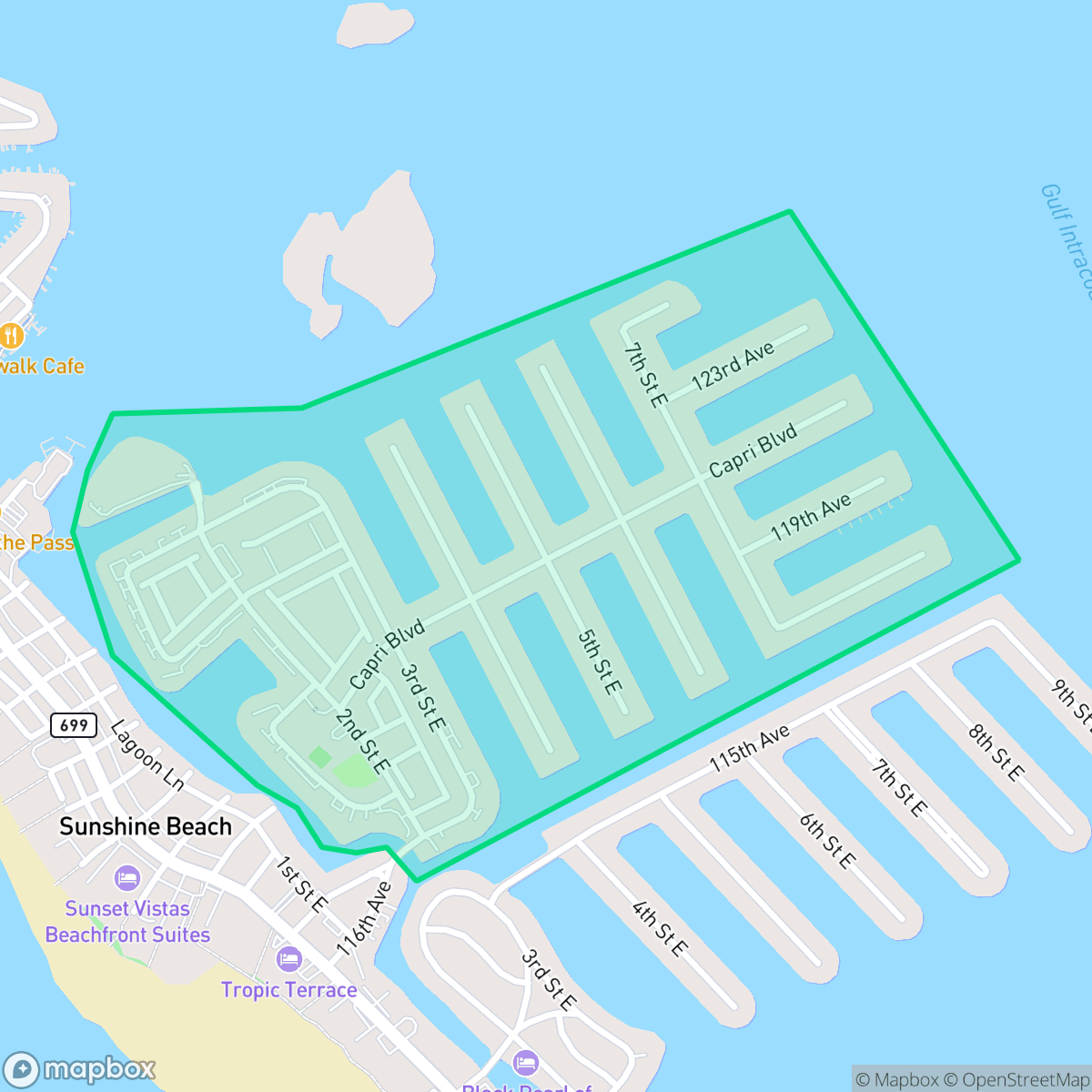
The Isle of Capri in Treasure Island, Florida, originated as a series of mangrove islands known historically as the 'Kitchen Keys.' In the mid-1950s, these islands underwent significant land reclamation through major dredging and filling efforts to create the current residential community. The neighborhood is characterized by its man-made 'fingers' of land extending into Boca Ciega Bay, designed to maximize waterfront access for homes. Notable local history includes the site of 'Camp Key,' which once featured a Timucuan burial mound where archaeological artifacts were unearthed in the mid-20th century; this site is now occupied by the Key Capri Condominiums. Today, the neighborhood remains a distinct island community accessible by a single bridge, defined by its canal-front homes and proximity to the Gulf of Mexico.
The area is characterized by its unique layout of residential fingers extending into the water, providing many homeowners with private docks and immediate access to the bay. It maintains a primarily residential environment with virtually no industrial activity, creating a tranquil setting that focuses on coastal living. The visual landscape is dominated by well-maintained properties and swimming pools, reflecting an upscale aesthetic that remains consistent with the broader Treasure Island region.
Prospective residents should consider the trade-offs of living in this coastal community, as the area experiences persistent noise from nearby transportation routes and faces notable flood risks that typically necessitate specialized insurance. The neighborhood is best suited for those seeking a mature, quiet environment, though it offers limited green space for pets and lower privacy levels due to the mix of multi-unit condo complexes and single-family homes. According to iHuus data, while the community provides a stable environment, it is important to factor in the environmental and acoustic conditions when evaluating long-term livability.
Neighborhood Scores Across 15 Qualities
Residential spacing varies throughout the area, featuring both multi-unit buildings with shared walls and pockets of more buffered homes. This level of privacy is slightly lower than the average for Treasure Island, according to iHuus data.
Sidewalks are available along major roads and low-traffic interior loops, providing safe crossings for pedestrians. This level of accessibility is slightly lower than the average seen across Treasure Island.
Well-maintained waterfront properties with private docks and swimming pools define the area. This neighborhood presents a visual landscape that is very similar to the Treasure Island average.
Central park access and ball fields provide some outdoor space, but residential streets lack the wide green verges found elsewhere in Treasure Island. According to iHuus data, walking pets through the immediate neighborhood offers fewer grassy areas than the city average.
Residential pockets feature a mix of multi-story condo complexes and single-family canal homes, reflecting a density that aligns with the city average. This landscape provides a blend of developed coastal infrastructure and open waterfront views.
Low levels of commercial activity and social density create a much more subdued atmosphere than the city average. Most areas are primarily residential and lack significant points of interest, though certain pockets near coastal landmarks offer increased walkability and hospitality options.
Persistent noise from nearby transit infrastructure makes this area significantly louder than the Treasure Island average. Residents should expect frequent disruptions from heavy transportation or industrial activity according to iHuus data.
Frequent periods of unhealthy air quality pose a significant risk to sensitive groups. According to iHuus data, these levels are consistent with the city average for Treasure Island.
Industrial activity is virtually non-existent in this area, with no warehouses or hazardous facilities detected. According to iHuus data, the landscape consists entirely of residential streets, recreational marinas, and small-scale hospitality venues, which is even more tranquil than the city average.
Health insurance access is nearly universal among residents, sitting slightly above the Treasure Island average according to iHuus data.
Political demographics in this area favor conservative viewpoints more heavily than the Treasure Island average, according to iHuus data.
Predominantly older adults reside in this area, with a modest presence of younger residents. This age distribution is consistent with the broader Treasure Island area, according to iHuus data.
Property within the 100-year floodplain faces significant inundation risks, and flood insurance is typically required for residents. This level of risk is slightly higher than the average found throughout Treasure Island, according to iHuus data.
Address-Level Insights for Isle of Capri


iHuus Neighborhood Intelligence Insights
Get address-level neighborhood insights for Isle of Capri
- Street-level scores — see how individual blocks compare, not just neighborhood averages
- Micro-zone boundaries — identify quiet pockets, flood boundaries, and walkable clusters before you visit
- 15 dimensions in full — walkability, noise, air quality, school quality, insurance coverage, population age profile, urban/rural index, and more
- Boundary risk alerts — know if your address sits near a block boundary where scores drop, the kind of detail no listing will ever mention
- School insights — individual school ratings and insights, not just district-level data
- Compare before you commit — side-by-side data across neighborhoods, down to block precision
No credit card required
Compare with Any Neighborhood
| Dimension | Isle of Capri | Isle of Palms |
|---|---|---|
| 🚶 Walkabilityavg 7.62 | ||
| 🔊 Acoustic Comfortavg 2.86 | ||
| 🤫 Privacy Indexavg 5.43 | ||
| 🎨 Visual Appealavg 8.1 | ||
| 🐕 Dog Friendlinessavg 5.14 | ||
| 🗺️ Urban-Rural Indexavg 6.55 | ||
| ✨ Neighborhood Vibeavg 4.39 | ||
| 🏥 Health Insurance Coverageavg 8.97 | ||
| 🌿 Air Qualityavg 2 | ||
| 🏭 Industrial Proximityavg 9.33 | ||
| 🌊 Flood Safetyavg 2.59 | ||
| 🗳️ Ideological Leanavg 2.04 | ||
| 👥 Population Age Profileavg 6.6 | ||
| 🔥 Fire Safety | ||
| 🏫 School Quality |
Isle of Capri Rankings
School Districts Serving Isle of Capri
School Insights for Isle of Capri
Below average outcomes; significant attendance and academic challenges.
School Insights
See what's really behind every school rating near Isle of Capri
- Individual school ratings — each school's own score with outcome context, not just a district average
- Enrollment & class size data — student-to-teacher ratio and how it compares to the state average
- Full demographics breakdown — ethnicity and gender composition for every school in the enrollment zone
- Every school in the district — all schools within the enrollment boundary ranked by rating, not just the closest one
- Grade levels & benchmarks — elementary through high school, with below/above state-average flags
No credit card required