Ybor City, Tampa
Updated · 5,546 residents
Ybor City is defined by its historic brick architecture and vibrant nightlife centered along 7th Avenue. While the area offers a dense, walkable urban environment with a strong sense of community, residents should expect frequent noise from nearby transit and limited private outdoor space.
Key Highlights
About Ybor City
Founded in 1885 by Vicente Martinez-Ybor, Ybor City was established as a company town for cigar manufacturing, quickly earning the title 'Cigar Capital of the World.' Its unique character was shaped by a diverse immigrant workforce from Cuba, Spain, Italy, and Eastern Europe, who established influential mutual aid societies to provide social and medical support. The neighborhood is a National Historic Landmark District, distinguished by its iconic red-brick cigar factories, wrought-iron balconies, and shotgun-style houses. Signature landmarks include the historic 7th Avenue commercial strip and the Columbia Restaurant, Florida’s oldest restaurant. Despite the decline of the cigar industry by the mid-20th century, the area has preserved its industrial architecture and Latin heritage, remaining a cultural anchor defined by its immigrant roots and distinctive role in Tampa’s economic history.
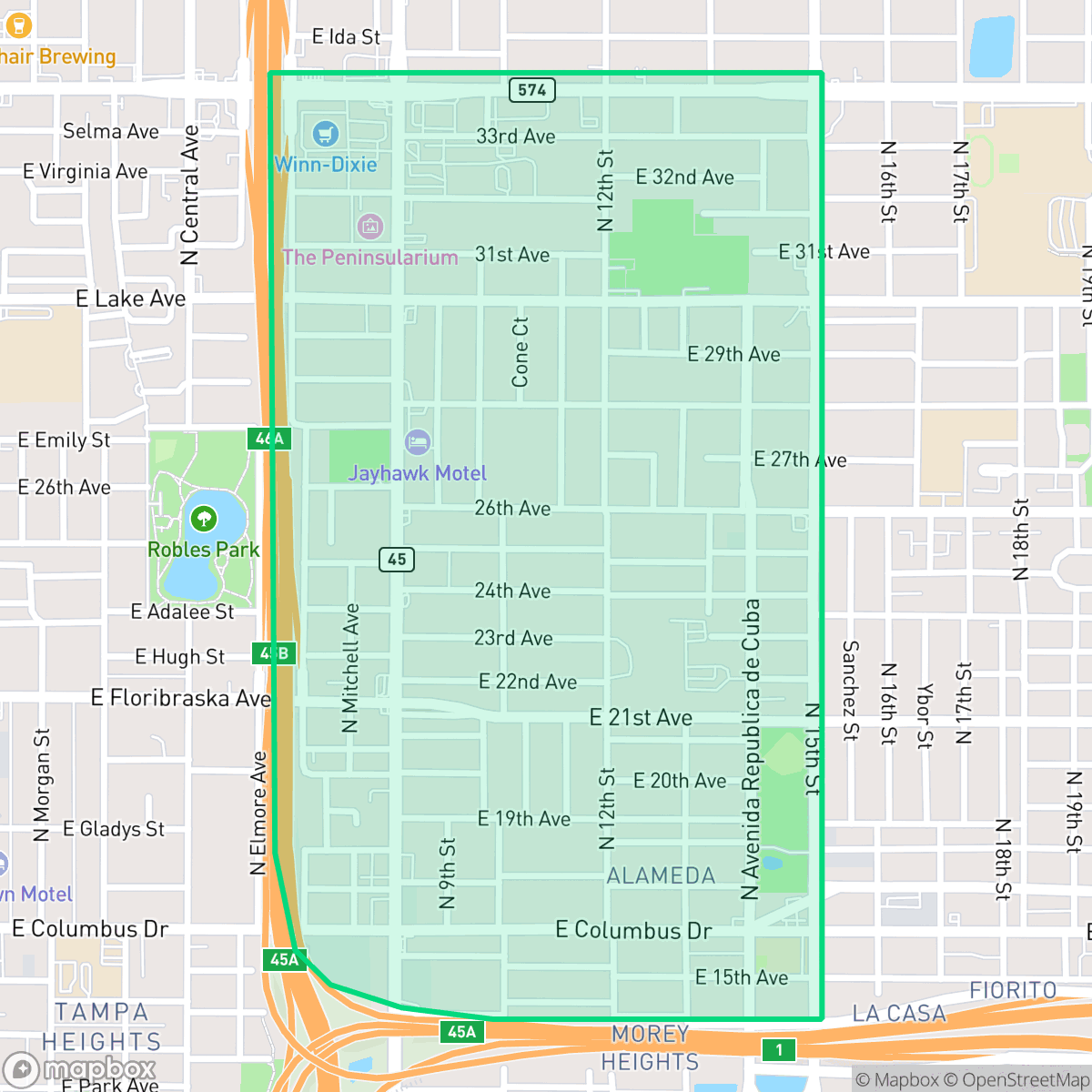
The neighborhood functions as a dense urban hub characterized by its grid layout and proximity to major transit infrastructure. It maintains a high level of social activity, featuring a wide array of dining, museums, and entertainment venues that distinguish it from more suburban sections of Tampa. The landscape is primarily composed of multi-story buildings and compact residential structures, contributing to a lively atmosphere that attracts those seeking an active, central lifestyle.
Living in this area involves specific trade-offs, including noticeable noise levels from nearby railroad tracks and heavy traffic. The neighborhood also experiences challenges regarding air quality and limited privacy due to the close proximity of residential buildings. While the area provides good access to amenities, potential residents should be aware of these environmental factors. It is well-suited for individuals who prioritize walkability and proximity to cultural landmarks over the quiet and expansive greenery found in more peripheral parts of the city.
Neighborhood Scores Across 15 Qualities
Residential structures are closely spaced with frequent shared walls and narrow setbacks, resulting in a level of privacy that is roughly average for Tampa. Proximity to major highways further reduces buffer zones between neighbors according to iHuus data.
A dense grid pattern with sidewalks and safe crossings facilitates pedestrian movement, though major highway interchanges create significant barriers to flow. This level of walkability is slightly above the Tampa average according to iHuus data.
Dense, modest housing with small yards and uniform rooftops characterizes this area. The visual landscape is less lush than the Tampa average, as iHuus data indicates a predominance of standard tract homes and limited private greenery.
Public parks with lakes and green spaces provide decent walking opportunities, though some residential areas lack wide verges and are interrupted by highway access. Overall dog friendliness is slightly below the Tampa average according to iHuus data.
Predominantly urban in character, this area features a dense grid of multi-story buildings and commercial corridors that are slightly more developed than the Tampa average. According to iHuus data, the landscape consists of a mix of apartment blocks, single-family homes, and significant transit infrastructure.
Vibrant pockets of activity and a dense concentration of dining, bars, and museums create a much more active atmosphere than the typical Tampa neighborhood. While some residential stretches remain subdued, the area generally offers a higher level of social energy and amenity density than the city average.
Frequent sounds from nearby railroad tracks and heavy traffic are common in this area. According to iHuus data, acoustic disturbance levels are slightly higher than the Tampa city average.
Frequent unhealthy air quality levels present significant risks for sensitive groups. According to iHuus data, these conditions are worse than the average seen throughout Tampa.
Light commercial activity and nearby highway proximity introduce occasional transit noise and utility odors, though heavy industrial hazards are largely absent. This level of industrial proximity is slightly higher than the Tampa average due to the presence of warehouses and logistics hubs near major arterial roads.
Health insurance accessibility among residents is notably higher than the Tampa average, according to iHuus data.
Voting patterns and census indicators show a significantly more liberal leaning than the Tampa average, according to iHuus data.
Residents encounter a balanced demographic of young professionals, families, and seniors. According to iHuus data, this age distribution is slightly more varied than the average found across Tampa.
Flood safety levels in this area are roughly comparable to the Tampa average, though specific risk details remain unverified due to a lack of detailed federal studies. Residents should account for potential uncertainty regarding long term flood vulnerability according to iHuus data.
Address-Level Insights for Ybor City


iHuus Neighborhood Intelligence Insights
Get address-level neighborhood insights for Ybor City
- Street-level scores — see how individual blocks compare, not just neighborhood averages
- Micro-zone boundaries — identify quiet pockets, flood boundaries, and walkable clusters before you visit
- 15 dimensions in full — walkability, noise, air quality, school quality, insurance coverage, population age profile, urban/rural index, and more
- Boundary risk alerts — know if your address sits near a block boundary where scores drop, the kind of detail no listing will ever mention
- School insights — individual school ratings and insights, not just district-level data
- Compare before you commit — side-by-side data across neighborhoods, down to block precision
No credit card required
Compare with Any Neighborhood
| Dimension | Ybor City | Arbor Greene |
|---|---|---|
| 🚶 Walkabilityavg 6.08 | ||
| 🔊 Acoustic Comfortavg 2.94 | ||
| 🤫 Privacy Indexavg 5.25 | ||
| 🎨 Visual Appealavg 5.82 | ||
| 🐕 Dog Friendlinessavg 5.48 | ||
| 🗺️ Urban-Rural Indexavg 6.28 | ||
| ✨ Neighborhood Vibeavg 3.39 | ||
| 🏥 Health Insurance Coverageavg 5.93 | ||
| 🌿 Air Qualityavg 1.36 | ||
| 🏭 Industrial Proximityavg 6.63 | ||
| 🌊 Flood Safetyavg 4.98 | ||
| 🗳️ Ideological Leanavg 5.57 | ||
| 👥 Population Age Profileavg 4.16 | ||
| 🔥 Fire Safety | ||
| 🏫 School Quality |
Ybor City Rankings
School Districts Serving Ybor City
School Insights for Ybor City
Below average outcomes; significant attendance and academic challenges.
School Insights
See what's really behind every school rating near Ybor City
- Individual school ratings — each school's own score with outcome context, not just a district average
- Enrollment & class size data — student-to-teacher ratio and how it compares to the state average
- Full demographics breakdown — ethnicity and gender composition for every school in the enrollment zone
- Every school in the district — all schools within the enrollment boundary ranked by rating, not just the closest one
- Grade levels & benchmarks — elementary through high school, with below/above state-average flags
No credit card required