West Riverfront, Tampa
Updated · 3,230 residents
West Riverfront offers a vibrant, urban atmosphere defined by its active nightlife and proximity to the Hillsborough River. While the area provides good access to parks and moderate walkability, residents should expect frequent traffic noise and occasional air quality concerns.
Key Highlights
About West Riverfront
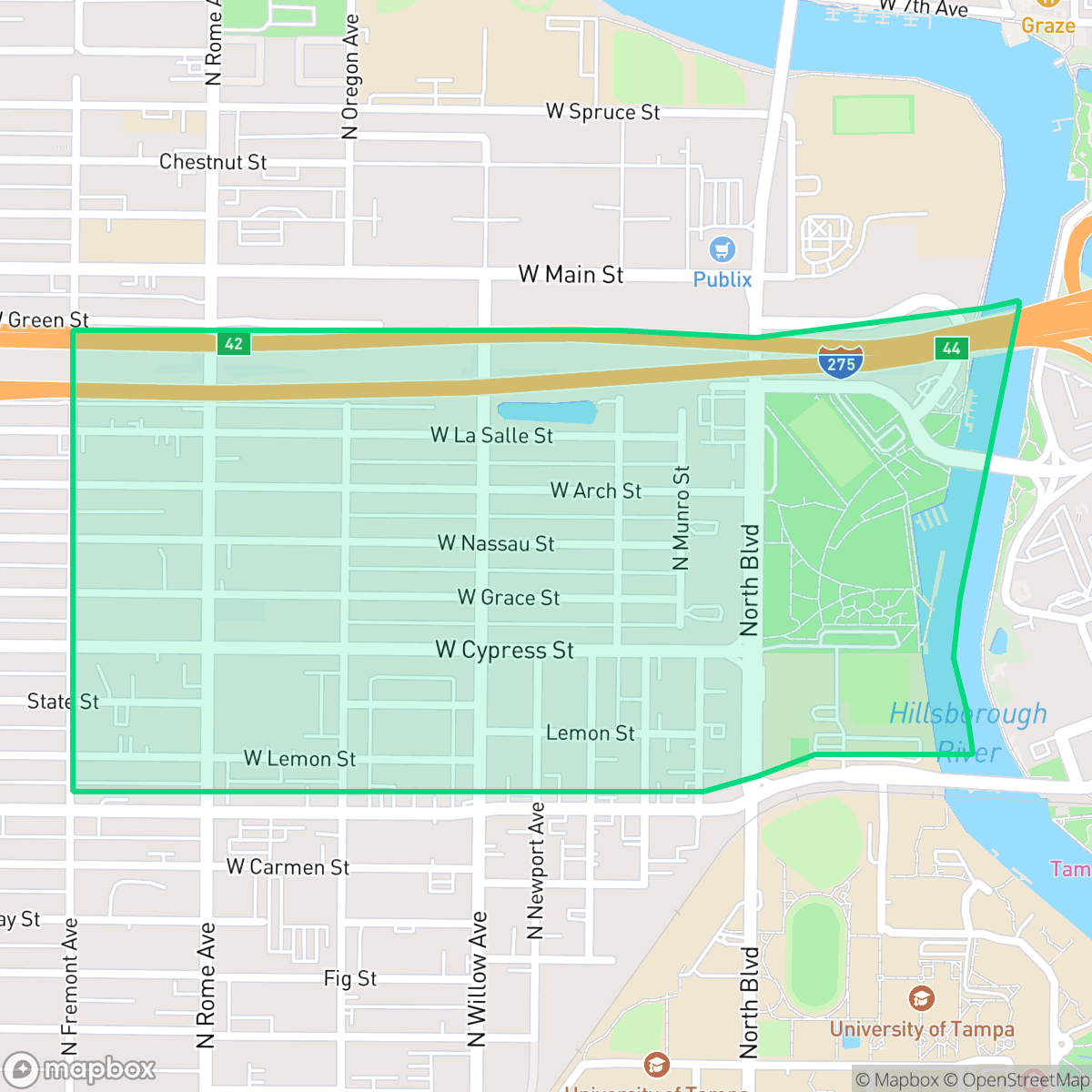
The West Riverfront neighborhood, situated along the Hillsborough River across from downtown Tampa, is defined by its academic heritage and significant urban transformation. The area is anchored by the University of Tampa, housed in the historic former Tampa Bay Hotel—a National Historic Landmark renowned for its iconic Moorish-style minarets and Gilded Age architecture. Historically, the neighborhood underwent substantial changes during the 1960s through major urban renewal projects that cleared large swaths of residential and industrial land. Today, the area serves as a corridor of education and modern development, bridging the city's historic academic institutions with ongoing waterfront revitalization efforts. Landmarks such as Plant Park and the surrounding riverfront continue to shape its character, marking a transition from its industrial past to a contemporary, student-focused urban landscape.
This district serves as a hub of activity, drawing a diverse population of students, families, and professionals to its dense grid of dining and entertainment venues. The neighborhood thrives on a lively energy, particularly after dark, and benefits from pedestrian-friendly infrastructure like bridges that connect the community to nearby green spaces. The visual landscape is characterized by a mix of residential apartment blocks and institutional buildings, creating an environment that feels both functional and deeply connected to the city's academic core.
Prospective residents should weigh these urban benefits against specific lifestyle trade-offs. The proximity to major transit corridors results in elevated noise levels, and the area experiences air quality challenges that may affect sensitive groups. While the neighborhood offers decent access to outdoor spaces for dog owners, those considering a move should also be aware of the moderate flood risk associated with its riverfront location and the variable performance of local schools within the broader county district.
Neighborhood Scores Across 15 Qualities
Residential structures and apartment blocks feature varied spacing, though some areas exhibit high density with shared walls. According to iHuus data, neighbors are generally more closely positioned here than the city average.
Pedestrian connectivity is above the city average due to clear crosswalks and sidewalk networks, though navigation is hindered by a high-traffic highway corridor. According to iHuus data, the presence of pedestrian bridges supports safer movement despite the nearby expressway.
Residential views consist of a mix of uniform apartment blocks and smaller houses with tight yards. This visual landscape is slightly below the Tampa average due to the prevalence of standard, boxy rooflines and institutional structures.
Access to riverfront parks and public green spaces makes this area slightly more dog friendly than the Tampa average. While some pockets feature wide verges for walking, other sections are constrained by narrow sidewalks and nearby highway traffic.
A balance of residential streets and green spaces exists alongside dense apartment complexes and major transit infrastructure. This mix of density is slightly lower than the typical Tampa urban-rural profile, according to iHuus data.
Highly active after dark, this district offers much greater density of nightlife and dining destinations than the typical Tampa neighborhood. Residents can access a diverse range of breweries, restaurants, and wellness services within a bustling urban grid.
Frequent noise from nearby heavy transit corridors and rail lines characterizes this area. According to iHuus data, acoustic comfort in West Riverfront is slightly lower than the Tampa average.
Frequent unhealthy air quality levels pose a significant risk to sensitive groups. According to iHuus data, these conditions are worse than the typical levels found across Tampa.
Industrial presence is generally low throughout the area, though some sections near logistics hubs experience increased truck traffic and noise. According to iHuus data, the level of industrial proximity is roughly comparable to the Tampa average.
Health insurance accessibility in this area is lower than the Tampa average. Residents may find fewer options for coverage compared to other parts of the city.
Political leanings in this area are notably more liberal than the Tampa average, according to iHuus data.
Residents of various life stages live here, as the area maintains a diverse mix of young adults, families, and seniors. This age distribution is roughly in line with the broader Tampa area according to iHuus data.
Flood risk in this area is slightly above the Tampa average, though precise assessments are currently unavailable due to incomplete federal studies. Residents should remain aware of potential vulnerabilities common to riverfront locations.
Address-Level Insights for West Riverfront


iHuus Neighborhood Intelligence Insights
Get address-level neighborhood insights for West Riverfront
- Street-level scores — see how individual blocks compare, not just neighborhood averages
- Micro-zone boundaries — identify quiet pockets, flood boundaries, and walkable clusters before you visit
- 15 dimensions in full — walkability, noise, air quality, school quality, insurance coverage, population age profile, urban/rural index, and more
- Boundary risk alerts — know if your address sits near a block boundary where scores drop, the kind of detail no listing will ever mention
- School insights — individual school ratings and insights, not just district-level data
- Compare before you commit — side-by-side data across neighborhoods, down to block precision
No credit card required
Compare with Any Neighborhood
| Dimension | West Riverfront | Arbor Greene |
|---|---|---|
| 🚶 Walkabilityavg 6.08 | ||
| 🔊 Acoustic Comfortavg 2.94 | ||
| 🤫 Privacy Indexavg 5.25 | ||
| 🎨 Visual Appealavg 5.82 | ||
| 🐕 Dog Friendlinessavg 5.48 | ||
| 🗺️ Urban-Rural Indexavg 6.28 | ||
| ✨ Neighborhood Vibeavg 3.39 | ||
| 🏥 Health Insurance Coverageavg 5.93 | ||
| 🌿 Air Qualityavg 1.36 | ||
| 🏭 Industrial Proximityavg 6.63 | ||
| 🌊 Flood Safetyavg 4.98 | ||
| 🗳️ Ideological Leanavg 5.57 | ||
| 👥 Population Age Profileavg 4.16 | ||
| 🔥 Fire Safety | ||
| 🏫 School Quality |
West Riverfront Rankings
School Districts Serving West Riverfront
School Insights for West Riverfront
Below average outcomes; significant attendance and academic challenges.
School Insights
See what's really behind every school rating near West Riverfront
- Individual school ratings — each school's own score with outcome context, not just a district average
- Enrollment & class size data — student-to-teacher ratio and how it compares to the state average
- Full demographics breakdown — ethnicity and gender composition for every school in the enrollment zone
- Every school in the district — all schools within the enrollment boundary ranked by rating, not just the closest one
- Grade levels & benchmarks — elementary through high school, with below/above state-average flags
No credit card required