Wellswood, Tampa
Updated · 8,858 residents
Wellswood is a historic, tree-lined residential enclave known for its mid-century ranch-style homes and strong community spirit. While the area offers a pleasant, suburban atmosphere with moderate walkability, residents should anticipate higher levels of traffic noise and air quality concerns typical of its proximity to major transit corridors.
Key Highlights
About Wellswood
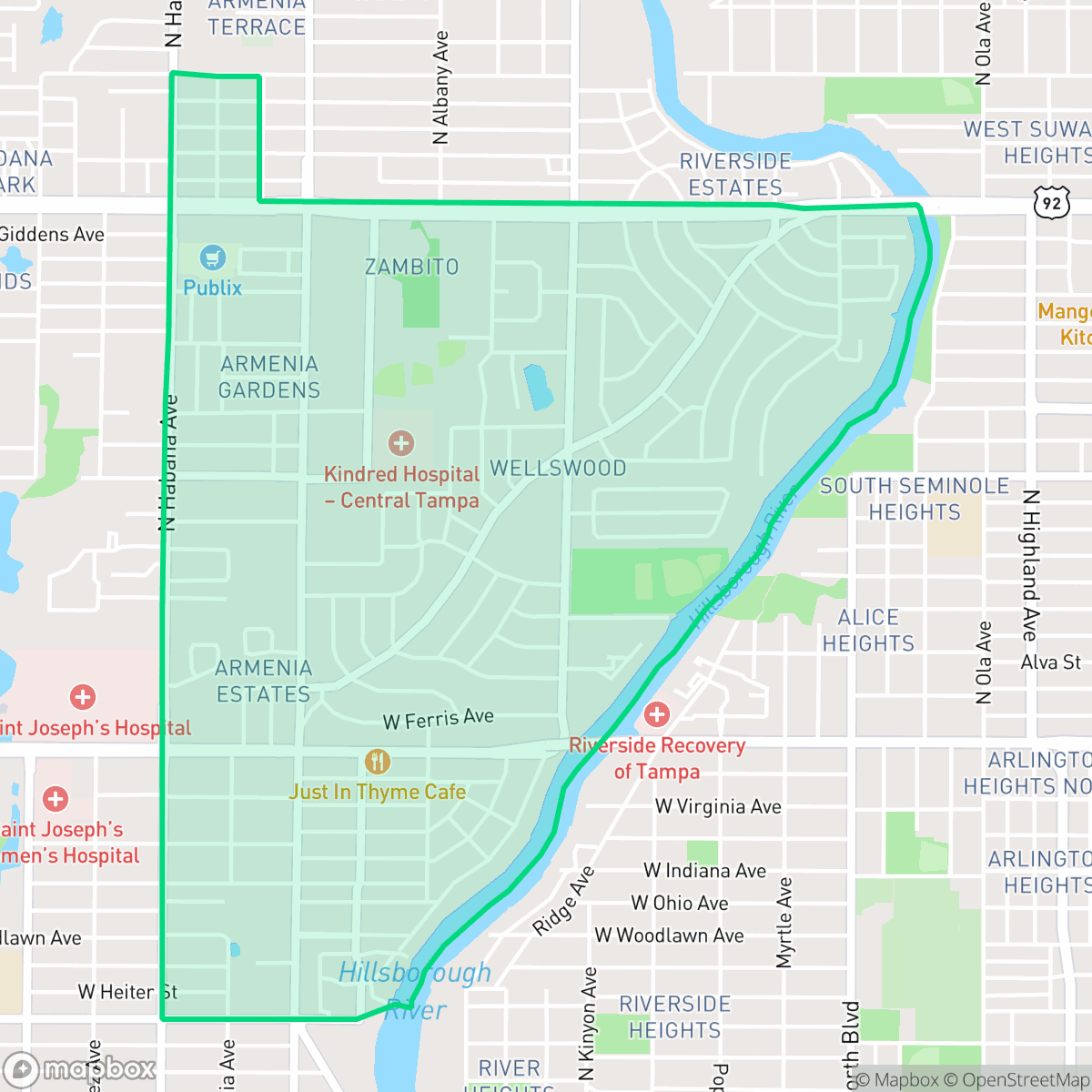
Wellswood, a historic Tampa neighborhood, was established in 1950 on a former 640-acre dairy farm owned by James F. and Edna Wells Wishart. Originally named "Wells Park," the area was rebranded as "Wellswood" to reflect its dense canopy of native pine and oak trees. Developed as one of Tampa’s first post-World War II suburbs, the neighborhood is characterized by its master-planned layout and collection of mid-century ranch-style homes. The community is anchored by the Wellswood Civic Association, which was established in 1949 and remains a focal point for neighborhood life. Bounded by the Hillsborough River to the east, the area maintains a distinct, close-knit identity with a diverse demographic heritage and a long-standing tradition of community engagement, including ongoing oral history projects that preserve its evolution from farmland to a vibrant residential enclave.
Wellswood serves as a quiet residential retreat characterized by its mature canopy of native trees and well-manicured properties. The area features a mix of single-family homes and apartment complexes, providing a balanced suburban environment that feels more spacious than many other parts of Tampa. Residents benefit from a high degree of health insurance coverage and a notably low presence of industrial activity, which contributes to a stable and comfortable living experience. Prospective residents should consider certain environmental trade-offs, as the area experiences higher levels of traffic noise and air quality challenges due to nearby major roadways. While the community is moderately walkable, the presence of these transit corridors can create barriers for pedestrians. This neighborhood is well-suited for those who value a multi-generational mix of neighbors and a steady, predictable rhythm of life, provided they are comfortable with the acoustic and environmental realities of a suburban location near central transit hubs.
Neighborhood Scores Across 15 Qualities
Housing spacing varies from clustered apartment complexes to detached single-family homes with standard suburban setbacks. According to iHuus data, this level of separation provides more personal buffer than the typical density found across Tampa.
A comprehensive sidewalk network exists along main arterials and through most residential blocks, making the area more walkable than many parts of Tampa. While mature tree canopy often obscures paths, low-traffic streets and safe crossings support pedestrian movement, though major roads and canals can act as barriers.
Large riverside estates and well-manicured properties with private pools contribute to a visual landscape that is more attractive than the Tampa average. According to iHuus data, this area features notable pockets of affluence alongside standard suburban residential layouts.
Large public parks and residential yards provide sufficient space for pets, though opportunities for off-leash exercise are consistent with the Tampa average. Sidewalks often feature green verges that accommodate walking, but access to open green spaces varies by specific street.
Residential streets feature a mix of single-family homes and apartment complexes set within a dense suburban landscape. This area maintains a slightly higher degree of open land and greenery compared to the typical urban density found in Tampa.
Local activity levels are more active than the Tampa average, offering a balanced mix of residential life and steady access to dining and wellness services. Depending on the specific block, the atmosphere ranges from subdued residential streets to lively neighborhood hubs near transit and civic centers.
Frequent noise from nearby major roadways and transit corridors persists throughout the area. According to iHuus data, acoustic levels in Wellswood are higher than the Tampa average.
Frequent unhealthy air quality levels pose a significant risk to sensitive groups. According to iHuus data, the air quality in Wellswood is worse than the Tampa city average.
Industrial activity is notably lower than the Tampa average, as the area consists primarily of residential streets and light retail. Residents may encounter occasional heavy vehicle traffic or utility-related noise near large storage facilities and arterial roads, but no heavy industry or hazardous plants are present.
Health insurance accessibility is notably higher than the Tampa average, according to iHuus data. Most residents in this area have access to comprehensive medical coverage.
Political views in this area are split relatively evenly between conservative and liberal leanings, mirroring a distribution that is slightly more varied than the Tampa average.
Residents live alongside a diverse age range of young professionals, families, and seniors. This demographic spread is more varied than the typical profile found across Tampa.
Flood risk in this area sits slightly above the Tampa average. According to iHuus data, FEMA has not yet completed a detailed flood study for this specific location.
Address-Level Insights for Wellswood


iHuus Neighborhood Intelligence Insights
Get address-level neighborhood insights for Wellswood
- Street-level scores — see how individual blocks compare, not just neighborhood averages
- Micro-zone boundaries — identify quiet pockets, flood boundaries, and walkable clusters before you visit
- 15 dimensions in full — walkability, noise, air quality, school quality, insurance coverage, population age profile, urban/rural index, and more
- Boundary risk alerts — know if your address sits near a block boundary where scores drop, the kind of detail no listing will ever mention
- School insights — individual school ratings and insights, not just district-level data
- Compare before you commit — side-by-side data across neighborhoods, down to block precision
No credit card required
Compare with Any Neighborhood
| Dimension | Wellswood | Arbor Greene |
|---|---|---|
| 🚶 Walkabilityavg 6.08 | ||
| 🔊 Acoustic Comfortavg 2.94 | ||
| 🤫 Privacy Indexavg 5.25 | ||
| 🎨 Visual Appealavg 5.82 | ||
| 🐕 Dog Friendlinessavg 5.48 | ||
| 🗺️ Urban-Rural Indexavg 6.28 | ||
| ✨ Neighborhood Vibeavg 3.39 | ||
| 🏥 Health Insurance Coverageavg 5.93 | ||
| 🌿 Air Qualityavg 1.36 | ||
| 🏭 Industrial Proximityavg 6.63 | ||
| 🌊 Flood Safetyavg 4.98 | ||
| 🗳️ Ideological Leanavg 5.57 | ||
| 👥 Population Age Profileavg 4.16 | ||
| 🔥 Fire Safety | ||
| 🏫 School Quality |
Wellswood Rankings
School Districts Serving Wellswood
School Insights for Wellswood
Below average outcomes; significant attendance and academic challenges.
School Insights
See what's really behind every school rating near Wellswood
- Individual school ratings — each school's own score with outcome context, not just a district average
- Enrollment & class size data — student-to-teacher ratio and how it compares to the state average
- Full demographics breakdown — ethnicity and gender composition for every school in the enrollment zone
- Every school in the district — all schools within the enrollment boundary ranked by rating, not just the closest one
- Grade levels & benchmarks — elementary through high school, with below/above state-average flags
No credit card required