Terrace Park, Tampa
Updated · 20,010 residents
Terrace Park is a centrally located neighborhood defined by its proximity to the University of South Florida and major regional attractions like Busch Gardens. The area features a highly walkable grid of streets and a semi-rural aesthetic, though residents should anticipate noticeable noise from nearby traffic corridors.
Key Highlights
About Terrace Park
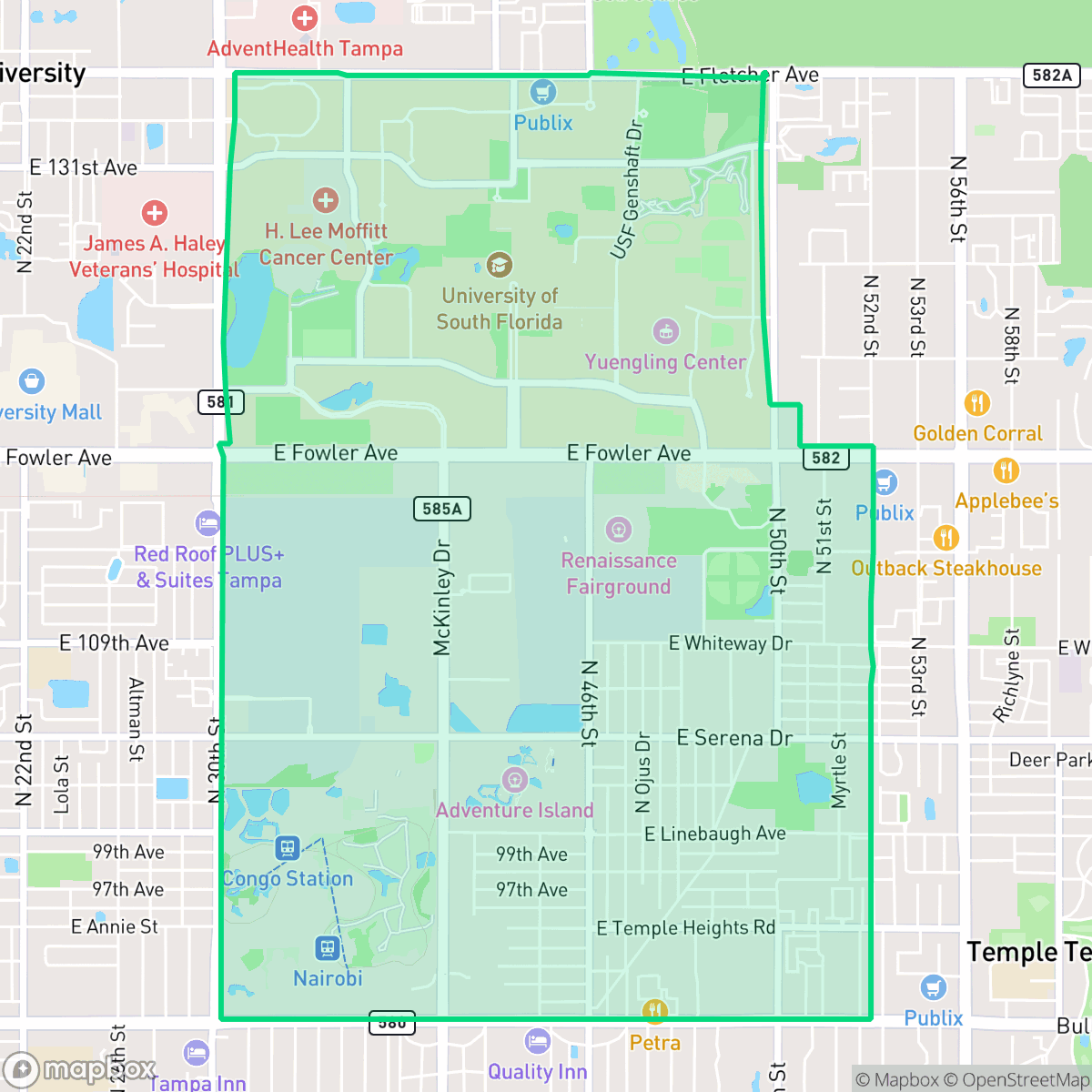
Terrace Park is a suburban neighborhood in North Tampa whose development was significantly spurred by the 1960 opening of the nearby University of South Florida. Characterized by a residential landscape of single-family bungalows primarily constructed during the 1970s, the area is defined by its proximity to major regional landmarks, including Busch Gardens Tampa Bay, Adventure Island, and the Museum of Science and Industry (MOSI). The neighborhood is bounded by the university to the north, 30th Street to the west, Busch Boulevard to the south, and the city of Temple Terrace to the east. Local character is shaped by its role as a residential hub for students and faculty, alongside the presence of the historic Yuengling Brewing Company and community-focused green spaces like Takomah Trails Park.
The neighborhood maintains a balanced urban rhythm, characterized by a mix of single-family bungalows and multi-family complexes that provide a consistent visual profile. With a strong concentration of young adults, the area functions as a residential hub for students and faculty, supported by a well-established grid of sidewalks that makes local transit and pedestrian travel highly accessible. Residents benefit from a semi-rural feel created by scattered homes and green spaces, offering a slightly less dense environment than much of the surrounding city.
Prospective residents should weigh several livability factors, including a moderate risk of flooding and the presence of a legacy industrial site that requires ongoing environmental monitoring. The area also experiences air quality levels that can be challenging for sensitive groups, and constant traffic noise from adjacent transit corridors is a common feature. Despite these trade-offs, the community is characterized by high rates of health insurance coverage and a strong liberal political leaning, reflecting a population that is highly engaged with local and regional developments.
Neighborhood Scores Across 15 Qualities
Residential spacing varies between tightly packed multi-family units and detached homes with moderate yard buffers. According to iHuus data, this level of density provides slightly more separation between neighbors than the typical Tampa area.
Pedestrian connectivity is above the city average due to a well-established grid of sidewalks and tree-lined streets. While some high-traffic arterials present challenges, most residential areas offer safe, low-speed routes for walking.
Standard tract housing and multi-family complexes define the landscape, offering a visual profile that is slightly above the city average for Tampa. The area features consistent roof geometries and modest yards alongside shared community amenities like pools.
Access to large public baseball parks, wooded areas, and retention ponds provides more opportunities for pet exercise than the city average. Many residential streets feature wide grassy verges that facilitate easy walking around the neighborhood.
Open land and wooded areas are more frequent here than in most of Tampa. Residents will find a landscape characterized by scattered homes amidst greenery, providing a slightly less dense environment than the city average.
Residents experience a steady level of activity characterized by a mix of residential life and local services, providing more vibrancy than the city average. The area offers a functional balance of dining, wellness, and transit-oriented spaces without being overly dense or quiet.
Frequent noise from nearby major roadways and transit corridors characterizes the area, though levels remain slightly above the city average. According to iHuus data, this acoustic environment may be disruptive for those sensitive to constant traffic sounds.
Frequent unhealthy air quality levels present significant risks to sensitive groups. According to iHuus data, the pollution levels in Terrace Park are worse than the Tampa average.
A blend of small businesses, such as cafes and printing services, exists alongside residential areas. While the neighborhood lacks heavy industrial zones, residents should be aware of nearby commercial activity and a legacy EPA Superfund site that requires ongoing monitoring for soil and groundwater quality.
Health insurance enrollment among residents is notably higher than the Tampa average, according to iHuus data.
Voting patterns and census indicators reflect a deeply liberal political leaning, which is significantly more pronounced than the average seen across Tampa.
Young adults represent the largest demographic in this area, with a smaller presence of families and older residents compared to the Tampa average. According to iHuus data, the community maintains a notably younger age profile than much of the city.
Flood risk in this area is slightly higher than the Tampa average, though precise details remain undetermined because a complete federal flood study has not yet been finalized for this specific location.
Address-Level Insights for Terrace Park


iHuus Neighborhood Intelligence Insights
Get address-level neighborhood insights for Terrace Park
- Street-level scores — see how individual blocks compare, not just neighborhood averages
- Micro-zone boundaries — identify quiet pockets, flood boundaries, and walkable clusters before you visit
- 15 dimensions in full — walkability, noise, air quality, school quality, insurance coverage, population age profile, urban/rural index, and more
- Boundary risk alerts — know if your address sits near a block boundary where scores drop, the kind of detail no listing will ever mention
- School insights — individual school ratings and insights, not just district-level data
- Compare before you commit — side-by-side data across neighborhoods, down to block precision
No credit card required
Compare with Any Neighborhood
| Dimension | Terrace Park | Arbor Greene |
|---|---|---|
| 🚶 Walkabilityavg 6.08 | ||
| 🔊 Acoustic Comfortavg 2.94 | ||
| 🤫 Privacy Indexavg 5.25 | ||
| 🎨 Visual Appealavg 5.82 | ||
| 🐕 Dog Friendlinessavg 5.48 | ||
| 🗺️ Urban-Rural Indexavg 6.28 | ||
| ✨ Neighborhood Vibeavg 3.39 | ||
| 🏥 Health Insurance Coverageavg 5.93 | ||
| 🌿 Air Qualityavg 1.36 | ||
| 🏭 Industrial Proximityavg 6.63 | ||
| 🌊 Flood Safetyavg 4.98 | ||
| 🗳️ Ideological Leanavg 5.57 | ||
| 👥 Population Age Profileavg 4.16 | ||
| 🔥 Fire Safety | ||
| 🏫 School Quality |
Terrace Park Rankings
School Districts Serving Terrace Park
School Insights for Terrace Park
Below average outcomes; significant attendance and academic challenges.
School Insights
See what's really behind every school rating near Terrace Park
- Individual school ratings — each school's own score with outcome context, not just a district average
- Enrollment & class size data — student-to-teacher ratio and how it compares to the state average
- Full demographics breakdown — ethnicity and gender composition for every school in the enrollment zone
- Every school in the district — all schools within the enrollment boundary ranked by rating, not just the closest one
- Grade levels & benchmarks — elementary through high school, with below/above state-average flags
No credit card required