Temple Crest, Tampa
Updated · 9,116 residents
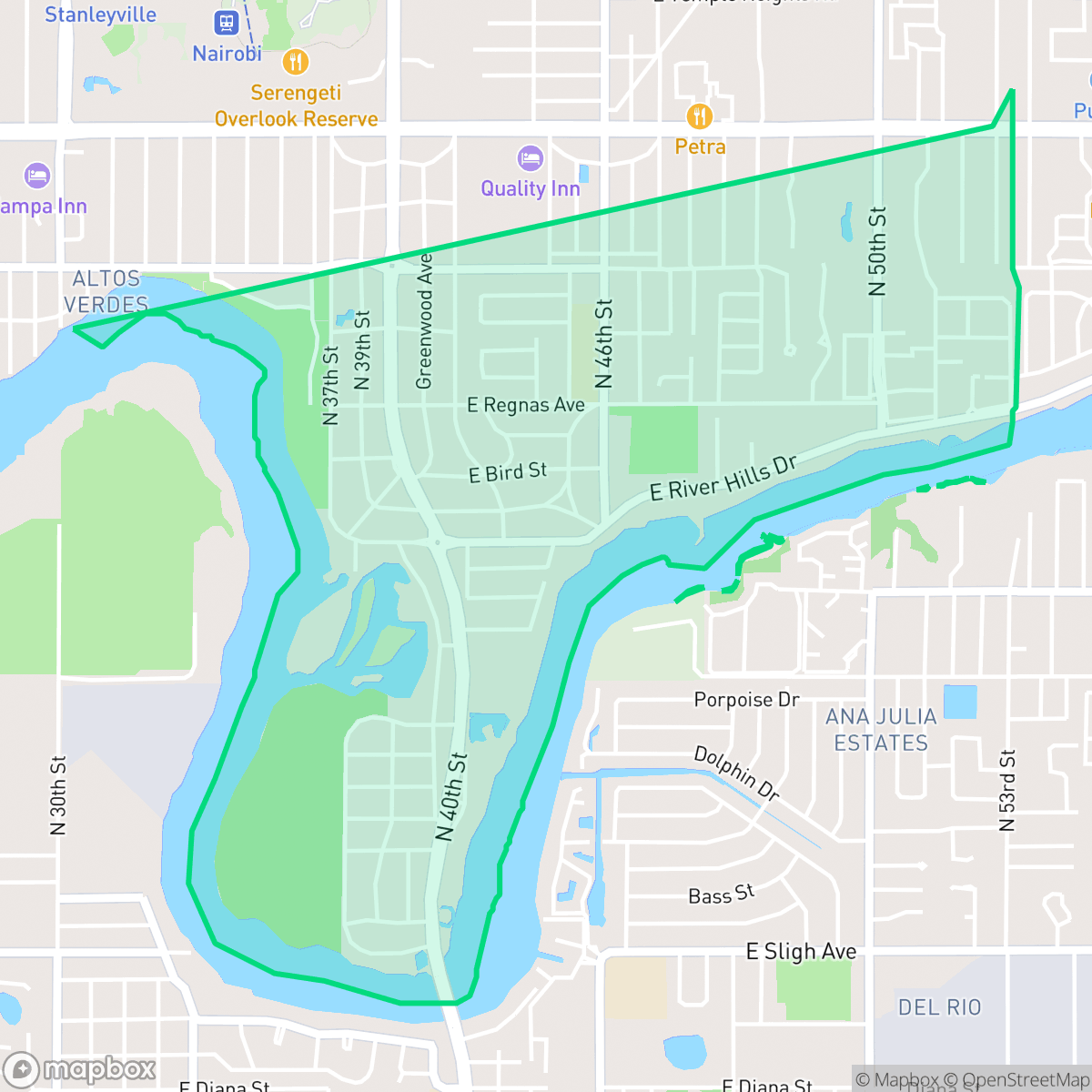
Temple Crest is a culturally diverse neighborhood in Northeast Tampa known for its semi-rural character and proximity to the Hillsborough River. Residents enjoy a quiet, residential atmosphere with more private spacing than typical city areas, though the neighborhood experiences notable noise from nearby transit and industry.
Key Highlights
About Temple Crest
Temple Crest, located in Northeast Tampa, was originally part of Bertha Potter Palmer’s expansive Riverhills Ranch and later developed on land once dedicated to Temple Orange groves. Named in 1924 following its sale to the Florida Realty and Mortgage Company, the area was initially envisioned as a luxury development. The neighborhood, which remained unincorporated until its 1961 annexation into Tampa, is bordered by the Hillsborough River, where remnants of an 1897 electrical dam—famously dynamited by local cattle barons—can still be found during low water. Today, Temple Crest is recognized for its cultural diversity, particularly its significant Jamaican and Haitian communities, and its proximity to major regional landmarks like Busch Gardens.
The neighborhood offers a distinct semi-rural environment characterized by scattered woodland and modest single-family homes, providing more privacy than many denser parts of the city. While the streets are generally quiet and suitable for local walking, the lack of consistent pedestrian infrastructure along major roads can limit mobility for those without a vehicle. The area maintains a diverse demographic mix, fostering a strong sense of community that aligns with progressive ideological trends.
Prospective residents should consider that the area faces environmental trade-offs, including air quality concerns and higher-than-average noise levels from nearby rail lines and commercial activity. While the neighborhood provides a peaceful retreat from the urban core, it is located within a flood-sensitive zone where residents should monitor local development closely. Families will find themselves within the Hillsborough County School District, which offers a range of academic environments, though buyers should research specific school boundaries due to the variance in performance across the district.
Neighborhood Scores Across 15 Qualities
Residential spacing varies between dense apartment clusters and single-family homes with mature tree buffers. This level of privacy is higher than the typical Tampa average due to more consistent separation between structures.
Low-traffic residential streets provide a calm environment for walking, though the lack of consistent sidewalks and pedestrian buffers on major arterials makes navigation near main roads difficult. According to iHuus data, overall walkability in this area is roughly comparable to the Tampa average.
Residential scenery consists primarily of modest tract housing and apartment complexes with small yards. According to iHuus data, the area offers slightly more visual variety than the typical Tampa neighborhood due to the presence of scattered private and communal pools.
Green verges and proximity to river-adjacent spaces provide decent walking opportunities, though the availability of public parks is slightly above the Tampa average. Many residential areas rely more on private fenced yards than accessible public greenery.
Open land and scattered greenery provide a more spread out environment than the typical Tampa cityscape. Residents will find a landscape of single-family homes and pockets of woodland that feels less dense than the city average.
Local activity levels are slightly above the city average, though most areas remain calm and suburban with sparse commercial density. While some pockets near transit hubs offer lively dining and entertainment, much of the neighborhood is characterized by a low-key, residential atmosphere.
Frequent noise from nearby railroad tracks and heavy freeway traffic characterizes this area. According to iHuus data, acoustic levels are slightly higher than the Tampa average.
Frequent unhealthy air quality levels pose a significant risk to sensitive groups. According to iHuus data, the pollution levels in Temple Crest are notably worse than the Tampa average.
Occasional light commercial activity and utility-related traffic are present, though the area lacks the heavy industrial density found in some other parts of Tampa. Residents should be aware of localized environmental remediation efforts and moderate noise from nearby mechanical structures at an adjacent amusement park.
Health insurance accessibility in Temple Crest aligns with the typical levels found across Tampa. According to iHuus data, coverage rates for residents are consistent with the city average.
Voting patterns and census indicators show a notably liberal political leaning, which is significantly more progressive than the Tampa average according to iHuus data.
Residents experience a varied demographic mix of young adults, families, and seniors. According to iHuus data, this age distribution is more balanced than the city average.
Flood risk in this area is higher than the Tampa average, though current FEMA studies for the neighborhood remain incomplete. Residents should exercise caution as official detailed flood mapping has not yet been finalized for this specific location.
Address-Level Insights for Temple Crest


iHuus Neighborhood Intelligence Insights
Get address-level neighborhood insights for Temple Crest
- Street-level scores — see how individual blocks compare, not just neighborhood averages
- Micro-zone boundaries — identify quiet pockets, flood boundaries, and walkable clusters before you visit
- 15 dimensions in full — walkability, noise, air quality, school quality, insurance coverage, population age profile, urban/rural index, and more
- Boundary risk alerts — know if your address sits near a block boundary where scores drop, the kind of detail no listing will ever mention
- School insights — individual school ratings and insights, not just district-level data
- Compare before you commit — side-by-side data across neighborhoods, down to block precision
No credit card required
Compare with Any Neighborhood
| Dimension | Temple Crest | Arbor Greene |
|---|---|---|
| 🚶 Walkabilityavg 6.08 | ||
| 🔊 Acoustic Comfortavg 2.94 | ||
| 🤫 Privacy Indexavg 5.25 | ||
| 🎨 Visual Appealavg 5.82 | ||
| 🐕 Dog Friendlinessavg 5.48 | ||
| 🗺️ Urban-Rural Indexavg 6.28 | ||
| ✨ Neighborhood Vibeavg 3.39 | ||
| 🏥 Health Insurance Coverageavg 5.93 | ||
| 🌿 Air Qualityavg 1.36 | ||
| 🏭 Industrial Proximityavg 6.63 | ||
| 🌊 Flood Safetyavg 4.98 | ||
| 🗳️ Ideological Leanavg 5.57 | ||
| 👥 Population Age Profileavg 4.16 | ||
| 🔥 Fire Safety | ||
| 🏫 School Quality |
Temple Crest Rankings
School Districts Serving Temple Crest
School Insights for Temple Crest
Below average outcomes; significant attendance and academic challenges.
School Insights
See what's really behind every school rating near Temple Crest
- Individual school ratings — each school's own score with outcome context, not just a district average
- Enrollment & class size data — student-to-teacher ratio and how it compares to the state average
- Full demographics breakdown — ethnicity and gender composition for every school in the enrollment zone
- Every school in the district — all schools within the enrollment boundary ranked by rating, not just the closest one
- Grade levels & benchmarks — elementary through high school, with below/above state-average flags
No credit card required