Tampa Palms, Tampa
Updated · 19,614 residents
Tampa Palms is a quiet, master-planned community in New Tampa characterized by extensive woodland buffers and a focus on suburban greenery. While the area offers a peaceful, residential atmosphere popular with young adults, residents often face challenges with high noise levels from nearby transit routes and limited pedestrian connectivity to commercial centers.
Key Highlights
About Tampa Palms
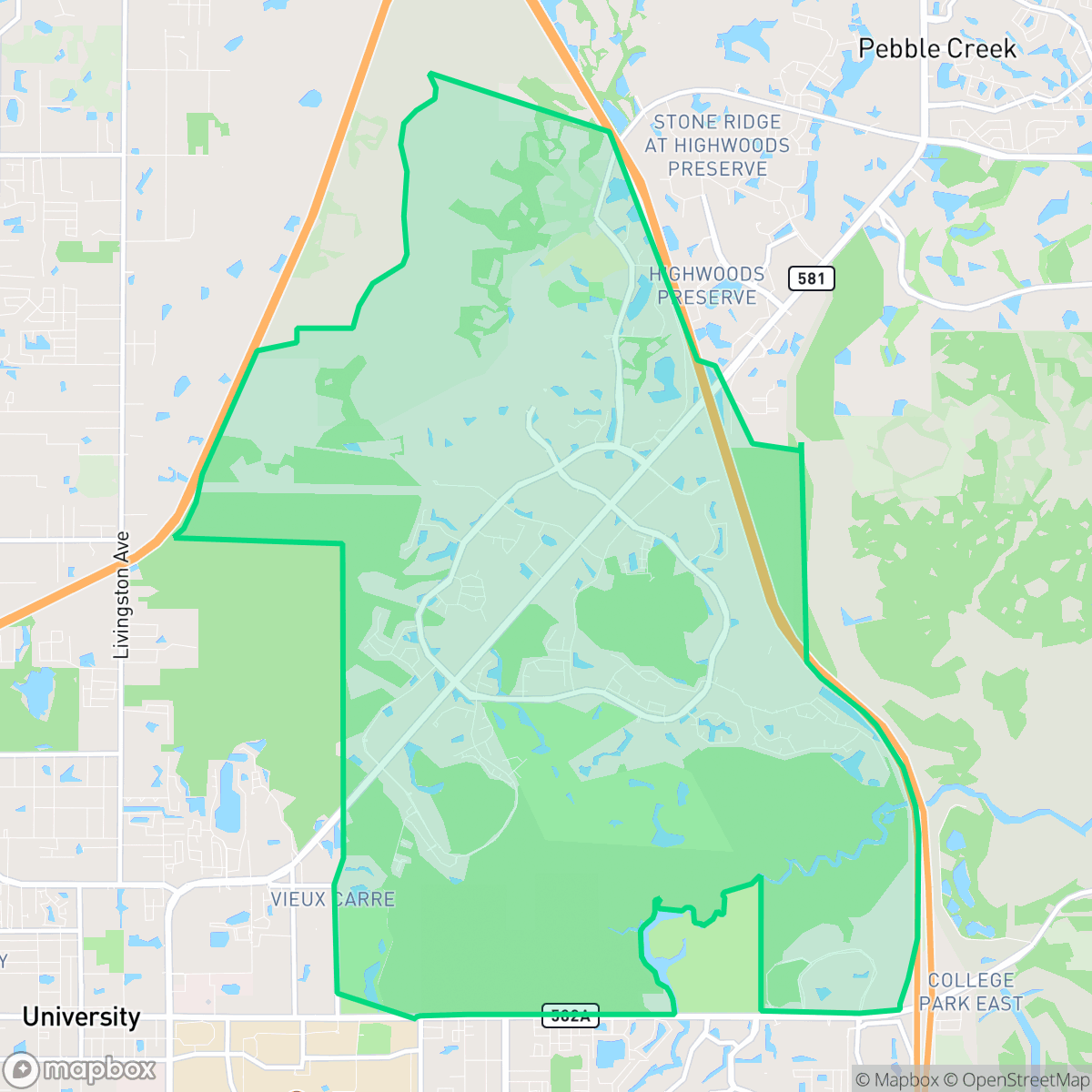
Tampa Palms is a prominent master-planned community in Tampa’s New Tampa district, developed in the 1980s on over 4,000 acres of former rural land along the Hillsborough River. Designed by the firm Post, Buckley, Schuh & Jernigan, the neighborhood was engineered to integrate residential villages with extensive natural conservation areas and wetlands. Its development gained national recognition in 1987 when it was named the 'top master-planned community in the U.S.' by the National Association of Home Builders and received the Aurora Award. The community is characterized by its distinct gated villages, wide spine roads like the 120-foot Tampa Palms Boulevard, and a focus on environmental preservation. It serves as a defining example of late 20th-century suburban expansion in Florida, blending residential, commercial, and recreational spaces, including the Arthur Hills-designed Tampa Palms Golf & Country Club.
The area functions as a low-key residential enclave that prioritizes natural space, featuring significant forested buffers and manicured landscapes. It maintains a distinct identity through its gated villages and proximity to the Hillsborough River, which contribute to a suburban environment that feels removed from the density of central Tampa. The demographic profile leans toward young adults, supported by high levels of local health insurance coverage.
Prospective residents should consider the trade-offs of living in this suburban setting. While the abundance of greenery and golf course access makes the neighborhood well-suited for dog owners, the area experiences frequent noise disturbances from major arterial roads. Additionally, the local air quality is a notable concern, and the disconnected nature of the street layout requires reliance on vehicles for most daily needs. While the Hillsborough County School District provides access to various public campuses, the educational landscape remains varied in quality across the broader region.
Neighborhood Scores Across 15 Qualities
Residential density varies between clustered multi-family complexes and more spaced single-family homes, though significant woodland buffers often separate different developments. This layout provides a level of privacy that is roughly in line with the Tampa average.
Residential streets offer calm environments for walking, though major arterial roads lack safe crossings and create barriers to reaching nearby commercial areas. This level of pedestrian connectivity is slightly lower than the Tampa average according to iHuus data.
Standard suburban architecture and manicured lawns characterize this area, which offers a visual profile very similar to the Tampa average. Residents will find a mix of established single-family homes with private pools alongside organized multi-family residential complexes.
Abundant wooded buffers, golf course greenery, and wide grass verges provide extensive space for pet owners. This level of access to natural walking paths is higher than the Tampa average according to iHuus data.
Significant portions of the area consist of preserved woodlands and large forested buffers. This layout provides more open space and natural greenery than the typical Tampa urban landscape.
Limited commercial activity and few local points of interest create a very low-key atmosphere. This area offers much less bustle than the typical Tampa neighborhood, making it ideal for those seeking a peaceful environment away from urban activity.
Frequent disturbances from nearby major roadways and transit routes characterize the area. According to iHuus data, acoustic comfort in this neighborhood is notably lower than the Tampa average.
Consistently hazardous air quality levels present serious health risks for residents. According to iHuus data, these readings are significantly worse than the average seen across Tampa.
Industrial presence is minimal, consisting mostly of light commercial services and retail without heavy industrial hazards. While the area is largely residential, iHuus data notes a nearby Superfund site that may present environmental considerations for the surrounding soil or groundwater.
Health insurance accessibility is notably higher in this area than the Tampa average, according to iHuus data.
Political perspectives in this area are relatively balanced, showing a slightly more even split between conservative and liberal leanings than the broader Tampa average.
A majority of residents are young adults, representing a younger demographic than the broader Tampa area. According to iHuus data, there is a relatively small presence of older residents or established families in this neighborhood.
Flood risk in this area is slightly above the Tampa average, though a lack of detailed FEMA studies means specific risk levels remain undetermined. Residents should monitor local updates as definitive flood studies for this area are not yet complete.
Address-Level Insights for Tampa Palms


iHuus Neighborhood Intelligence Insights
Get address-level neighborhood insights for Tampa Palms
- Street-level scores — see how individual blocks compare, not just neighborhood averages
- Micro-zone boundaries — identify quiet pockets, flood boundaries, and walkable clusters before you visit
- 15 dimensions in full — walkability, noise, air quality, school quality, insurance coverage, population age profile, urban/rural index, and more
- Boundary risk alerts — know if your address sits near a block boundary where scores drop, the kind of detail no listing will ever mention
- School insights — individual school ratings and insights, not just district-level data
- Compare before you commit — side-by-side data across neighborhoods, down to block precision
No credit card required
Compare with Any Neighborhood
| Dimension | Tampa Palms | Arbor Greene |
|---|---|---|
| 🚶 Walkabilityavg 6.08 | ||
| 🔊 Acoustic Comfortavg 2.94 | ||
| 🤫 Privacy Indexavg 5.25 | ||
| 🎨 Visual Appealavg 5.82 | ||
| 🐕 Dog Friendlinessavg 5.48 | ||
| 🗺️ Urban-Rural Indexavg 6.28 | ||
| ✨ Neighborhood Vibeavg 3.39 | ||
| 🏥 Health Insurance Coverageavg 5.93 | ||
| 🌿 Air Qualityavg 1.36 | ||
| 🏭 Industrial Proximityavg 6.63 | ||
| 🌊 Flood Safetyavg 4.98 | ||
| 🗳️ Ideological Leanavg 5.57 | ||
| 👥 Population Age Profileavg 4.16 | ||
| 🔥 Fire Safety | ||
| 🏫 School Quality |
Tampa Palms Rankings
School Districts Serving Tampa Palms
School Insights for Tampa Palms
Below average outcomes; significant attendance and academic challenges.
School Insights
See what's really behind every school rating near Tampa Palms
- Individual school ratings — each school's own score with outcome context, not just a district average
- Enrollment & class size data — student-to-teacher ratio and how it compares to the state average
- Full demographics breakdown — ethnicity and gender composition for every school in the enrollment zone
- Every school in the district — all schools within the enrollment boundary ranked by rating, not just the closest one
- Grade levels & benchmarks — elementary through high school, with below/above state-average flags
No credit card required