Tampa International Airport Area, Tampa
Updated · 2,978 residents
The Tampa International Airport Area serves as a primary transit and commercial gateway characterized by its proximity to aviation infrastructure and dense, car-dependent development. Residents experience significant noise from flight traffic and limited pedestrian access, making this a functional district best suited for those requiring frequent travel access.
Key Highlights
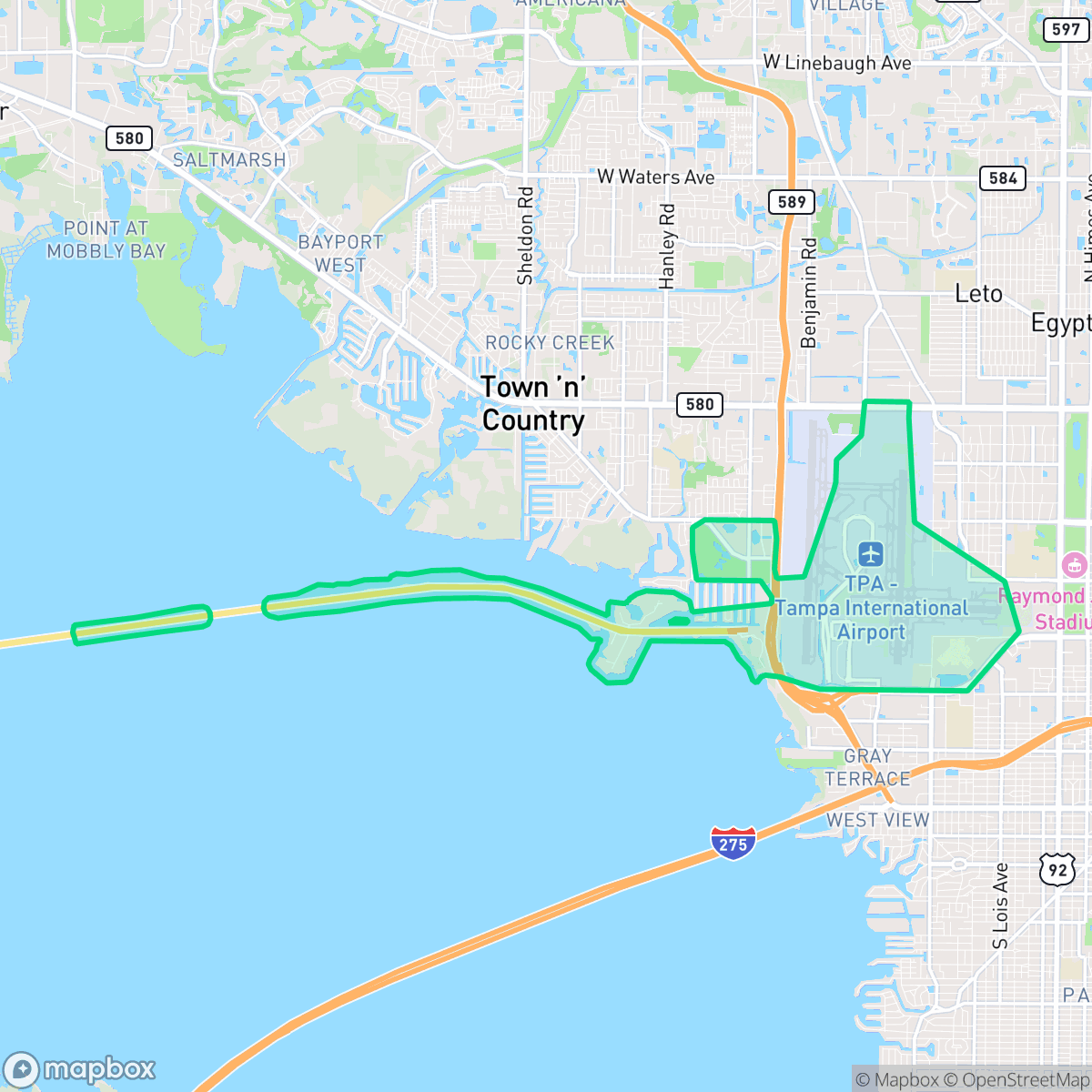
About Tampa International Airport Area
The Tampa International Airport area is historically rooted in the development of Drew Field, which opened in the 1930s and served as a significant U.S. Army Air Forces base during World War II. Following the war, the site transitioned into a commercial aviation hub. The neighborhood’s character was fundamentally transformed by the 1971 opening of the airport’s current terminal complex, designed by Leigh Fisher; this facility was widely praised for its innovative landside-airside configuration, which influenced airport design globally. Surrounding the airport, the area developed into a major commercial and hospitality corridor, serving as a primary gateway for the city. While primarily defined by its aviation infrastructure, the district remains a critical economic engine for Tampa, reflecting the evolution from a military installation to a modern, passenger-centric transit hub.
This district functions as a vital economic engine for the region, defined by its concentration of hotels, logistics centers, and commercial hubs. The landscape is primarily composed of compact residential pockets and sprawling office complexes, creating a low-density suburban environment that prioritizes transit connectivity over traditional neighborhood amenities.
Prospective residents should account for specific environmental factors, including high levels of aircraft noise and poor air quality. The area faces challenges with walkability due to fragmented paths and heavy traffic, and the local geography carries a notable risk of flooding. While the population skews toward young adults, the lack of extensive green space and pet-friendly infrastructure suggests the area is less suited for families or those seeking an active outdoor lifestyle. Educational needs are supported by the Hillsborough County School District, though families should research specific school performance as the district maintains a diverse range of academic outcomes.
Neighborhood Scores Across 15 Qualities
Residential lots are notably tight with limited separation between structures, placing the area well below the Tampa average for privacy. According to iHuus data, much of the housing consists of closely packed homes and dense apartment blocks.
Pedestrian movement is significantly more challenging here than in the rest of Tampa due to major arterials and large parking lots. While some residential streets feature sidewalks, heavy traffic and fragmented paths make navigating the area on foot uncomfortable.
Landscape variety is limited by high-density housing, corporate offices, and industrial tracts. This area lacks the greenery and aesthetic diversity found across much of the wider Tampa area.
Sparse greenery and narrow verges make for limited walking options, which is significantly below the city average. While nearby sports complexes and waterfront lawns offer some space for exercise, the area lacks dedicated dog parks or extensive trails.
Sprawling suburban landscapes and large commercial blocks define this area, which features a much lower level of urban density than the rest of Tampa. According to iHuus data, the terrain is primarily composed of single-family homes and expansive sports or commercial complexes.
Limited commercial activity and sparse points of interest create a subdued atmosphere that is less active than the city average. Most residents will find this area primarily residential, with much of the landscape being car-dependent due to the lack of local amenities.
Constant noise from nearby airport runways and heavy flight traffic makes this area significantly louder than the Tampa average. According to iHuus data, residents will experience frequent interruptions from ascending and descending aircraft.
Air quality levels in this area are consistently dangerous and pose serious health risks. According to iHuus data, these readings remain worse than the average for the city of Tampa.
Heavy industrial activity is significantly lower than the city average, as the area primarily consists of residential pockets, retail spaces, and light commercial hubs. While some logistics warehouses and highway corridors introduce moderate traffic and intermittent loading noise, there are no heavy industrial hazards present.
Health insurance accessibility is significantly lower than the Tampa average. According to iHuus data, a small portion of the local population possesses health coverage.
Political leanings in this area are significantly more conservative than the Tampa average, according to iHuus data.
Young adults comprise the majority of the population here, representing a significantly younger demographic than the Tampa city average. According to iHuus data, there is only a modest presence of families or older residents in this area.
Significant flood vulnerability exists in this area as it sits within a designated floodplain. This risk is substantially higher than the average for Tampa, and residents should expect that flood insurance will likely be a requirement.
Address-Level Insights for Tampa International Airport Area


iHuus Neighborhood Intelligence Insights
Get address-level neighborhood insights for Tampa International Airport Area
- Street-level scores — see how individual blocks compare, not just neighborhood averages
- Micro-zone boundaries — identify quiet pockets, flood boundaries, and walkable clusters before you visit
- 15 dimensions in full — walkability, noise, air quality, school quality, insurance coverage, population age profile, urban/rural index, and more
- Boundary risk alerts — know if your address sits near a block boundary where scores drop, the kind of detail no listing will ever mention
- School insights — individual school ratings and insights, not just district-level data
- Compare before you commit — side-by-side data across neighborhoods, down to block precision
No credit card required
Compare with Any Neighborhood
| Dimension | Tampa International Airport Area | Arbor Greene |
|---|---|---|
| 🚶 Walkabilityavg 6.08 | ||
| 🔊 Acoustic Comfortavg 2.94 | ||
| 🤫 Privacy Indexavg 5.25 | ||
| 🎨 Visual Appealavg 5.82 | ||
| 🐕 Dog Friendlinessavg 5.48 | ||
| 🗺️ Urban-Rural Indexavg 6.28 | ||
| ✨ Neighborhood Vibeavg 3.39 | ||
| 🏥 Health Insurance Coverageavg 5.93 | ||
| 🌿 Air Qualityavg 1.36 | ||
| 🏭 Industrial Proximityavg 6.63 | ||
| 🌊 Flood Safetyavg 4.98 | ||
| 🗳️ Ideological Leanavg 5.57 | ||
| 👥 Population Age Profileavg 4.16 | ||
| 🔥 Fire Safety | ||
| 🏫 School Quality |
Tampa International Airport Area Rankings
School Districts Serving Tampa International Airport Area
School Insights for Tampa International Airport Area
Below average outcomes; significant attendance and academic challenges.
School Insights
See what's really behind every school rating near Tampa International Airport Area
- Individual school ratings — each school's own score with outcome context, not just a district average
- Enrollment & class size data — student-to-teacher ratio and how it compares to the state average
- Full demographics breakdown — ethnicity and gender composition for every school in the enrollment zone
- Every school in the district — all schools within the enrollment boundary ranked by rating, not just the closest one
- Grade levels & benchmarks — elementary through high school, with below/above state-average flags
No credit card required