Tampa Heights, Tampa
Updated · 8,549 residents
Tampa Heights is a vibrant, historically significant neighborhood known for its lively dining scene and proximity to the Armature Works. While it offers a walkable urban environment with diverse housing, residents should expect notable noise from nearby rail and traffic, as well as occasional air quality challenges.
Key Highlights
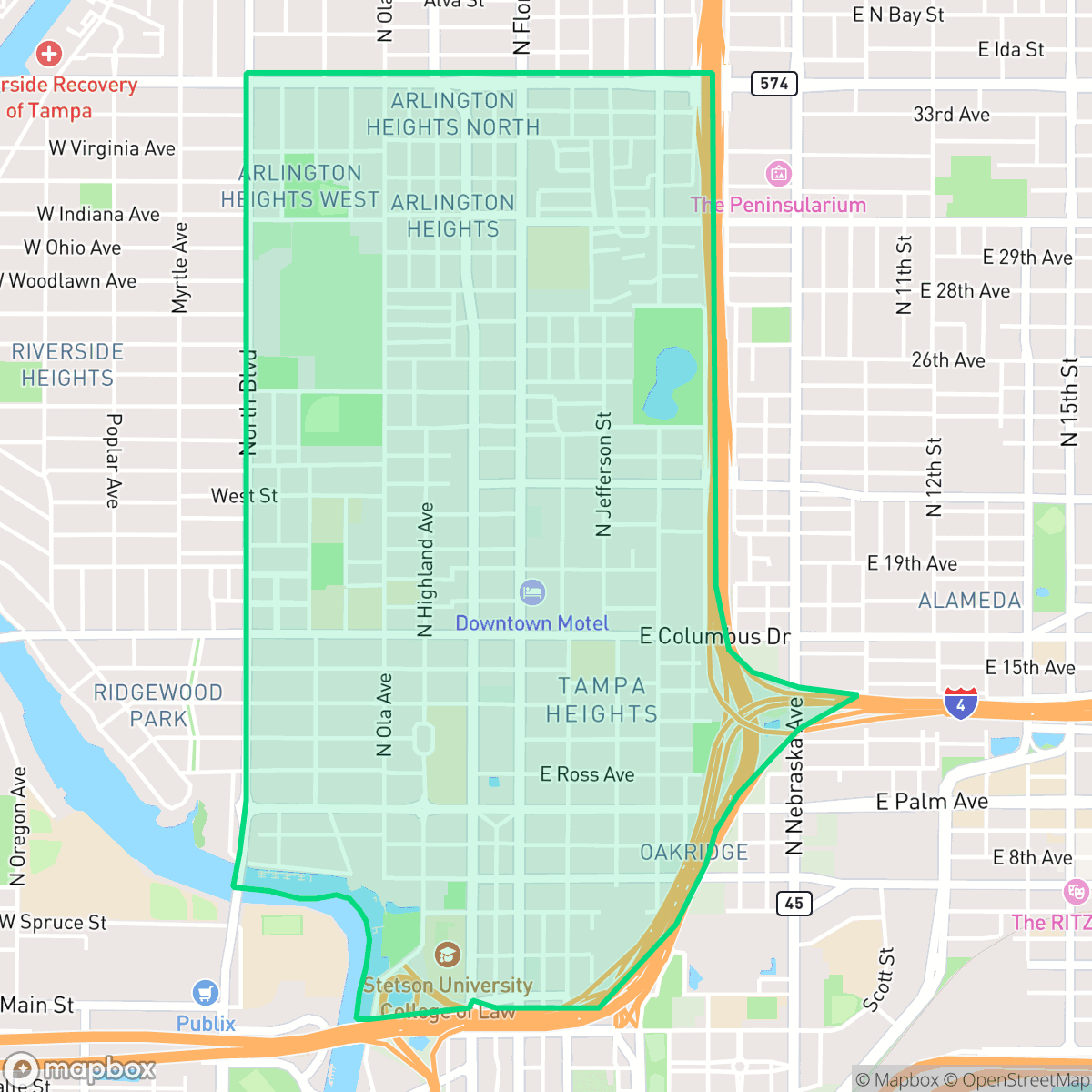
About Tampa Heights
Established in the early 1880s as Tampa’s first residential suburb, Tampa Heights was developed on elevated land north of downtown, which residents sought as a healthier environment during the 1887 yellow fever epidemic. Originally named the “Highlands,” the area became a prestigious enclave for the city’s elite, featuring Victorian, Craftsman, and vernacular architectural styles. Its historical significance is anchored by its role as a strategic military staging ground during the 1898 Spanish-American War, where units including the Rough Riders encamped. Listed on the National Register of Historic Places in 1995, the neighborhood remains defined by its historic churches, tree-lined streets, and the repurposed industrial landmark Armature Works. Despite mid-20th-century decline, the area has undergone a significant cultural and economic revitalization, blending its preserved heritage with modern urban development.
The area serves as a high-energy hub characterized by a dense cluster of restaurants, breweries, and social landmarks that contribute to its distinct urban vitality. The streetscape features a varied mix of residential housing, ranging from modest, uniform homes to larger properties along the river, creating a balanced urban atmosphere. Residents benefit from good access to health insurance and a community that reflects a strongly liberal demographic, fostering a social environment that attracts a diverse mix of young professionals, families, and seniors according to iHuus data.
Living here involves certain trade-offs, particularly regarding environmental and acoustic factors. Frequent disturbances from heavy traffic and railroad tracks create a noisy atmosphere, and residents may experience periods of poor air quality. While the neighborhood is moderately walkable, highway interchanges and large parking lots can interrupt pedestrian connectivity. Prospective residents should also consider the moderate flood risk in the area and the broader educational landscape of the Hillsborough County School District, which provides access to notable flagship programs while navigating disparities between urban and suburban campuses.
Neighborhood Scores Across 15 Qualities
Residential spacing varies from closely packed multi-family units to detached houses with moderate setbacks. This density levels out to be roughly in line with the Tampa average, according to iHuus data.
Pedestrian movement is possible via a dense grid of sidewalks and tree-lined streets, though major highway interchanges and high-traffic arterials create significant barriers to connectivity. This level of walkability is higher than the Tampa average, despite interruptions caused by large parking lots and heavy traffic flows.
Residential streetscapes feature a mix of modest, uniform housing and larger riverside properties. This variety in lot size and architectural style is roughly in line with the average across Tampa.
Access to public parks and wide walking verges varies by street, though overall opportunities for pet exercise are slightly above the city average. While some areas feature large green spaces and tracks, other residential pockets have narrow sidewalks and rely primarily on private yards.
A blend of residential grids and commercial corridors provides a suburban feel with an even distribution of greenery and built structures. This density is slightly lower than the city average, offering more tree canopy alongside major transit routes.
Significant activity and a diverse selection of dining and nightlife options make this area considerably more lively than the Tampa average. According to iHuus data, the neighborhood functions as a high-energy hub with dense clusters of restaurants, breweries, and social landmarks.
Frequent disturbances from nearby railroad tracks and heavy traffic are common in this area. According to iHuus data, the level of acoustic disruption is consistent with the city average.
Frequent unhealthy air quality levels pose a significant risk to sensitive groups. According to iHuus data, conditions in this area are worse than the Tampa average.
Heavy industrial activity is largely absent from the area, providing a cleaner environment than much of Tampa. While some residents may experience noise or traffic near the highway interchange and utility substations, the neighborhood remains primarily residential and light commercial.
Health insurance coverage among residents is higher than the Tampa average, according to iHuus data. This level of coverage indicates a relatively stable access to medical services for the local population.
Voting patterns and census indicators show a much more liberal leaning than the Tampa average, according to iHuus data.
Residents live alongside a balanced mix of young professionals, families, and seniors. According to iHuus data, the demographic spread is more varied than in many other parts of Tampa.
Flood risk in this area is higher than the Tampa average, though FEMA has not yet completed a detailed study for this specific location.
Address-Level Insights for Tampa Heights


iHuus Neighborhood Intelligence Insights
Get address-level neighborhood insights for Tampa Heights
- Street-level scores — see how individual blocks compare, not just neighborhood averages
- Micro-zone boundaries — identify quiet pockets, flood boundaries, and walkable clusters before you visit
- 15 dimensions in full — walkability, noise, air quality, school quality, insurance coverage, population age profile, urban/rural index, and more
- Boundary risk alerts — know if your address sits near a block boundary where scores drop, the kind of detail no listing will ever mention
- School insights — individual school ratings and insights, not just district-level data
- Compare before you commit — side-by-side data across neighborhoods, down to block precision
No credit card required
Compare with Any Neighborhood
| Dimension | Tampa Heights | Arbor Greene |
|---|---|---|
| 🚶 Walkabilityavg 6.08 | ||
| 🔊 Acoustic Comfortavg 2.94 | ||
| 🤫 Privacy Indexavg 5.25 | ||
| 🎨 Visual Appealavg 5.82 | ||
| 🐕 Dog Friendlinessavg 5.48 | ||
| 🗺️ Urban-Rural Indexavg 6.28 | ||
| ✨ Neighborhood Vibeavg 3.39 | ||
| 🏥 Health Insurance Coverageavg 5.93 | ||
| 🌿 Air Qualityavg 1.36 | ||
| 🏭 Industrial Proximityavg 6.63 | ||
| 🌊 Flood Safetyavg 4.98 | ||
| 🗳️ Ideological Leanavg 5.57 | ||
| 👥 Population Age Profileavg 4.16 | ||
| 🔥 Fire Safety | ||
| 🏫 School Quality |
Tampa Heights Rankings
School Districts Serving Tampa Heights
School Insights for Tampa Heights
Below average outcomes; significant attendance and academic challenges.
School Insights
See what's really behind every school rating near Tampa Heights
- Individual school ratings — each school's own score with outcome context, not just a district average
- Enrollment & class size data — student-to-teacher ratio and how it compares to the state average
- Full demographics breakdown — ethnicity and gender composition for every school in the enrollment zone
- Every school in the district — all schools within the enrollment boundary ranked by rating, not just the closest one
- Grade levels & benchmarks — elementary through high school, with below/above state-average flags
No credit card required