Sulphur Springs, Tampa
Updated · 7,699 residents
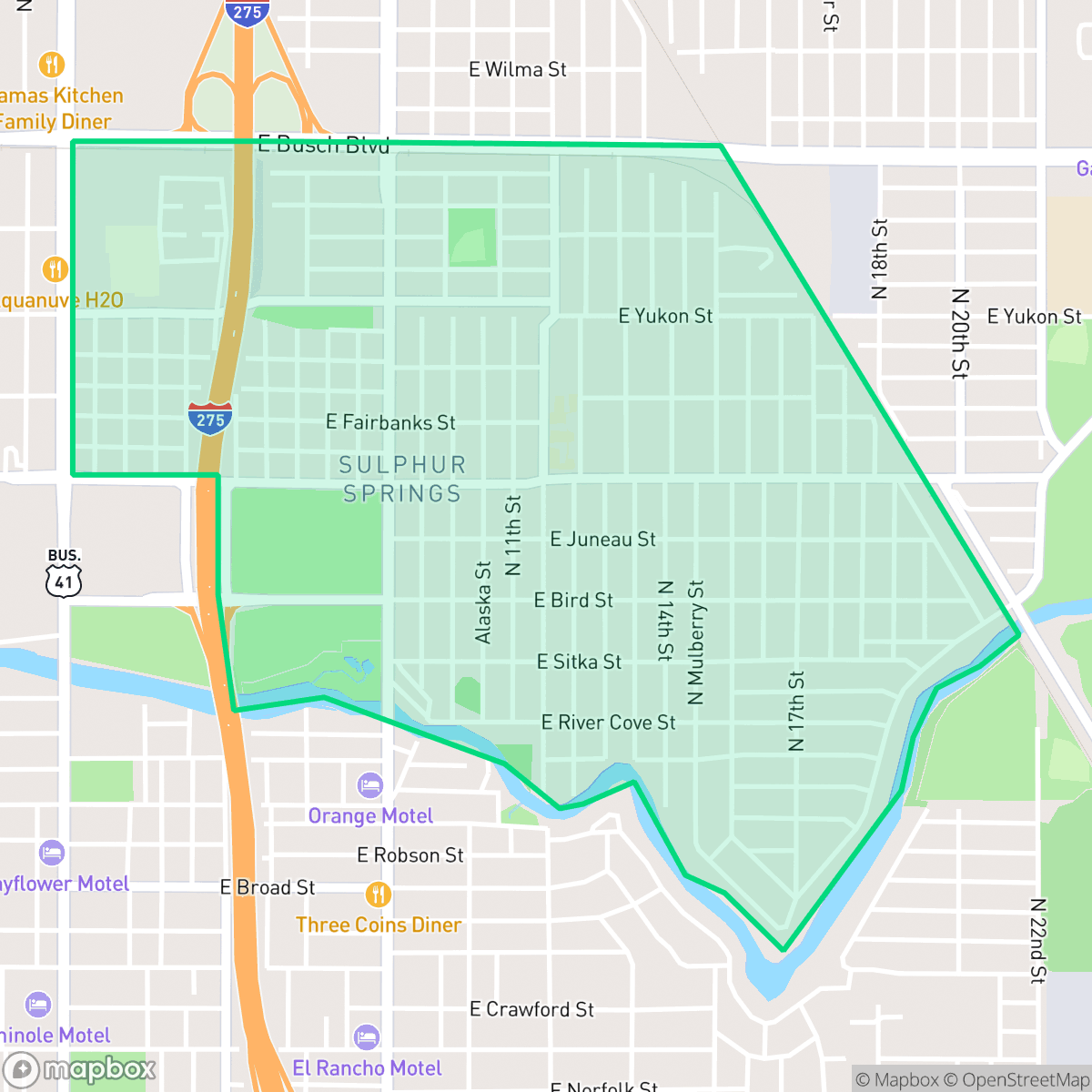
Sulphur Springs is a historically significant neighborhood defined by its riverside location and iconic water tower. Residents enjoy a suburban atmosphere with pockets of greenery, though the area experiences frequent traffic noise and fragmented pedestrian access.
Key Highlights
About Sulphur Springs
Sulphur Springs, located along the Hillsborough River, rose to prominence in the early 20th century as a popular tourist destination known for its mineral springs. Developer Josiah Richardson transformed the area into a resort-style attraction, including a bathhouse, pool, and the Sulphur Springs Hotel and Arcade, which has been cited as one of the nation's first indoor shopping centers. A defining architectural landmark is the 225-foot Sulphur Springs Water Tower, constructed in 1927 to support the resort's water needs. Once dubbed 'Florida's Coney Island' for its entertainment offerings, the neighborhood was annexed by Tampa in 1953. Today, the area is home to the Sulphur Springs Museum and Heritage Center, which preserves its legacy of resort-era tourism, the history of the Spring Hill community, and the neighborhood's complex social history during the segregation era.
The area maintains a steady local rhythm, blending residential streets with a diverse mix of young adults, families, and seniors. While the landscape is largely functional with modest housing, the presence of significant tree cover and scattered open spaces provides a semi-rural feel within the broader urban environment. The community leans strongly liberal, fostering a distinct social character that complements its long-standing heritage as a former resort destination.
Prospective residents should consider the trade-offs of living here, including higher-than-average traffic noise from nearby transit corridors and inconsistent sidewalk infrastructure that can make walking difficult. While the neighborhood offers more visual privacy than many parts of the city, it also faces challenges regarding air quality and moderate flood risks. It is best suited for those who value an established community and are comfortable navigating the practical realities of a suburban setting with limited dedicated public park space.
Neighborhood Scores Across 15 Qualities
Housing density varies throughout the area, offering more separation between neighbors than the typical Tampa average. Residents will find a mix of closely clustered homes and properties with significant tree buffers that provide visual privacy.
Low-traffic residential streets provide a shaded environment for walking, though the sidewalk network is inconsistent and often obscured by heavy tree canopy. While internal neighborhood movement is manageable, major roads and highway barriers make traversing the wider area difficult for pedestrians.
Residential streets feature standard tract housing with simple rooflines and small yards. This visual landscape is slightly less varied than the Tampa average due to the prevalence of dense, utilitarian structures and nearby commercial lots.
Access to dedicated dog walking areas is somewhat restricted, as greenery is largely confined to private yards rather than continuous public verges. While a central park with sports fields provides some exercise options, the availability of open space for pets is slightly below the Tampa average according to iHuus data.
A mix of single-family homes and scattered greenery provides a slightly more open, semi-rural feel than the typical Tampa urban landscape. According to iHuus data, residents will find significant tree cover and pockets of low-density development throughout the area.
A blend of parks, universities, and local eateries provides a more active atmosphere than the typical Tampa residential area. While some pockets offer lively nightlife and dining, other sections remain subdued and centered around quiet, tree-lined streets.
Frequent traffic and transit sounds from nearby railways and major roads characterize the area. This level of acoustic disturbance is slightly higher than the typical experience found elsewhere in Tampa.
Frequent unhealthy air quality levels present a significant health risk for sensitive groups. According to iHuus data, these conditions are notably worse than the average across Tampa.
Industrial presence is minimal, though some light commercial zones and storage facilities exist along certain borders. This area remains slightly lower in industrial activity than the Tampa average.
Health insurance access among residents is slightly below the Tampa average. According to iHuus data, a significant portion of the population remains uninsured.
Political leanings in this area are notably more liberal than the Tampa average. Residents will find a community characterized by a progressive majority with a small presence of opposing viewpoints.
Residents live alongside a balanced mix of young adults, families, and seniors. According to iHuus data, this demographic spread is more varied than the typical age distribution found across Tampa.
Flood risk in this area is higher than the Tampa average, though specific details remain undetermined due to incomplete federal flood studies. According to iHuus data, residents should prepare for potential inundation levels that exceed typical city-wide patterns.
Address-Level Insights for Sulphur Springs


iHuus Neighborhood Intelligence Insights
Get address-level neighborhood insights for Sulphur Springs
- Street-level scores — see how individual blocks compare, not just neighborhood averages
- Micro-zone boundaries — identify quiet pockets, flood boundaries, and walkable clusters before you visit
- 15 dimensions in full — walkability, noise, air quality, school quality, insurance coverage, population age profile, urban/rural index, and more
- Boundary risk alerts — know if your address sits near a block boundary where scores drop, the kind of detail no listing will ever mention
- School insights — individual school ratings and insights, not just district-level data
- Compare before you commit — side-by-side data across neighborhoods, down to block precision
No credit card required
Compare with Any Neighborhood
| Dimension | Sulphur Springs | Arbor Greene |
|---|---|---|
| 🚶 Walkabilityavg 6.08 | ||
| 🔊 Acoustic Comfortavg 2.94 | ||
| 🤫 Privacy Indexavg 5.25 | ||
| 🎨 Visual Appealavg 5.82 | ||
| 🐕 Dog Friendlinessavg 5.48 | ||
| 🗺️ Urban-Rural Indexavg 6.28 | ||
| ✨ Neighborhood Vibeavg 3.39 | ||
| 🏥 Health Insurance Coverageavg 5.93 | ||
| 🌿 Air Qualityavg 1.36 | ||
| 🏭 Industrial Proximityavg 6.63 | ||
| 🌊 Flood Safetyavg 4.98 | ||
| 🗳️ Ideological Leanavg 5.57 | ||
| 👥 Population Age Profileavg 4.16 | ||
| 🔥 Fire Safety | ||
| 🏫 School Quality |
Sulphur Springs Rankings
School Districts Serving Sulphur Springs
School Insights for Sulphur Springs
Below average outcomes; significant attendance and academic challenges.
School Insights
See what's really behind every school rating near Sulphur Springs
- Individual school ratings — each school's own score with outcome context, not just a district average
- Enrollment & class size data — student-to-teacher ratio and how it compares to the state average
- Full demographics breakdown — ethnicity and gender composition for every school in the enrollment zone
- Every school in the district — all schools within the enrollment boundary ranked by rating, not just the closest one
- Grade levels & benchmarks — elementary through high school, with below/above state-average flags
No credit card required