Seminole Heights, Tampa
Updated · 7,270 residents
Seminole Heights is a historic district defined by its early 20th-century architecture and a vibrant, independent culinary scene that draws locals to its many breweries and cafes. While the area offers a walkable grid and a diverse generational mix, residents should be prepared for frequent traffic noise and occasional air quality challenges.
Key Highlights
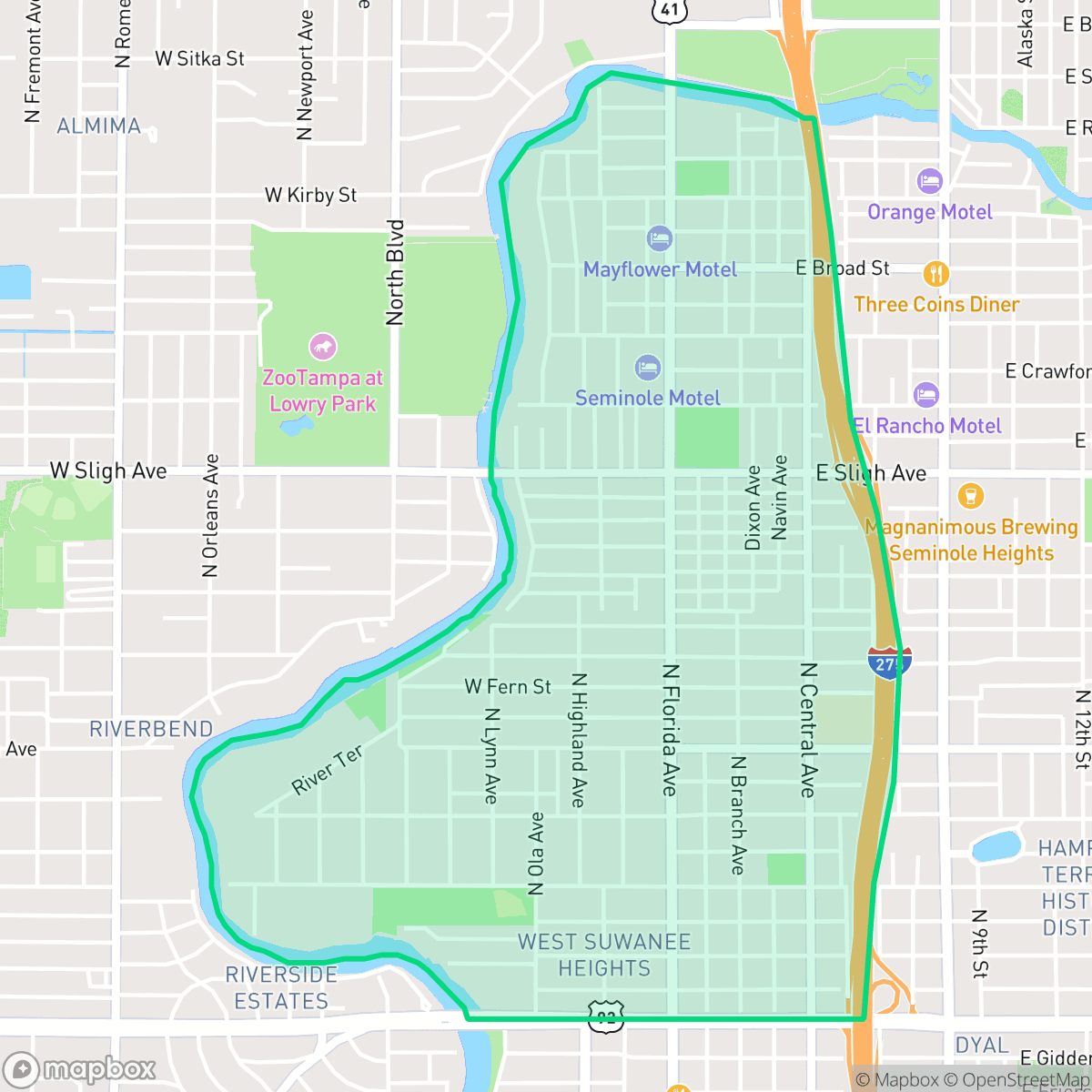
About Seminole Heights
Established in 1911 by developer T. Roy Young, Seminole Heights emerged as one of Tampa’s premier streetcar suburbs, designed to connect residents to downtown via the Sulphur Springs trolley line. The neighborhood is architecturally distinguished by its high concentration of early 20th-century Craftsman-style bungalows, complemented by later Mediterranean Revival and Tudor residences. Key landmarks include the 1927 Gothic-style Hillsborough High School, the Seminole Heights Methodist Church, and the expansive riverfront park system along the Hillsborough River, which includes Epps and Rivercrest parks. After experiencing a period of mid-century economic decline, the area underwent a significant cultural and commercial resurgence, transforming into a vibrant enclave known for its preserved historic housing stock and independent culinary scene.
The neighborhood maintains a distinct suburban feel characterized by a mix of residential grids and lush, mature tree canopies. It serves as a hub for social activity, with dense clusters of eateries and breweries creating a lively atmosphere that stands out from other parts of Tampa. The community supports a progressive ideological environment and benefits from high levels of health insurance coverage among its residents. Prospective residents should weigh these cultural benefits against specific environmental factors. According to iHuus data, the area experiences high levels of traffic noise from nearby transit corridors and highways, and air quality can be a concern for sensitive groups. While the grid layout supports walkability, pet owners may find that access to public green space is limited in certain sections. The area is well suited for those who prioritize a socially active, diverse community and historic character over complete acoustic privacy.
Neighborhood Scores Across 15 Qualities
Residential lots feature compact spacing with homes typically separated by small yards and fences. According to iHuus data, this level of separation provides more buffer between neighbors than the average area in Tampa.
Residential streets feature a consistent grid with sidewalks and mature tree canopy, though heavy traffic on major arterials and nearby highways creates notable pedestrian barriers. This level of walkability sits above the Tampa city average according to iHuus data.
Standard residential architecture and tidy, small yards define much of the area. While the neighborhood features some affluent pockets with private pools and lush greenery, it remains slightly more understated than the Tampa average.
Walking routes for dogs vary by block, as some streets feature wide grassy verges and proximity to public sports fields while others lack significant public green space. According to iHuus data, the availability of accessible parkland for exercise is slightly below the Tampa average.
Residential grids and commercial corridors create a suburban landscape that is slightly more open than the Tampa average. Large tree canopies and scattered pockets of greenery characterize much of the area according to iHuus data.
Highly active dining and social hubs provide a much more energetic atmosphere than the city average. While some residential pockets remain quiet, many blocks feature dense clusters of breweries, cafes, and diverse eateries that create a lively suburban environment.
Frequent noise from nearby rail lines and heavy traffic is a common occurrence. This level of acoustic disturbance is slightly higher than the average for Tampa.
Frequent unhealthy air quality levels pose a significant risk to sensitive groups. According to iHuus data, atmospheric conditions in this area are notably worse than the Tampa average.
Heavy industrial activity is largely absent, though some light commercial warehouses and utility structures exist near the neighborhood periphery. According to iHuus data, this area maintains a lower level of industrial proximity than the Tampa average.
Health insurance accessibility among residents is notably higher than the Tampa average, according to iHuus data.
Political leanings in this area are notably more liberal than the Tampa average; residents will find a community with a strong progressive presence.
Residents experience a diverse demographic spread of young professionals, families, and seniors. According to iHuus data, this age distribution is more balanced than the typical profile found across Tampa.
Flood risk levels are slightly higher than the Tampa average, though specific risk details remain undetermined due to incomplete federal studies. Residents should consult local maps as official assessments for this area are still pending.
Address-Level Insights for Seminole Heights


iHuus Neighborhood Intelligence Insights
Get address-level neighborhood insights for Seminole Heights
- Street-level scores — see how individual blocks compare, not just neighborhood averages
- Micro-zone boundaries — identify quiet pockets, flood boundaries, and walkable clusters before you visit
- 15 dimensions in full — walkability, noise, air quality, school quality, insurance coverage, population age profile, urban/rural index, and more
- Boundary risk alerts — know if your address sits near a block boundary where scores drop, the kind of detail no listing will ever mention
- School insights — individual school ratings and insights, not just district-level data
- Compare before you commit — side-by-side data across neighborhoods, down to block precision
No credit card required
Compare with Any Neighborhood
| Dimension | Seminole Heights | Arbor Greene |
|---|---|---|
| 🚶 Walkabilityavg 6.08 | ||
| 🔊 Acoustic Comfortavg 2.94 | ||
| 🤫 Privacy Indexavg 5.25 | ||
| 🎨 Visual Appealavg 5.82 | ||
| 🐕 Dog Friendlinessavg 5.48 | ||
| 🗺️ Urban-Rural Indexavg 6.28 | ||
| ✨ Neighborhood Vibeavg 3.39 | ||
| 🏥 Health Insurance Coverageavg 5.93 | ||
| 🌿 Air Qualityavg 1.36 | ||
| 🏭 Industrial Proximityavg 6.63 | ||
| 🌊 Flood Safetyavg 4.98 | ||
| 🗳️ Ideological Leanavg 5.57 | ||
| 👥 Population Age Profileavg 4.16 | ||
| 🔥 Fire Safety | ||
| 🏫 School Quality |
Seminole Heights Rankings
School Districts Serving Seminole Heights
School Insights for Seminole Heights
Below average outcomes; significant attendance and academic challenges.
School Insights
See what's really behind every school rating near Seminole Heights
- Individual school ratings — each school's own score with outcome context, not just a district average
- Enrollment & class size data — student-to-teacher ratio and how it compares to the state average
- Full demographics breakdown — ethnicity and gender composition for every school in the enrollment zone
- Every school in the district — all schools within the enrollment boundary ranked by rating, not just the closest one
- Grade levels & benchmarks — elementary through high school, with below/above state-average flags
No credit card required