Rattlesnake, Tampa
Updated · 2,970 residents
Rattlesnake is a functional, suburban community in South Tampa defined by its proximity to industrial logistics centers and major transit corridors. Residents experience a modest residential landscape characterized by a mix of single-family homes and multi-family units, though the area faces challenges with limited pedestrian infrastructure and frequent traffic noise.
Key Highlights
About Rattlesnake
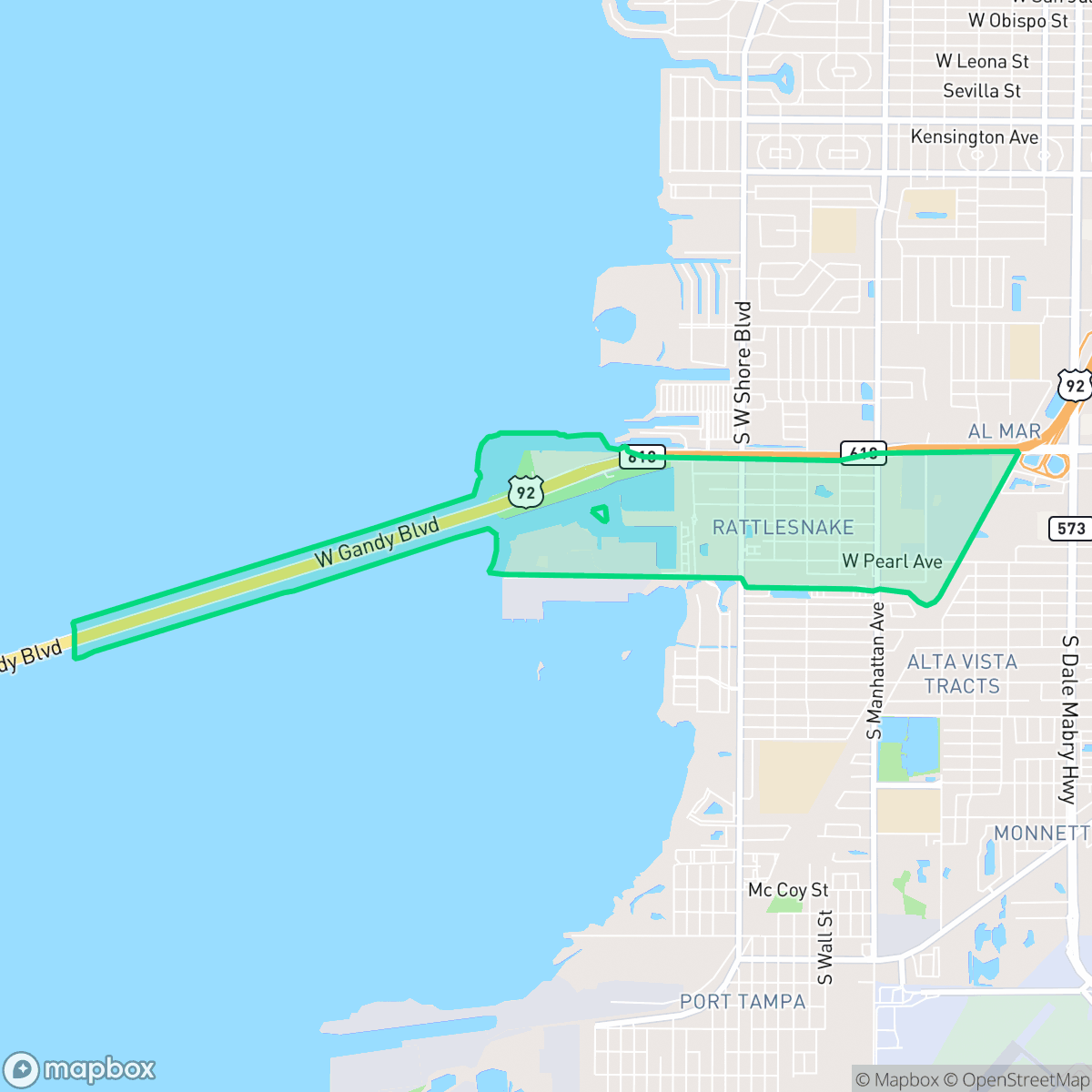
The Rattlesnake neighborhood in South Tampa originated in the late 1930s as a quirky, unincorporated community centered on the commercialization of Eastern diamondback rattlesnakes. Named for the dense population of snakes inhabiting the area's pine and palmetto thickets, it was established by entrepreneur George K. End. The site, located near Gandy Boulevard and Bridge Street, featured the 'Rattlesnake Cannery and Reptilorium,' which processed snake meat, venom for medical research, and hides. The settlement grew to include a post office, general store, and tourist-focused snake pits that attracted soldiers from nearby MacDill Field and travelers. Following End's death in 1944, the operation declined, and the area was eventually annexed by the City of Tampa in the 1950s, transitioning into the residential community known today as part of the Interbay peninsula.
The area serves as a practical residential pocket within the Interbay peninsula, maintaining a subdued atmosphere that balances suburban living with nearby commercial services. Its layout features a diverse mix of housing types, ranging from traditional single-family dwellings to denser apartment complexes, providing a range of options for those seeking a central location in Tampa. While the neighborhood lacks extensive public green spaces, its functional design supports a varied demographic of residents who value being situated near major employment hubs and arterial roads. Prospective residents should note that the area is situated within a designated floodplain, which may influence insurance requirements and long-term planning. The proximity to industrial logistics warehouses contributes to regular heavy vehicle traffic and intermittent noise, while the lack of sidewalks and limited public parks can make the environment less conducive to walking or pet ownership. Despite these logistical trade-offs, the neighborhood offers high levels of health insurance coverage and a stable, conservative-leaning community environment that appeals to those prioritizing utility and accessibility over scenic walkability.
Neighborhood Scores Across 15 Qualities
Residential spacing varies between close-set single-family homes and dense apartment clusters, resulting in less seclusion than the Tampa average. According to iHuus data, some areas feature minimal natural buffering between neighbors.
Walking is difficult due to a lack of sidewalks and the presence of high traffic arterial roads. According to iHuus data, walkability in this area is below the Tampa average.
Standard tract housing and multi-family complexes define the area, featuring small yards and boxy rooflines. This visual landscape is less varied than the average found across Tampa.
Few public parks or continuous green spaces exist for walking dogs, as greenery is largely restricted to private fenced yards. This lack of accessible outdoor space makes the area less dog friendly than much of Tampa.
A blend of residential streets and green spaces characterizes the area, offering a less dense environment than the typical Tampa urban core. According to iHuus data, this layout features a diverse mix of single-family homes, apartment complexes, and large-scale industrial or commercial footprints.
Activity levels are slightly above the city average, characterized by a mix of quiet residential stretches and pockets of suburban activity. While some areas rely on vehicles for transit, specific hubs offer surprising energy with accessible dining, cafes, and local retail.
Frequent sound disruptions from nearby transit corridors and heavy infrastructure are common in this area. According to iHuus data, acoustic levels are slightly higher than the Tampa average.
Frequent unhealthy air quality levels pose a significant risk to sensitive groups. According to iHuus data, these conditions are slightly worse than the average found throughout Tampa.
A blend of residential units and commercial services exists alongside significant logistics warehouses. Residents may encounter heavy freight traffic, semi-truck activity, and intermittent operational noise from nearby distribution centers, which is more prevalent here than in the typical Tampa area.
Health insurance accessibility is notably higher in this area than the Tampa average, according to iHuus data.
Conservative views represent a significant majority in this area, marking a notable departure from the more balanced political landscape found across Tampa. According to iHuus data, the neighborhood maintains a much more conservative leaning than the city average.
Residents will find a varied demographic mix ranging from young adults to older populations. This age distribution is largely consistent with the broader Tampa area according to iHuus data.
Properties in this area are located within a designated floodplain, making flood insurance a common necessity. According to iHuus data, the risk of flooding in Rattlesnake is notably higher than the Tampa city average.
Address-Level Insights for Rattlesnake


iHuus Neighborhood Intelligence Insights
Get address-level neighborhood insights for Rattlesnake
- Street-level scores — see how individual blocks compare, not just neighborhood averages
- Micro-zone boundaries — identify quiet pockets, flood boundaries, and walkable clusters before you visit
- 15 dimensions in full — walkability, noise, air quality, school quality, insurance coverage, population age profile, urban/rural index, and more
- Boundary risk alerts — know if your address sits near a block boundary where scores drop, the kind of detail no listing will ever mention
- School insights — individual school ratings and insights, not just district-level data
- Compare before you commit — side-by-side data across neighborhoods, down to block precision
No credit card required
Compare with Any Neighborhood
| Dimension | Rattlesnake | Arbor Greene |
|---|---|---|
| 🚶 Walkabilityavg 6.08 | ||
| 🔊 Acoustic Comfortavg 2.94 | ||
| 🤫 Privacy Indexavg 5.25 | ||
| 🎨 Visual Appealavg 5.82 | ||
| 🐕 Dog Friendlinessavg 5.48 | ||
| 🗺️ Urban-Rural Indexavg 6.28 | ||
| ✨ Neighborhood Vibeavg 3.39 | ||
| 🏥 Health Insurance Coverageavg 5.93 | ||
| 🌿 Air Qualityavg 1.36 | ||
| 🏭 Industrial Proximityavg 6.63 | ||
| 🌊 Flood Safetyavg 4.98 | ||
| 🗳️ Ideological Leanavg 5.57 | ||
| 👥 Population Age Profileavg 4.16 | ||
| 🔥 Fire Safety | ||
| 🏫 School Quality |
Rattlesnake Rankings
School Districts Serving Rattlesnake
School Insights for Rattlesnake
Below average outcomes; significant attendance and academic challenges.
School Insights
See what's really behind every school rating near Rattlesnake
- Individual school ratings — each school's own score with outcome context, not just a district average
- Enrollment & class size data — student-to-teacher ratio and how it compares to the state average
- Full demographics breakdown — ethnicity and gender composition for every school in the enrollment zone
- Every school in the district — all schools within the enrollment boundary ranked by rating, not just the closest one
- Grade levels & benchmarks — elementary through high school, with below/above state-average flags
No credit card required