Port Tampa City, Tampa
Updated · 4,490 residents
Port Tampa City is a quiet, residential enclave defined by its suburban-industrial landscape and proximity to major maritime infrastructure. The area features a dense, functional layout that attracts a younger demographic, though residents face challenges regarding limited pedestrian connectivity and significant nearby industrial activity.
Key Highlights
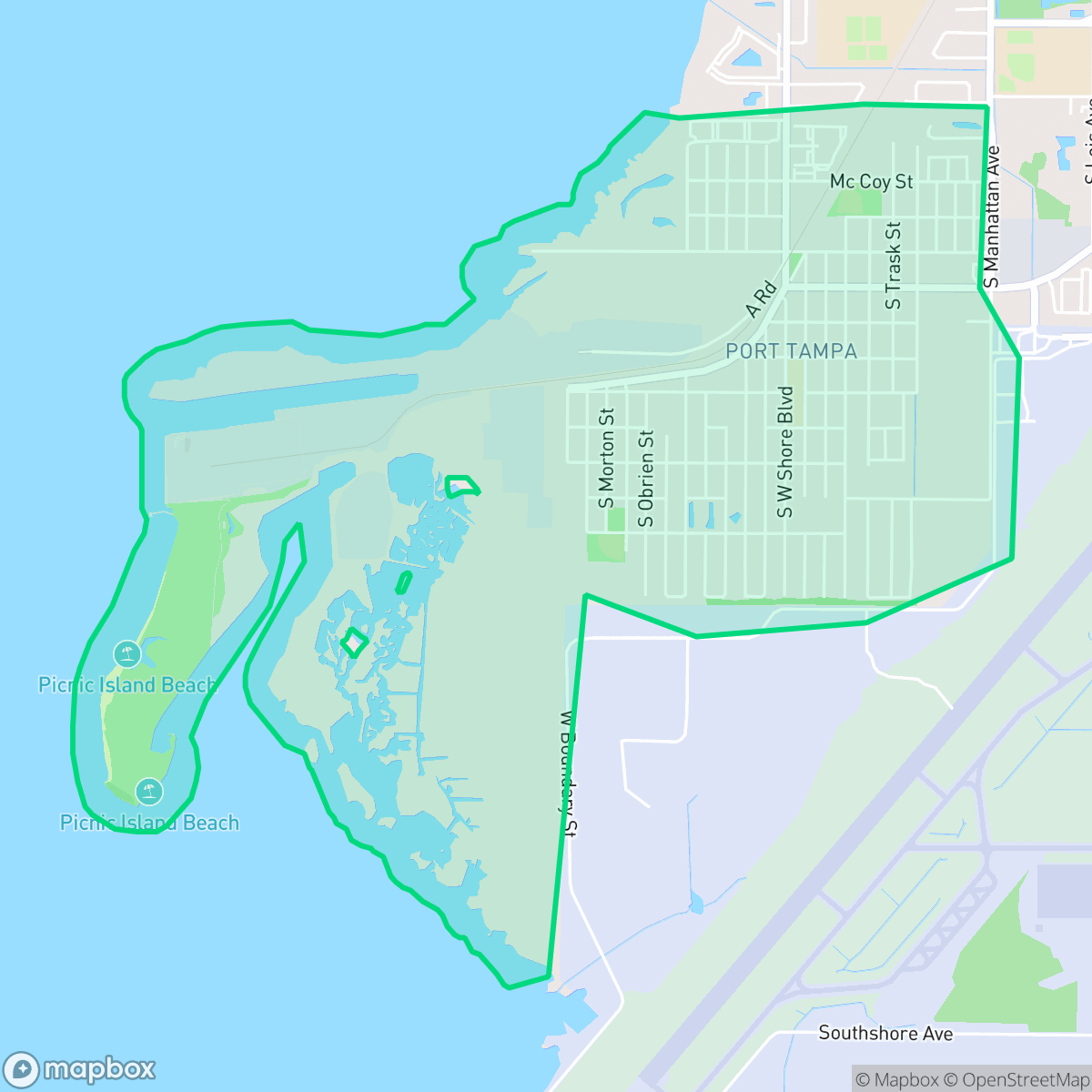
About Port Tampa City
Established in 1885, Port Tampa City emerged as a distinct town at the terminus of Henry B. Plant’s railroad line. Because the shallow waters of Tampa’s original harbor hindered large vessels, Plant constructed a mile-long pier and deep-water terminal here to facilitate phosphate exports and steamship travel to Havana. The town served as a primary embarkation point for U.S. troops, including Theodore Roosevelt and his Rough Riders, during the 1898 Spanish-American War. Early landmarks included the St. Elmo and Port Tampa inns, which catered to travelers arriving by rail. While the area was once a bustling industrial hub with its own business district—known as the 'Brick Corner'—its prominence waned as dredging projects improved access to downtown Tampa. The City of Tampa annexed the community in 1961, though it retains a unique identity centered on its maritime heritage and the Spanish-American War Memorial Park.
The neighborhood maintains a distinct character shaped by its transition from a bustling rail terminal to a residential and industrial mix. While the area is generally peaceful due to infrequent local traffic, it remains closely integrated with large-scale industrial facilities, including oil tank farms and active railway corridors. The visual landscape is primarily composed of functional tract housing and dense apartment complexes, offering a subdued environment that lacks a central commercial hub. This setting appeals to a younger population looking for a quiet, straightforward living experience that remains connected to the broader Tampa region.
Prospective residents should consider several livability factors, including a higher-than-average flood risk and concerns regarding air quality. The neighborhood is not highly walkable, as limited sidewalk infrastructure and heavy traffic patterns often necessitate the use of a vehicle for daily errands. While the community benefits from the educational resources of the Hillsborough County School District, families should note that local health insurance coverage rates are lower than the city average. Overall, the area is best suited for those who prioritize a quiet, close-knit residential environment and are comfortable with the trade-offs associated with an industrial-adjacent location.
Neighborhood Scores Across 15 Qualities
Residential structures are often positioned in close quarters with minimal separation between homes. According to iHuus data, this density of housing is notably higher than the city average.
Limited sidewalk availability and heavy traffic patterns make pedestrian travel uncomfortable. According to iHuus data, the connectivity for walkers is significantly lower than the city average.
Standard tract housing and dense apartment complexes dominate the landscape, offering much less visual variety than the Tampa average. Most lots feature small yards and uniform rooflines with few ornamental amenities or greenery visible.
Fragmented lawns and narrow sidewalk buffers make for restricted walking paths, which is notably lower than the city average. While some access to shoreline trails and school athletic fields exists, proximity to industrial tank farms limits available green space for pets.
Residential grids featuring single-family homes and apartments transition into heavy industrial zones near the western and southern borders. This area presents a more suburban character than the more densely urbanized parts of Tampa.
Local activity is minimal, with a notable lack of commercial hubs and points of interest compared to the broader Tampa area. Most residents will find a calm, subdued environment that lacks a central commercial pulse.
Acoustic levels are notably lower than the Tampa average, consisting primarily of infrequent trains and distant vehicle traffic. Residents can expect a much more peaceful environment than most parts of the city according to iHuus data.
Frequent hazardous air quality readings present serious health risks for residents. According to iHuus data, these pollution levels are slightly worse than the Tampa average.
Frequent heavy freight traffic and proximity to large-scale industrial facilities, such as oil tank farms and airport operations, create a much higher level of industrial activity than the Tampa average. According to iHuus data, residents may encounter regular noise from loading docks, railway corridors, and nearby warehouses.
Health insurance accessibility in this area is lower than the Tampa average. According to iHuus data, a significant portion of the population remains uninsured.
Political leanings in this area favor conservative perspectives, representing a notable departure from the more moderate ideological distribution seen across Tampa.
A significant majority of residents are young adults, creating a demographic profile that is notably younger than the Tampa average. This concentration of young adults results in a smaller presence of families and older residents according to iHuus data.
Significant flood risk exists because parts of this area are located within a designated floodplain. According to iHuus data, the likelihood of flooding is substantially higher than the average for Tampa.
Address-Level Insights for Port Tampa City


iHuus Neighborhood Intelligence Insights
Get address-level neighborhood insights for Port Tampa City
- Street-level scores — see how individual blocks compare, not just neighborhood averages
- Micro-zone boundaries — identify quiet pockets, flood boundaries, and walkable clusters before you visit
- 15 dimensions in full — walkability, noise, air quality, school quality, insurance coverage, population age profile, urban/rural index, and more
- Boundary risk alerts — know if your address sits near a block boundary where scores drop, the kind of detail no listing will ever mention
- School insights — individual school ratings and insights, not just district-level data
- Compare before you commit — side-by-side data across neighborhoods, down to block precision
No credit card required
Compare with Any Neighborhood
| Dimension | Port Tampa City | Arbor Greene |
|---|---|---|
| 🚶 Walkabilityavg 6.08 | ||
| 🔊 Acoustic Comfortavg 2.94 | ||
| 🤫 Privacy Indexavg 5.25 | ||
| 🎨 Visual Appealavg 5.82 | ||
| 🐕 Dog Friendlinessavg 5.48 | ||
| 🗺️ Urban-Rural Indexavg 6.28 | ||
| ✨ Neighborhood Vibeavg 3.39 | ||
| 🏥 Health Insurance Coverageavg 5.93 | ||
| 🌿 Air Qualityavg 1.36 | ||
| 🏭 Industrial Proximityavg 6.63 | ||
| 🌊 Flood Safetyavg 4.98 | ||
| 🗳️ Ideological Leanavg 5.57 | ||
| 👥 Population Age Profileavg 4.16 | ||
| 🔥 Fire Safety | ||
| 🏫 School Quality |
Port Tampa City Rankings
School Districts Serving Port Tampa City
School Insights for Port Tampa City
Below average outcomes; significant attendance and academic challenges.
School Insights
See what's really behind every school rating near Port Tampa City
- Individual school ratings — each school's own score with outcome context, not just a district average
- Enrollment & class size data — student-to-teacher ratio and how it compares to the state average
- Full demographics breakdown — ethnicity and gender composition for every school in the enrollment zone
- Every school in the district — all schools within the enrollment boundary ranked by rating, not just the closest one
- Grade levels & benchmarks — elementary through high school, with below/above state-average flags
No credit card required