Old West Tampa, Tampa
Updated · 5,674 residents
Old West Tampa is a vibrant, culturally rich district known for its historic bungalows and deep-rooted Latin heritage. While the neighborhood offers a lively atmosphere with diverse dining and active nightlife, residents should be prepared for frequent traffic noise and air quality levels that are lower than the city average.
Key Highlights
About Old West Tampa
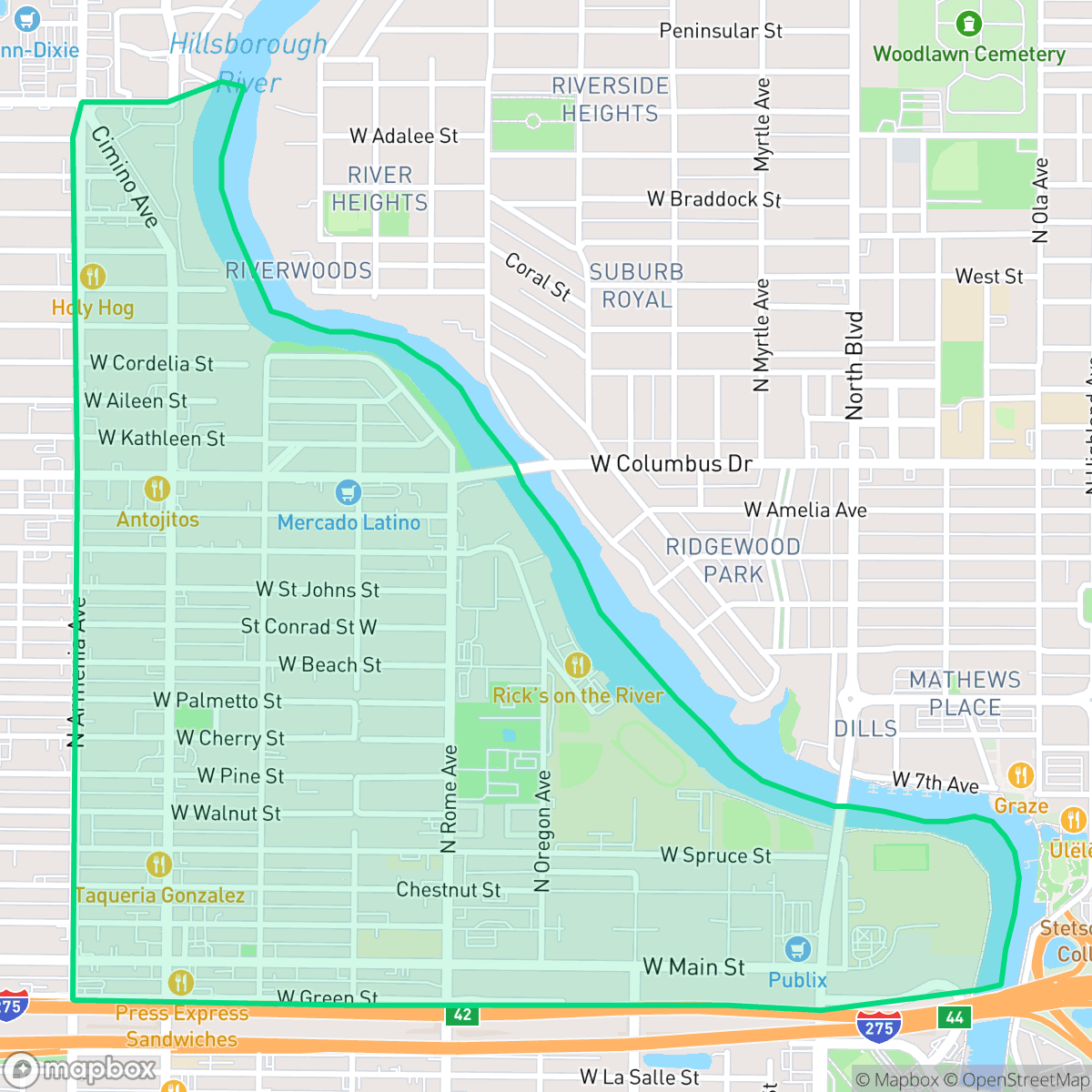
Founded in 1892 by Scottish immigrant Hugh MacFarlane, Old West Tampa was developed as a distinct industrial hub for the cigar industry, attracting waves of Cuban, Spanish, and Italian immigrants. Originally incorporated as an independent city in 1895, the neighborhood flourished as a center for cigar manufacturing, characterized by its historic brick factories and worker housing. Notable landmarks include the 1914 West Tampa Library, a Carnegie-funded institution, and MacFarlane Park. The area’s cultural identity was shaped by its ethnic social clubs, or 'casinos,' and its resilience as a predominantly Latin community. Despite the mid-20th-century disruption caused by the construction of Interstate 275, the neighborhood retains its architectural character, featuring a mix of historic bungalows and repurposed industrial buildings that reflect its deep-rooted heritage as a cornerstone of Tampa’s cigar-making history.
The area functions as a dense, grid-based community that balances residential living with small commercial clusters. Its energetic vibe is supported by a variety of local dining and cultural venues, making it a central hub for those who value proximity to city activity. The visual landscape consists primarily of traditional housing, creating a consistent architectural rhythm that reflects the long-standing development of the region. According to iHuus data, the neighborhood maintains a balanced mix of residential and commercial spaces, providing a consistent layout for its diverse age demographic.
Prospective residents should consider the trade-offs of living in a central urban environment, including higher noise levels from nearby rail lines and major roadways. While the street grid provides moderate walkability, highway infrastructure can occasionally disrupt pedestrian movement. Those sensitive to air quality or flood concerns should conduct thorough local research, as the area faces challenges common to older, centrally located districts. Access to healthcare remains a factor for some, as insurance coverage levels in the area mirror broader county trends.
Neighborhood Scores Across 15 Qualities
Residential spacing varies throughout the area, with some sections featuring closely packed homes and others offering more buffer between neighbors. This level of density is roughly in line with the average for Tampa.
Pedestrian navigation is generally functional due to a consistent sidewalk grid, though the presence of high-traffic highway corridors can make crossing certain areas difficult. While walkability remains slightly above the Tampa average, some streets are bisected by major expressway barriers that hinder continuous movement.
Uniform housing layouts and small yards define the visual landscape, which aligns with the broader Tampa average. The area consists primarily of traditional tract housing with consistent roof geometries and limited luxury landscaping.
Access to public parks and sports fields provides decent space for pets, though some areas feature narrow sidewalks and limited street greenery. This level of dog friendliness sits slightly above the Tampa average according to iHuus data.
Residential streets and green spaces are distributed in equal measure to the city average. This layout provides a mix of single-family homes, apartment complexes, and small commercial clusters within a consistent grid.
Diverse dining, nightlife, and cultural landmarks create a much more energetic atmosphere than the typical Tampa neighborhood. While some pockets offer quiet residential living, many areas feature dense urban grids with high activity levels after dark.
Frequent sounds from nearby railroad tracks and busy roadways characterize the area. According to iHuus data, acoustic levels are slightly higher than the Tampa average.
Frequent unhealthy air quality levels pose a significant risk to sensitive groups. According to iHuus data, the air quality in this area is worse than the average for Tampa.
Light commercial activity and warehouse corridors are present, but the area lacks heavy manufacturing hazards. Residents experience less industrial presence than the typical Tampa neighborhood, though some noise from nearby logistics hubs and highways exists.
Health insurance access for residents in this area aligns with the average coverage levels seen across Tampa. According to iHuus data, a significant portion of the population remains uninsured.
Political leanings in this area are notably more liberal than the Tampa average. According to iHuus data, a liberal majority exists within the community alongside a modest opposing presence.
A varied demographic of young professionals, families, and seniors resides here, representing a slightly more balanced age distribution than the Tampa average according to iHuus data.
Flood risk levels remain undetermined because a detailed FEMA study has not been completed for this area, though the risk appears slightly higher than the Tampa average according to iHuus data.
Address-Level Insights for Old West Tampa


iHuus Neighborhood Intelligence Insights
Get address-level neighborhood insights for Old West Tampa
- Street-level scores — see how individual blocks compare, not just neighborhood averages
- Micro-zone boundaries — identify quiet pockets, flood boundaries, and walkable clusters before you visit
- 15 dimensions in full — walkability, noise, air quality, school quality, insurance coverage, population age profile, urban/rural index, and more
- Boundary risk alerts — know if your address sits near a block boundary where scores drop, the kind of detail no listing will ever mention
- School insights — individual school ratings and insights, not just district-level data
- Compare before you commit — side-by-side data across neighborhoods, down to block precision
No credit card required
Compare with Any Neighborhood
| Dimension | Old West Tampa | Arbor Greene |
|---|---|---|
| 🚶 Walkabilityavg 6.08 | ||
| 🔊 Acoustic Comfortavg 2.94 | ||
| 🤫 Privacy Indexavg 5.25 | ||
| 🎨 Visual Appealavg 5.82 | ||
| 🐕 Dog Friendlinessavg 5.48 | ||
| 🗺️ Urban-Rural Indexavg 6.28 | ||
| ✨ Neighborhood Vibeavg 3.39 | ||
| 🏥 Health Insurance Coverageavg 5.93 | ||
| 🌿 Air Qualityavg 1.36 | ||
| 🏭 Industrial Proximityavg 6.63 | ||
| 🌊 Flood Safetyavg 4.98 | ||
| 🗳️ Ideological Leanavg 5.57 | ||
| 👥 Population Age Profileavg 4.16 | ||
| 🔥 Fire Safety | ||
| 🏫 School Quality |
Old West Tampa Rankings
School Districts Serving Old West Tampa
School Insights for Old West Tampa
Below average outcomes; significant attendance and academic challenges.
School Insights
See what's really behind every school rating near Old West Tampa
- Individual school ratings — each school's own score with outcome context, not just a district average
- Enrollment & class size data — student-to-teacher ratio and how it compares to the state average
- Full demographics breakdown — ethnicity and gender composition for every school in the enrollment zone
- Every school in the district — all schools within the enrollment boundary ranked by rating, not just the closest one
- Grade levels & benchmarks — elementary through high school, with below/above state-average flags
No credit card required