Old Seminole Heights, Tampa
Updated · 8,764 residents
Old Seminole Heights is a vibrant hub known for its active local dining and brewery scene set against a backdrop of historic residential streets. While the area offers a diverse community and high rates of health insurance coverage, residents should expect notable noise from nearby transit corridors and varying air quality levels.
Key Highlights
About Old Seminole Heights
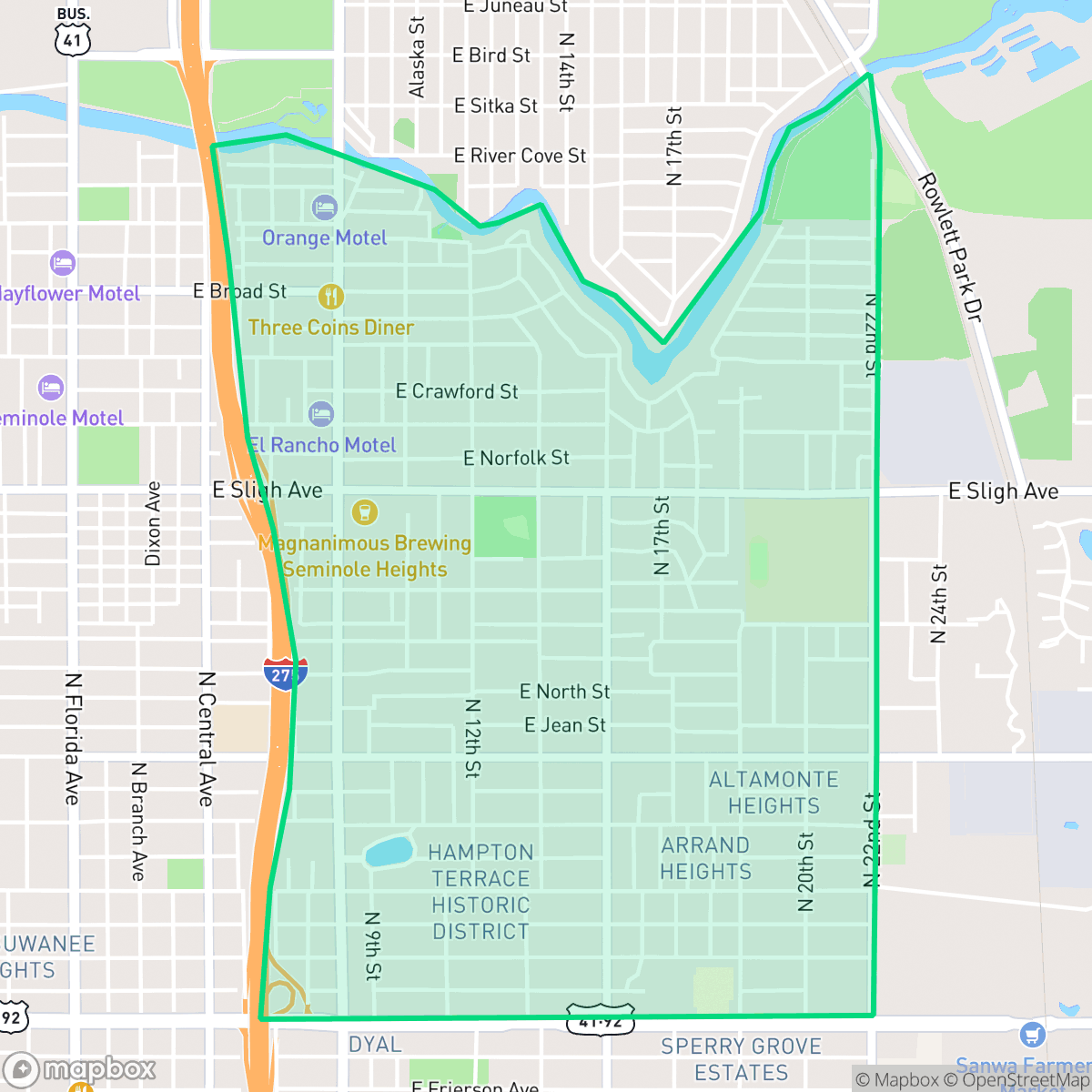
Old Seminole Heights, established in 1911 by developer T. Roy Young, originated as one of Tampa’s first streetcar suburbs, designed to connect residents to downtown via the Sulphur Springs Traction Line. The neighborhood is defined by its extensive collection of early 20th-century Craftsman bungalows and Florida Vernacular architecture, many featuring signature broad porches and intricate woodwork. Historically, the area served as a residential retreat for the middle class, though it faced significant challenges in the late 20th century following the construction of Interstate 275. Today, Old Seminole Heights is recognized for its historic preservation, brick-lined streets, and proximity to the Hillsborough River. It has experienced a marked cultural resurgence, characterized by the revitalization of its historic building stock and a thriving local scene of independent businesses and community-focused institutions like the Seminole Heights Garden Center.
The area functions as an energetic destination for social gatherings and independent businesses, maintaining a distinct local identity that balances suburban greenery with urban activity. Residents enjoy a diverse demographic mix and a strong sense of community, supported by mature tree canopies that provide visual screening between properties. The neighborhood layout features a grid of streets that generally supports navigation, though the presence of major thoroughfares and highway infrastructure creates some barriers to continuous pedestrian movement. Prospective residents should consider the trade-offs associated with this central location, including higher levels of traffic noise and occasional air quality challenges. While the area provides access to public green spaces for dog walking, the flood risk remains a factor for homeowners to monitor as assessment data evolves. Overall, the neighborhood is well-suited for those who prioritize a central, socially active environment and value the character of an established community within the broader Hillsborough County school district.
Neighborhood Scores Across 15 Qualities
Homes are situated with moderate separation and often benefit from mature tree canopies that provide visual screening. This level of density offers more privacy than the typical Tampa average.
Low-traffic residential streets offer shaded, pleasant routes for pedestrians, though heavy traffic on major arterials and highways creates significant barriers. While the grid layout is generally navigable, sidewalks are often obscured by dense tree canopy or interrupted by large commercial lots, making walkability roughly comparable to the Tampa average.
Standard single-family homes feature repetitive rooflines and narrow lots with limited yard space. This area presents a visual profile similar to the rest of Tampa.
Access to public green space and baseball fields provides good walking opportunities, although some residential blocks feature narrow verges and limited public park access. Overall, the availability of open spaces for pets is roughly comparable to the Tampa average.
Residential blocks feature a dense suburban layout with significant mature tree cover and interspersed commercial corridors. This level of greenery and open space sits slightly above the Tampa average, according to iHuus data.
A steady rhythm of dining, breweries, and wellness services creates a level of activity that is notably higher than the city average. While some residential pockets remain quiet and leafy, many areas function as energetic destinations for local food and social gatherings.
Frequent noise from nearby rail lines and major thoroughfares characterizes the area. According to iHuus data, acoustic levels are slightly higher than the Tampa average.
Frequent unhealthy air quality levels present a significant risk to sensitive groups. This level of pollution is notably worse than the average found across Tampa.
Minimal industrial presence defines the area, though light commercial corridors and utility structures along the western edges create more active transit traffic than the city average. Most of the neighborhood remains strictly residential with very few heavy industrial hazards or large warehouses.
Health insurance access among residents is notably higher than the Tampa city average, according to iHuus data.
Voting patterns and census indicators show a distinctly liberal political leaning, which is significantly more pronounced than the average seen across Tampa.
Residents experience a balanced demographic spread of young adults, families, and older individuals. This age distribution is more varied than the typical profile found across Tampa.
Flood risk in this area is higher than the Tampa average, though current FEMA studies have not yet provided a definitive assessment of the danger level. Residents should remain aware that precise flood hazard classifications for this part of Old Seminole Heights are still being determined.
Address-Level Insights for Old Seminole Heights


iHuus Neighborhood Intelligence Insights
Get address-level neighborhood insights for Old Seminole Heights
- Street-level scores — see how individual blocks compare, not just neighborhood averages
- Micro-zone boundaries — identify quiet pockets, flood boundaries, and walkable clusters before you visit
- 15 dimensions in full — walkability, noise, air quality, school quality, insurance coverage, population age profile, urban/rural index, and more
- Boundary risk alerts — know if your address sits near a block boundary where scores drop, the kind of detail no listing will ever mention
- School insights — individual school ratings and insights, not just district-level data
- Compare before you commit — side-by-side data across neighborhoods, down to block precision
No credit card required
Compare with Any Neighborhood
| Dimension | Old Seminole Heights | Arbor Greene |
|---|---|---|
| 🚶 Walkabilityavg 6.08 | ||
| 🔊 Acoustic Comfortavg 2.94 | ||
| 🤫 Privacy Indexavg 5.25 | ||
| 🎨 Visual Appealavg 5.82 | ||
| 🐕 Dog Friendlinessavg 5.48 | ||
| 🗺️ Urban-Rural Indexavg 6.28 | ||
| ✨ Neighborhood Vibeavg 3.39 | ||
| 🏥 Health Insurance Coverageavg 5.93 | ||
| 🌿 Air Qualityavg 1.36 | ||
| 🏭 Industrial Proximityavg 6.63 | ||
| 🌊 Flood Safetyavg 4.98 | ||
| 🗳️ Ideological Leanavg 5.57 | ||
| 👥 Population Age Profileavg 4.16 | ||
| 🔥 Fire Safety | ||
| 🏫 School Quality |
Old Seminole Heights Rankings
School Districts Serving Old Seminole Heights
School Insights for Old Seminole Heights
Below average outcomes; significant attendance and academic challenges.
School Insights
See what's really behind every school rating near Old Seminole Heights
- Individual school ratings — each school's own score with outcome context, not just a district average
- Enrollment & class size data — student-to-teacher ratio and how it compares to the state average
- Full demographics breakdown — ethnicity and gender composition for every school in the enrollment zone
- Every school in the district — all schools within the enrollment boundary ranked by rating, not just the closest one
- Grade levels & benchmarks — elementary through high school, with below/above state-average flags
No credit card required