Northview Hills, Tampa
Updated · 3,028 residents
Northview Hills is a quiet, semi-rural residential pocket in East Tampa characterized by a mix of modest housing and light industrial presence. While the area offers a sense of privacy and a diverse demographic, residents should expect notable noise from nearby transit corridors and limited pedestrian infrastructure.
Key Highlights
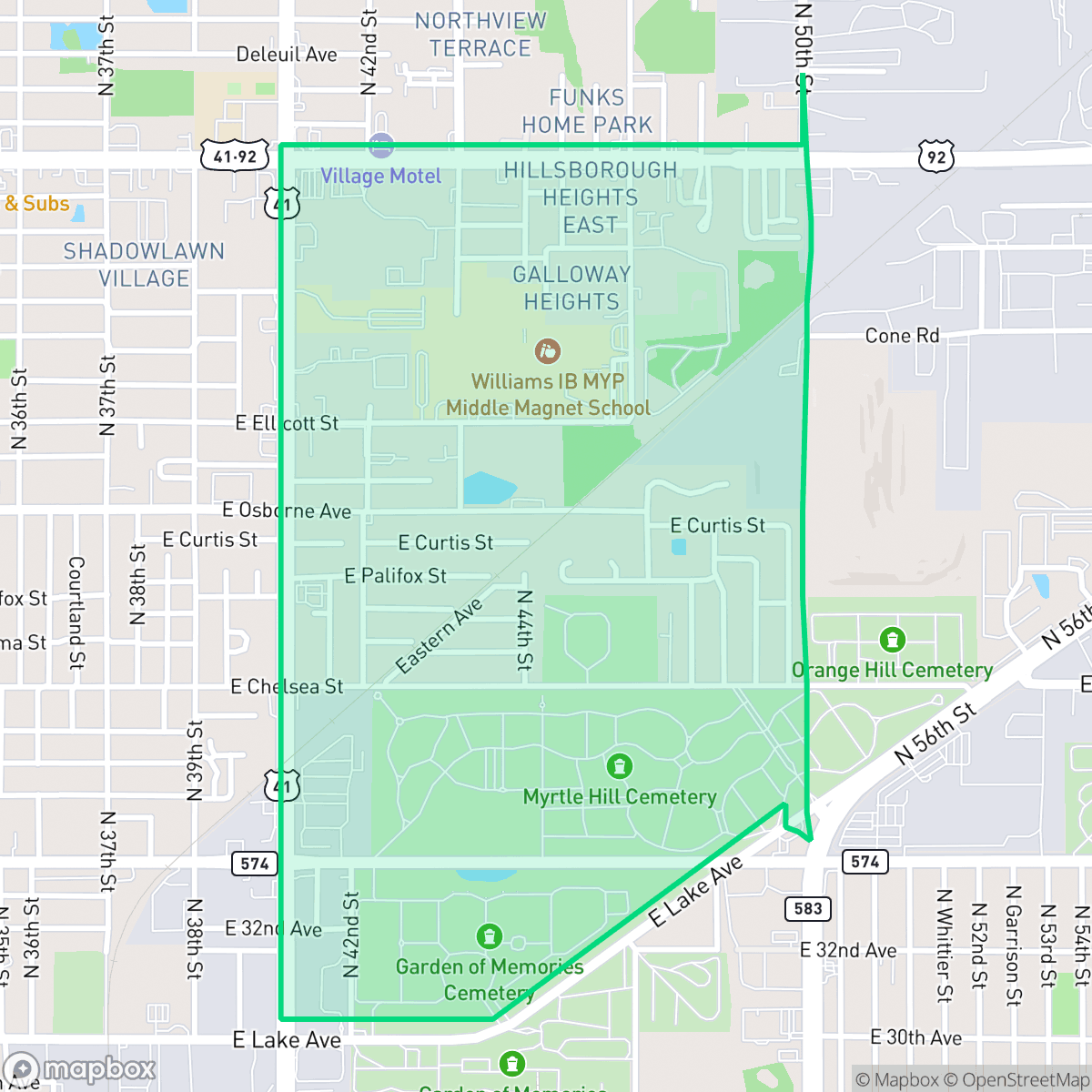
About Northview Hills
Northview Hills, a residential neighborhood in East Tampa, emerged during the 1960s as a predominantly Black community following the city’s 1953 annexation and post-WWII suburban expansion. Characterized by modest brick and stucco single-family homes, the neighborhood developed a distinct identity defined by strong civic pride and close-knit social ties. During the 1970s and 1980s, the area experienced significant demographic shifts linked to court-ordered school desegregation. Today, Northview Hills remains part of the East Tampa Community Redevelopment Area, with residents actively engaged in local associations and ongoing beautification efforts. Situated near landmarks such as James Elementary School and Williams Park, the neighborhood maintains the family-oriented character that has been a hallmark of the community since its founding.
The area presents a utilitarian landscape where modest single-family homes sit alongside light commercial facilities and storage lots. This creates a semi-rural atmosphere that feels distinct from the dense urban core of Tampa. While the neighborhood provides a more spacious environment with moderate privacy, the presence of nearby industrial sites and major thoroughfares contributes to consistent acoustic disruptions. Prospective residents will find a community that prioritizes a quiet, suburban pace, though this comes with trade-offs regarding walkability and public green space. The lack of continuous sidewalks and the prevalence of heavy truck traffic in industrial zones make navigating the area on foot challenging. Families and individuals seeking a diverse community may find the location suitable, provided they are comfortable with the noise levels and the need for a vehicle for most daily errands. According to iHuus data, the area benefits from a lower flood risk compared to many other parts of the city.
Neighborhood Scores Across 15 Qualities
Residential spacing varies between tightly packed clusters and homes with larger wooded buffers. This provides a level of seclusion that is slightly higher than the typical density found across Tampa.
Residential streets offer a quiet environment for walking, but the lack of continuous sidewalks and frequent interruptions from high traffic arterials make much of the area less walkable than the Tampa average. According to iHuus data, heavy truck traffic near industrial zones can also create challenging conditions for pedestrians.
Simple housing structures and industrial storage lots create a utilitarian landscape that is less visually diverse than the Tampa average. According to iHuus data, many properties feature small yards and unpaved patches.
Private yards predominate with narrow sidewalk verges and limited public parks for off-leash use. This availability of shared green space is slightly below the Tampa average, according to iHuus data.
Open land and scattered greenery provide a more spacious, semi-rural atmosphere than much of the surrounding Tampa area. Residents will find a mix of low-density residential pockets and wooded areas according to iHuus data.
Activity levels remain low throughout much of the area, creating a subdued atmosphere that is largely consistent with the rest of Tampa. While some pockets near transit hubs and local eateries offer moderate engagement, the neighborhood primarily functions as a calm residential stretch.
Frequent noise from nearby major thoroughfares and transit routes makes this area significantly louder than the Tampa average. According to iHuus data, residents can expect consistent acoustic disruptions due to proximity to heavy traffic corridors.
Frequent periods of unhealthy air quality present significant risks for sensitive groups. According to iHuus data, conditions in Northview Hills are notably worse than the average levels found across Tampa.
Light commercial activity and services like gas stations and storage facilities are integrated into the area. According to iHuus data, this results in slightly more transit traffic and operational noise than the typical Tampa neighborhood.
Health insurance enrollment among residents is lower than the Tampa average, according to iHuus data.
Voting patterns and census indicators in Northview Hills reflect a much more liberal leaning than the Tampa average, according to iHuus data.
Residents live alongside a varied mix of young professionals, families, and seniors. This demographic distribution is slightly more varied than the typical age profile found across Tampa.
Flood risk in this area is notably lower than the Tampa average, though some residual risk remains due to its location within a 500-year floodplain. According to iHuus data, the neighborhood sits in a zone with much higher safety levels compared to many other parts of the city.
Address-Level Insights for Northview Hills


iHuus Neighborhood Intelligence Insights
Get address-level neighborhood insights for Northview Hills
- Street-level scores — see how individual blocks compare, not just neighborhood averages
- Micro-zone boundaries — identify quiet pockets, flood boundaries, and walkable clusters before you visit
- 15 dimensions in full — walkability, noise, air quality, school quality, insurance coverage, population age profile, urban/rural index, and more
- Boundary risk alerts — know if your address sits near a block boundary where scores drop, the kind of detail no listing will ever mention
- School insights — individual school ratings and insights, not just district-level data
- Compare before you commit — side-by-side data across neighborhoods, down to block precision
No credit card required
Compare with Any Neighborhood
| Dimension | Northview Hills | Arbor Greene |
|---|---|---|
| 🚶 Walkabilityavg 6.08 | ||
| 🔊 Acoustic Comfortavg 2.94 | ||
| 🤫 Privacy Indexavg 5.25 | ||
| 🎨 Visual Appealavg 5.82 | ||
| 🐕 Dog Friendlinessavg 5.48 | ||
| 🗺️ Urban-Rural Indexavg 6.28 | ||
| ✨ Neighborhood Vibeavg 3.39 | ||
| 🏥 Health Insurance Coverageavg 5.93 | ||
| 🌿 Air Qualityavg 1.36 | ||
| 🏭 Industrial Proximityavg 6.63 | ||
| 🌊 Flood Safetyavg 4.98 | ||
| 🗳️ Ideological Leanavg 5.57 | ||
| 👥 Population Age Profileavg 4.16 | ||
| 🔥 Fire Safety | ||
| 🏫 School Quality |
Northview Hills Rankings
School Districts Serving Northview Hills
School Insights for Northview Hills
Below average outcomes; significant attendance and academic challenges.
School Insights
See what's really behind every school rating near Northview Hills
- Individual school ratings — each school's own score with outcome context, not just a district average
- Enrollment & class size data — student-to-teacher ratio and how it compares to the state average
- Full demographics breakdown — ethnicity and gender composition for every school in the enrollment zone
- Every school in the district — all schools within the enrollment boundary ranked by rating, not just the closest one
- Grade levels & benchmarks — elementary through high school, with below/above state-average flags
No credit card required