North Hyde Park, Tampa
Updated · 12,367 residents
North Hyde Park is a highly walkable community that blends historic architectural charm with a vibrant, high-energy atmosphere. Residents benefit from easy access to diverse dining and wellness destinations, though the area experiences notable traffic noise and occasional air quality concerns due to its proximity to major transit corridors.
Key Highlights
About North Hyde Park
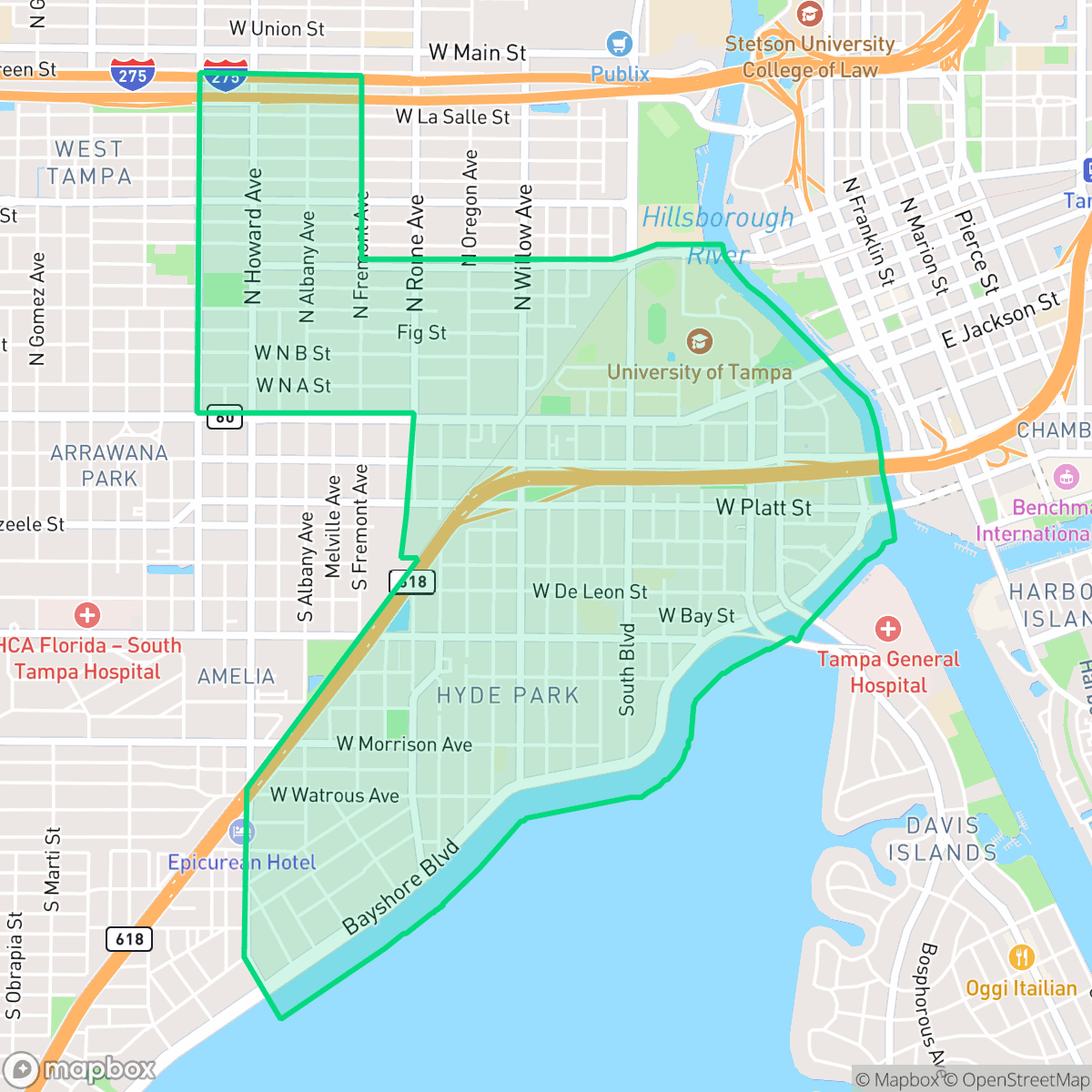
North Hyde Park is a historic neighborhood located west of downtown Tampa, serving as a transitional area between West Tampa and the more renowned Hyde Park district. The neighborhood features a diverse architectural landscape, including early 1900s cracker-style homes and brick structures along Howard Avenue that historically served as cigar factories. To preserve its character, most of the area is governed by the West Tampa Overlay (W.T.O.) district, established in 2004 to ensure new construction aligns with the aesthetic of 1920s development. While it shares proximity to the University of Tampa, North Hyde Park maintains a distinct identity as an older, mixed-use community that balances its industrial history with ongoing residential preservation efforts.
The area functions as a dense, energetic hub where the street grid encourages frequent pedestrian movement. Visual appeal is a defining feature, characterized by well-maintained properties and upscale landscaping that creates a polished environment. The community maintains a balanced mix of residents, ranging from young professionals to families, who contribute to a lively local culture centered around diverse commercial and social offerings.
Prospective residents should consider the trade-offs of living in a central, high-activity district. While the walkability is a significant advantage, the area faces challenges with higher noise levels from nearby roadways and moderate privacy due to the density of residential structures. According to iHuus data, health insurance coverage remains moderate, and while the flood risk is currently categorized as moderate, it is an important factor for long-term planning. The neighborhood is well-suited for those who prioritize proximity to urban amenities and a dynamic lifestyle over quiet, secluded living.
Neighborhood Scores Across 15 Qualities
Residential structures feature mixed spacing with some neighbors situated closely together. According to iHuus data, the level of privacy in this area is slightly lower than the Tampa average due to higher density and narrower setbacks.
A dense, gridded network of sidewalks and well-marked crosswalks allows for easy pedestrian movement. This connectivity significantly exceeds the Tampa average, making it easy to navigate much of the area on foot.
Manicured landscaping, luxury waterfront estates, and numerous private pools create a visual environment that is notably more polished than the Tampa average. According to iHuus data, the area features high-value real estate and well-maintained residential properties.
Access to waterfront trails and various public parks provides reliable space for pet exercise. This availability of green verges and riverside paths makes the area slightly more dog-friendly than the Tampa average.
Residential streets and green spaces exist in relatively equal measure, offering a transition between urban density and suburban openness. This landscape is slightly less dense than the typical Tampa average according to iHuus data.
Extremely active dining, wellness, and nightlife options create a much more energetic atmosphere than the city average. This area functions as a dense, walkable hub with significant foot traffic around local landmarks and diverse commercial destinations.
Frequent sounds from nearby major roadways and transit corridors characterize the area. According to iHuus data, noise levels are higher than the typical Tampa average.
Frequent unhealthy air quality levels pose a significant risk to sensitive groups. According to iHuus data, conditions in this area are notably worse than the Tampa average.
Heavy industry is largely absent, though proximity to major highway corridors and logistics hubs introduces some noise and heavy vehicle traffic. Most of the area remains residential or light commercial, sitting slightly below the city average for industrial density.
Health insurance accessibility in North Hyde Park is roughly in line with the Tampa average. According to iHuus data, a significant portion of the resident population lacks comprehensive coverage.
Political leanings in this area are largely split between conservative and liberal viewpoints, representing a distribution that is slightly more balanced than the Tampa average according to iHuus data.
Residents experience a balanced distribution of young adults, families, and seniors. This demographic spread is slightly more varied than the average seen across Tampa.
Flood safety in this area is slightly higher than the Tampa average, though FEMA has not yet finalized a detailed study for this specific location. Residents should remain aware of potential risks as flood levels are currently categorized as moderate/undetermined.
Address-Level Insights for North Hyde Park


iHuus Neighborhood Intelligence Insights
Get address-level neighborhood insights for North Hyde Park
- Street-level scores — see how individual blocks compare, not just neighborhood averages
- Micro-zone boundaries — identify quiet pockets, flood boundaries, and walkable clusters before you visit
- 15 dimensions in full — walkability, noise, air quality, school quality, insurance coverage, population age profile, urban/rural index, and more
- Boundary risk alerts — know if your address sits near a block boundary where scores drop, the kind of detail no listing will ever mention
- School insights — individual school ratings and insights, not just district-level data
- Compare before you commit — side-by-side data across neighborhoods, down to block precision
No credit card required
Compare with Any Neighborhood
| Dimension | North Hyde Park | Arbor Greene |
|---|---|---|
| 🚶 Walkabilityavg 6.08 | ||
| 🔊 Acoustic Comfortavg 2.94 | ||
| 🤫 Privacy Indexavg 5.25 | ||
| 🎨 Visual Appealavg 5.82 | ||
| 🐕 Dog Friendlinessavg 5.48 | ||
| 🗺️ Urban-Rural Indexavg 6.28 | ||
| ✨ Neighborhood Vibeavg 3.39 | ||
| 🏥 Health Insurance Coverageavg 5.93 | ||
| 🌿 Air Qualityavg 1.36 | ||
| 🏭 Industrial Proximityavg 6.63 | ||
| 🌊 Flood Safetyavg 4.98 | ||
| 🗳️ Ideological Leanavg 5.57 | ||
| 👥 Population Age Profileavg 4.16 | ||
| 🔥 Fire Safety | ||
| 🏫 School Quality |
North Hyde Park Rankings
School Districts Serving North Hyde Park
School Insights for North Hyde Park
Below average outcomes; significant attendance and academic challenges.
School Insights
See what's really behind every school rating near North Hyde Park
- Individual school ratings — each school's own score with outcome context, not just a district average
- Enrollment & class size data — student-to-teacher ratio and how it compares to the state average
- Full demographics breakdown — ethnicity and gender composition for every school in the enrollment zone
- Every school in the district — all schools within the enrollment boundary ranked by rating, not just the closest one
- Grade levels & benchmarks — elementary through high school, with below/above state-average flags
No credit card required