North Bon Air, Tampa
Updated · 1,031 residents
North Bon Air is a centrally located South Tampa community known for its well-maintained homes and mature landscaping. While it offers a lively atmosphere with nearby dining and shops, residents should be aware of significant noise from transit routes and air traffic.
Key Highlights
About North Bon Air
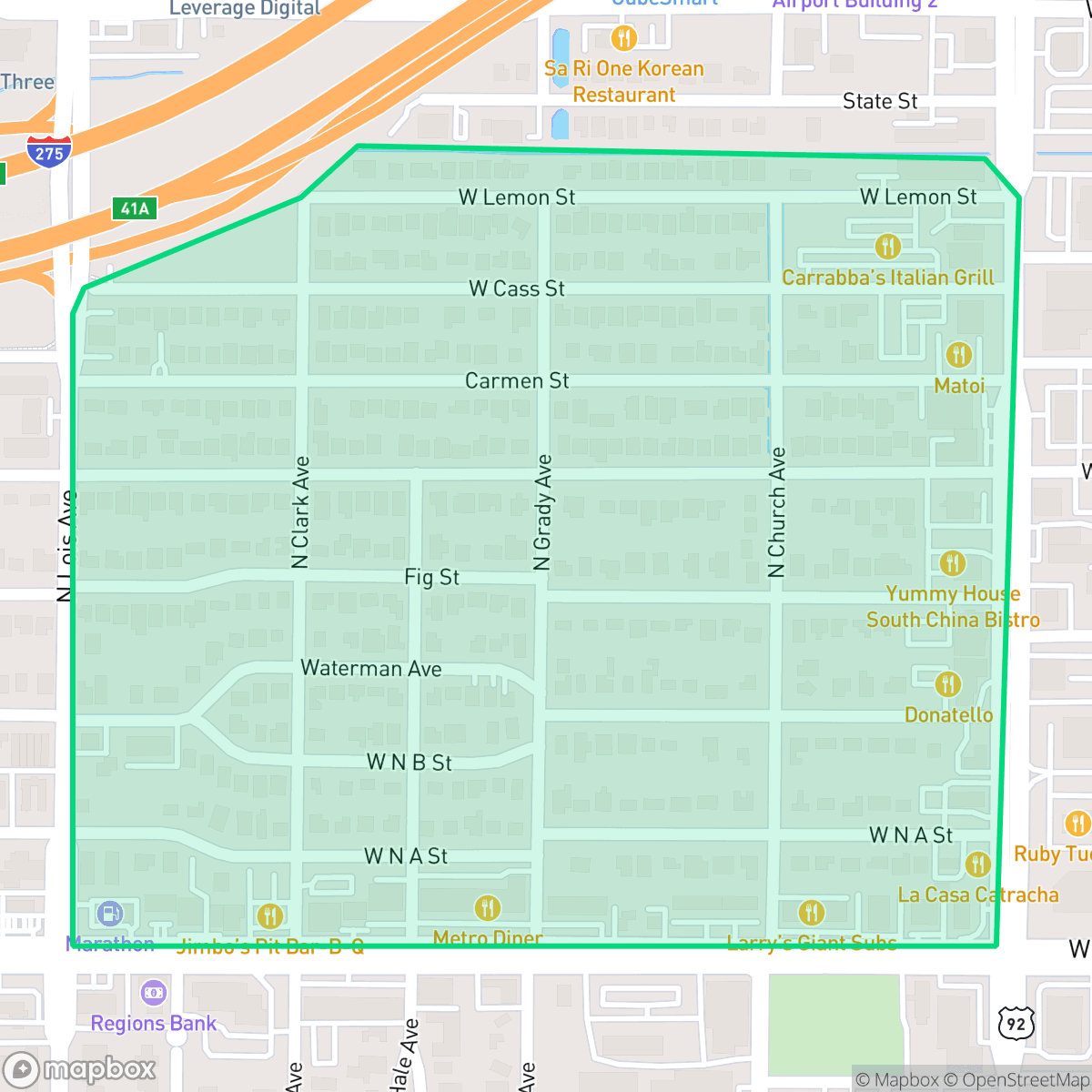
North Bon Air, a residential neighborhood in South Tampa, remained largely undeveloped until the early 1940s. Its growth was spurred by the expansion of Dale Mabry Highway, which was paved to connect MacDill and Drew airfields during World War II. Early development included some of the city's first homes funded by the Federal Housing Authority, notably on North A Street. The neighborhood saw a significant influx of residential construction throughout the 1950s, 1960s, and 1970s. Today, the area is characterized by its commitment to single-family zoning and a mix of modest and renovated homes. Positioned between Lois Avenue and Dale Mabry Highway, the neighborhood maintains a sense of suburban tranquility despite its central location near major transit corridors and the regional amenities of the Westshore district.
The area features an upscale aesthetic characterized by private yards and a semi-rural feel despite its proximity to the Westshore district. Residents benefit from a vibrant local scene that includes various cafes and specialty shops, making it a hub for daily errands and social gatherings. The neighborhood maintains a balanced demographic mix, creating a community where young adults, families, and seniors coexist in a relatively private setting with generous lot spacing. Prospective residents should weigh the neighborhood's visual appeal and central location against certain environmental trade-offs. According to iHuus data, the area experiences higher noise levels from nearby highways and flight paths, as well as air quality concerns that may impact sensitive individuals. While the neighborhood is moderately walkable, major arterial roads act as physical barriers to pedestrian movement. Families are served by the Hillsborough County School District, which provides access to notable academic programs while navigating a complex landscape of varying school performance.
Neighborhood Scores Across 15 Qualities
Homes are situated with a modest amount of separation, providing more buffer between neighbors than the typical Tampa area. Most residential lots feature private yards and fencing, though some houses sit relatively close to one another.
Sidewalks and safe crossings are available throughout much of the neighborhood, providing a slightly more walkable experience than the Tampa average. While residential streets remain quiet and accessible, major arterial roads and nearby highways present notable barriers for pedestrians.
Well-maintained homes and mature landscaping create a more attractive streetscape than the Tampa average. Residents will find many properties feature large yards, private pools, and premium amenities according to iHuus data.
Walking space for pets is constrained by narrow sidewalk verges and a lack of visible public park access. According to iHuus data, the neighborhood offers fewer green buffers and less pet-friendly infrastructure than the Tampa average.
Open land and scattered homes amidst woodlands create a landscape that is slightly more rural than the Tampa average. According to iHuus data, this area features a mix of single-family homes and significant tree canopy.
Local dining, cafes, and specialty shops create a lively atmosphere that is significantly more active than the typical Tampa neighborhood. According to iHuus data, this area serves as a bustling destination for social gatherings and daily errands due to its dense collection of local hubs.
Frequent disturbances from nearby major transit routes and flight paths characterize this area. Acoustic comfort levels are notably lower than the Tampa average, according to iHuus data.
Frequent unhealthy air quality levels pose significant risks to sensitive groups. This area experiences worse air conditions than the typical Tampa average, according to iHuus data.
Residential pockets coexist with light commercial units and logistics hubs, resulting in lower industrial density than the Tampa average. Residents may encounter active transit traffic from nearby services or noise from the central expressway.
Health insurance access is more prevalent among North Bon Air residents than in the broader Tampa area, according to iHuus data.
Political leanings in North Bon Air are fairly evenly split, representing a moderate ideological landscape that is very similar to the broader Tampa area.
Residents live alongside a balanced mix of young adults, families, and seniors. According to iHuus data, this demographic variety is more widely distributed than in many other parts of Tampa.
Residual flood risks exist within this area because it sits partially within a 500-year floodplain. According to iHuus data, the safety level regarding flooding is notably higher than the Tampa average.
Address-Level Insights for North Bon Air


iHuus Neighborhood Intelligence Insights
Get address-level neighborhood insights for North Bon Air
- Street-level scores — see how individual blocks compare, not just neighborhood averages
- Micro-zone boundaries — identify quiet pockets, flood boundaries, and walkable clusters before you visit
- 15 dimensions in full — walkability, noise, air quality, school quality, insurance coverage, population age profile, urban/rural index, and more
- Boundary risk alerts — know if your address sits near a block boundary where scores drop, the kind of detail no listing will ever mention
- School insights — individual school ratings and insights, not just district-level data
- Compare before you commit — side-by-side data across neighborhoods, down to block precision
No credit card required
Compare with Any Neighborhood
| Dimension | North Bon Air | Arbor Greene |
|---|---|---|
| 🚶 Walkabilityavg 6.08 | ||
| 🔊 Acoustic Comfortavg 2.94 | ||
| 🤫 Privacy Indexavg 5.25 | ||
| 🎨 Visual Appealavg 5.82 | ||
| 🐕 Dog Friendlinessavg 5.48 | ||
| 🗺️ Urban-Rural Indexavg 6.28 | ||
| ✨ Neighborhood Vibeavg 3.39 | ||
| 🏥 Health Insurance Coverageavg 5.93 | ||
| 🌿 Air Qualityavg 1.36 | ||
| 🏭 Industrial Proximityavg 6.63 | ||
| 🌊 Flood Safetyavg 4.98 | ||
| 🗳️ Ideological Leanavg 5.57 | ||
| 👥 Population Age Profileavg 4.16 | ||
| 🔥 Fire Safety | ||
| 🏫 School Quality |
North Bon Air Rankings
School Districts Serving North Bon Air
School Insights for North Bon Air
Below average outcomes; significant attendance and academic challenges.
School Insights
See what's really behind every school rating near North Bon Air
- Individual school ratings — each school's own score with outcome context, not just a district average
- Enrollment & class size data — student-to-teacher ratio and how it compares to the state average
- Full demographics breakdown — ethnicity and gender composition for every school in the enrollment zone
- Every school in the district — all schools within the enrollment boundary ranked by rating, not just the closest one
- Grade levels & benchmarks — elementary through high school, with below/above state-average flags
No credit card required