Lowry Park Central, Tampa
Updated · 14,077 residents
Lowry Park Central is defined by its mid-century architectural charm and deep-rooted cultural heritage, anchored by the nearby presence of ZooTampa. The area offers a balanced suburban lifestyle with a steady rhythm of daily activity and a diverse community profile.
Key Highlights
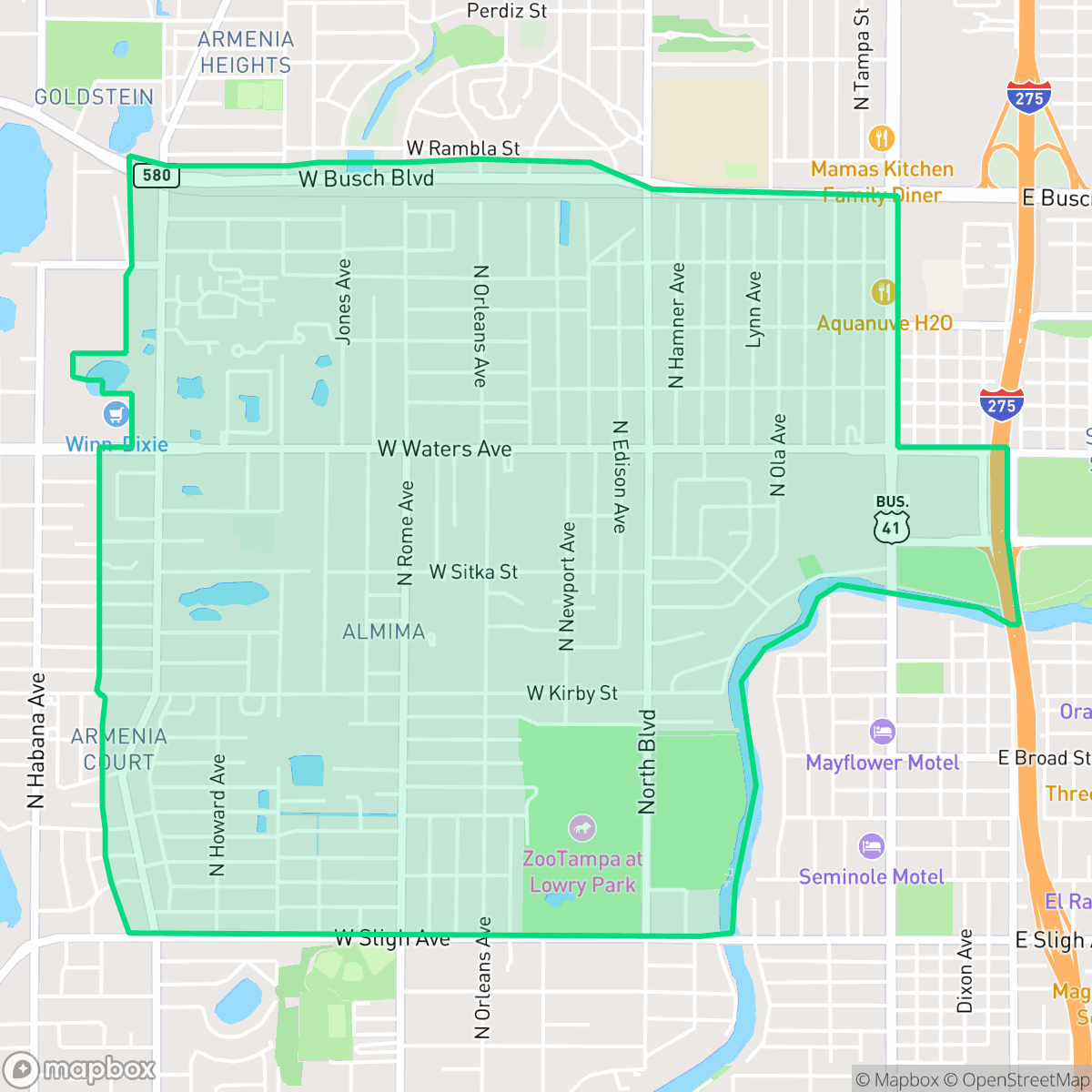
About Lowry Park Central
Lowry Park Central’s development is rooted in the 1918 city purchase of 105 acres from the Cone family, originally intended for a cemetery but repurposed as a public park. Dedicated in 1925 and named for City Commissioner Sumter L. Lowry, the area became a focal point for the community with the 1957 establishment of the Lowry Park Zoo, now known as ZooTampa. The neighborhood gained additional cultural character in the mid-20th century through the creation of 'Fairyland,' a popular fantasy-themed attraction within the park. Today, the neighborhood is characterized by a mix of mid-century residential architecture dating from the 1940s through the 1960s and is noted for its diverse cultural identity, with a significant population of residents tracing their ancestry to Cuba and Puerto Rico.
The neighborhood maintains an established suburban feel, characterized by a mix of single-family homes and apartment complexes nestled along tree-covered streets. Residents benefit from a consistent, middle-class aesthetic that emphasizes modest yards and a sense of privacy that exceeds much of the surrounding city. The area serves as a hub for cultural life, with a steady flow of activity from local dining options and transit connections that keep the community well-connected to the broader Tampa region.
Prospective residents should consider the trade-offs of living in this established environment, as the area experiences moderate traffic noise and air quality conditions that may require attention for sensitive individuals. While the grid-like street layout provides moderate walkability, the dense canopy can occasionally obscure pedestrian paths. Families are served by the Hillsborough County School District, which offers a range of academic options, though performance levels vary significantly across the region. The area is best suited for those seeking an age-diverse community that values a blend of suburban quiet and proximity to cultural landmarks.
Neighborhood Scores Across 15 Qualities
Residential spacing varies from closely packed homes to larger lakeside lots with some wooded buffers. According to iHuus data, the neighborhood offers more separation between neighbors than the Tampa average.
Residential streets are easy to navigate on foot due to a dense grid and low traffic, though heavy tree canopy often obscures sidewalks and major arterials lack continuous paths. This level of connectivity is roughly comparable to the rest of Tampa.
Uniform rooflines and modest yards characterize this area, which presents a visual profile very similar to the rest of Tampa. While some pockets feature larger homes with private pools, much of the landscape consists of consistent, middle-class tract housing.
Walking opportunities for pets vary, as some areas benefit from large nearby sports fields and lakes while others lack accessible public parks. According to iHuus data, the availability of green space for dogs is slightly below the Tampa average.
Suburban residential layouts dominate the area with a mix of single-family homes, apartment complexes, and tree-covered streets. This landscape offers slightly more open space and greenery than the typical Tampa urban environment.
This area offers a more active and balanced mix of residential life and commercial services than the city average. Residents can expect a steady flow of activity from local dining, transit hubs, and cultural venues throughout the day and evening.
Steady traffic sounds from nearby thoroughfares are present, though acoustic levels remain more tranquil than the typical experience in other parts of Tampa.
Unhealthy air quality levels are frequent in this area, presenting significant risks to sensitive groups. According to iHuus data, these conditions are worse than the average seen across Tampa.
Mostly residential areas are interspersed with light commercial corridors and occasional warehouse structures along main transit routes. While some truck traffic and utility-related noise exist near major arterials, the area lacks heavy industrial hazards and stays significantly clearer of large-scale manufacturing than the Tampa average.
Health insurance enrollment levels in this area are slightly lower than the Tampa average. According to iHuus data, a significant portion of the resident population lacks comprehensive coverage.
Political views in this area are distributed fairly evenly between conservative and liberal leaning residents. This distribution is very similar to the broader Tampa area, according to iHuus data.
A balanced mix of young adults, families, and older residents characterizes this area. According to iHuus data, the demographic spread is more varied than the city average.
Residual flood risk exists within this area, though safety levels remain notably higher than the Tampa average according to iHuus data.
Address-Level Insights for Lowry Park Central


iHuus Neighborhood Intelligence Insights
Get address-level neighborhood insights for Lowry Park Central
- Street-level scores — see how individual blocks compare, not just neighborhood averages
- Micro-zone boundaries — identify quiet pockets, flood boundaries, and walkable clusters before you visit
- 15 dimensions in full — walkability, noise, air quality, school quality, insurance coverage, population age profile, urban/rural index, and more
- Boundary risk alerts — know if your address sits near a block boundary where scores drop, the kind of detail no listing will ever mention
- School insights — individual school ratings and insights, not just district-level data
- Compare before you commit — side-by-side data across neighborhoods, down to block precision
No credit card required
Compare with Any Neighborhood
| Dimension | Lowry Park Central | Arbor Greene |
|---|---|---|
| 🚶 Walkabilityavg 6.08 | ||
| 🔊 Acoustic Comfortavg 2.94 | ||
| 🤫 Privacy Indexavg 5.25 | ||
| 🎨 Visual Appealavg 5.82 | ||
| 🐕 Dog Friendlinessavg 5.48 | ||
| 🗺️ Urban-Rural Indexavg 6.28 | ||
| ✨ Neighborhood Vibeavg 3.39 | ||
| 🏥 Health Insurance Coverageavg 5.93 | ||
| 🌿 Air Qualityavg 1.36 | ||
| 🏭 Industrial Proximityavg 6.63 | ||
| 🌊 Flood Safetyavg 4.98 | ||
| 🗳️ Ideological Leanavg 5.57 | ||
| 👥 Population Age Profileavg 4.16 | ||
| 🔥 Fire Safety | ||
| 🏫 School Quality |
Lowry Park Central Rankings
School Districts Serving Lowry Park Central
School Insights for Lowry Park Central
Below average outcomes; significant attendance and academic challenges.
School Insights
See what's really behind every school rating near Lowry Park Central
- Individual school ratings — each school's own score with outcome context, not just a district average
- Enrollment & class size data — student-to-teacher ratio and how it compares to the state average
- Full demographics breakdown — ethnicity and gender composition for every school in the enrollment zone
- Every school in the district — all schools within the enrollment boundary ranked by rating, not just the closest one
- Grade levels & benchmarks — elementary through high school, with below/above state-average flags
No credit card required