Historic Ybor, Tampa
Updated · 2,451 residents
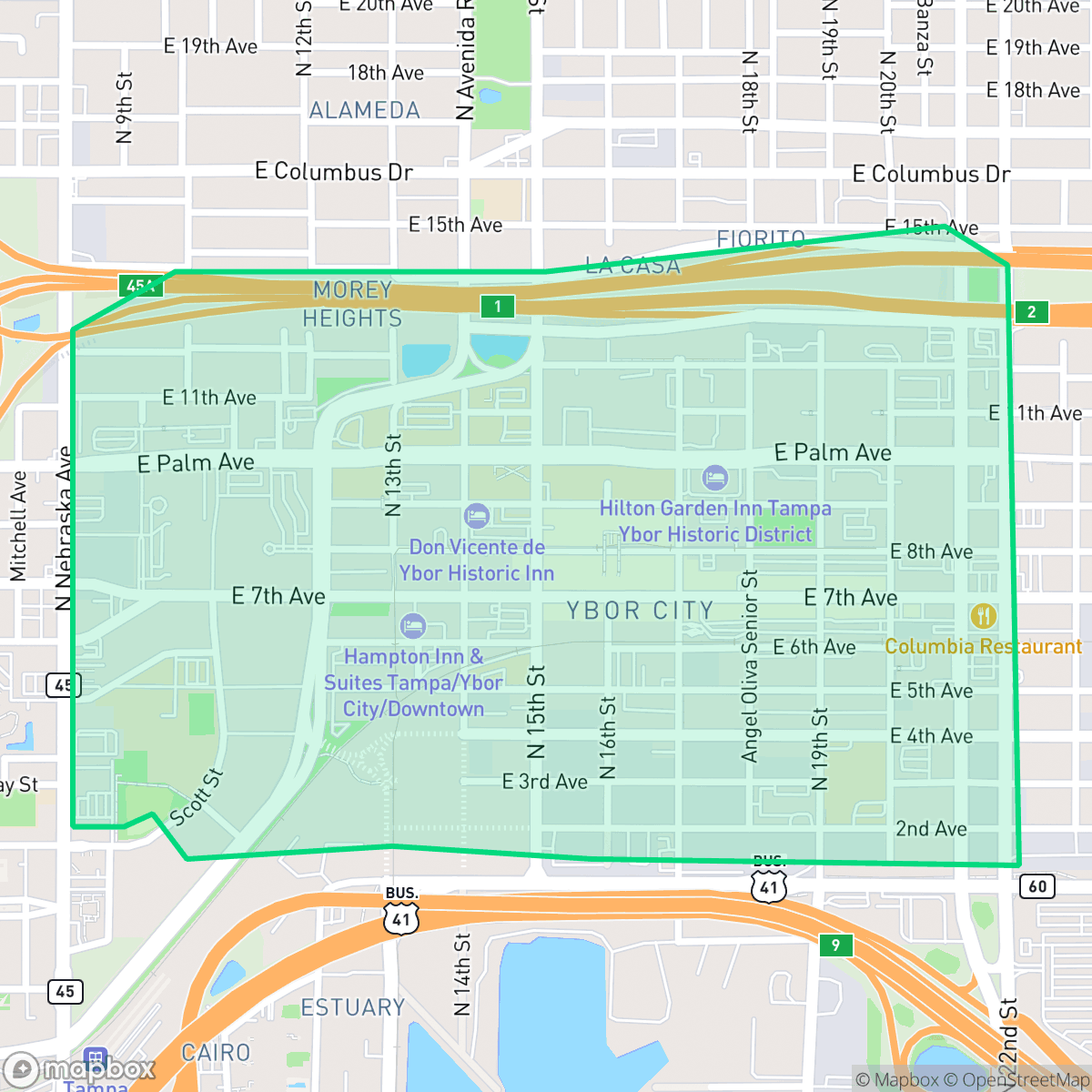
Historic Ybor is a vibrant urban district defined by its iconic red-brick architecture and a high-energy atmosphere centered on Seventh Avenue. While the neighborhood offers excellent pedestrian connectivity, residents should expect a dense urban environment with notable noise levels from nearby transit and traffic.
Key Highlights
About Historic Ybor
Founded in 1885 by Vicente Martinez-Ybor, Ybor City was established as a purpose-built industrial town for cigar manufacturing, quickly earning the title 'Cigar Capital of the World.' The neighborhood is defined by its unique multiethnic heritage, having attracted thousands of Cuban, Spanish, Italian, and Jewish immigrants. Its historic character is preserved through a National Historic Landmark District featuring signature red-brick cigar factories, wrought-iron balconies, and 'casitas'—small worker houses built to foster community retention. Culturally, the area was anchored by mutual aid societies like Centro Español and Circulo Cubano, which provided social and medical support. Seventh Avenue remains the neighborhood's historic commercial heart, while sites like José Martí Park—deeded to the Cuban government—reflect the area's pivotal role in supporting Cuban independence. Today, the neighborhood maintains its distinct identity through its preserved architecture, local culinary traditions, and free-roaming chickens.
The area functions as a bustling hub for social activity, characterized by a dense concentration of nightlife, dining, and cultural venues that keep the streets active throughout the week. Its layout promotes high pedestrian connectivity, allowing residents to navigate the historic grid with ease, though the proximity of major transit infrastructure and highway systems creates distinct barriers for those traveling beyond the immediate district. The neighborhood maintains a diverse demographic profile, appealing to those who prioritize immediate access to entertainment and a strong sense of place over quiet, suburban seclusion.
Prospective residents should weigh the unique cultural appeal against practical livability factors. The area experiences frequent acoustic disturbances from heavy traffic and railroad activity, alongside air quality concerns that are more pronounced than in other parts of Tampa. With a dense urban footprint and limited private green space, pet owners may find pet-friendly infrastructure somewhat restrictive. These trade-offs make the district best suited for young professionals and individuals who thrive in high-energy, walkable urban environments and are willing to accept the realities of living in a densely populated, historic commercial center.
Neighborhood Scores Across 15 Qualities
Residential and commercial structures are situated in close quarters with limited separation between buildings. According to iHuus data, this level of density is notably higher than the Tampa average.
Residential streets feature a dense grid of sidewalks and safe crossings, making the area more walkable than the Tampa average. Significant highway infrastructure and high traffic arterials can create barriers for pedestrians navigating near major thoroughfares.
Characterized by a mix of industrial zones, mid-range apartments, and modest tract housing, the visual landscape is slightly below the Tampa average. According to iHuus data, the area features narrow lots with small yards and lacks high-end luxury residential aesthetics.
Extensive pavement and industrial zones make finding green space difficult, though certain areas near central parks offer relief for pet owners. Overall, dog-friendly infrastructure in this area is below the Tampa average according to iHuus data.
A blend of dense commercial structures and residential streets provides a balance between built environment and open space. This area feels less suburban than the Tampa average according to iHuus data.
Vibrant social activity and a dense concentration of dining, nightlife, and cultural venues make this area significantly more active than the Tampa average. According to iHuus data, the neighborhood features a consistent presence of local hubs and busy street life.
Frequent acoustic disturbances stem from proximity to active railroad tracks and heavy traffic. According to iHuus data, noise levels in this area are more intense than the typical Tampa average.
Frequent unhealthy air quality levels pose a significant risk to sensitive groups. According to iHuus data, the atmospheric conditions in this area are worse than the average for Tampa.
Occasional light commercial activities like breweries and gas stations introduce active transit traffic and localized utility odors. While industrial presence is slightly higher than the Tampa average, the area remains primarily residential with no heavy industry nearby.
Health insurance access among residents is slightly below the Tampa average, according to iHuus data.
Voting patterns and census indicators show a distinctly liberal leaning that is significantly more pronounced than the Tampa average, according to iHuus data.
Residents experience a diverse age distribution that is slightly more balanced across generations than the Tampa average. This mix includes a comparable blend of young professionals, families, and older adults according to iHuus data.
Flood risk levels in this area are slightly higher than the Tampa average, though official FEMA studies for this specific district remain incomplete. Residents should remain aware of potential vulnerabilities during significant weather events according to iHuus data.
Address-Level Insights for Historic Ybor


iHuus Neighborhood Intelligence Insights
Get address-level neighborhood insights for Historic Ybor
- Street-level scores — see how individual blocks compare, not just neighborhood averages
- Micro-zone boundaries — identify quiet pockets, flood boundaries, and walkable clusters before you visit
- 15 dimensions in full — walkability, noise, air quality, school quality, insurance coverage, population age profile, urban/rural index, and more
- Boundary risk alerts — know if your address sits near a block boundary where scores drop, the kind of detail no listing will ever mention
- School insights — individual school ratings and insights, not just district-level data
- Compare before you commit — side-by-side data across neighborhoods, down to block precision
No credit card required
Compare with Any Neighborhood
| Dimension | Historic Ybor | Arbor Greene |
|---|---|---|
| 🚶 Walkabilityavg 6.08 | ||
| 🔊 Acoustic Comfortavg 2.94 | ||
| 🤫 Privacy Indexavg 5.25 | ||
| 🎨 Visual Appealavg 5.82 | ||
| 🐕 Dog Friendlinessavg 5.48 | ||
| 🗺️ Urban-Rural Indexavg 6.28 | ||
| ✨ Neighborhood Vibeavg 3.39 | ||
| 🏥 Health Insurance Coverageavg 5.93 | ||
| 🌿 Air Qualityavg 1.36 | ||
| 🏭 Industrial Proximityavg 6.63 | ||
| 🌊 Flood Safetyavg 4.98 | ||
| 🗳️ Ideological Leanavg 5.57 | ||
| 👥 Population Age Profileavg 4.16 | ||
| 🔥 Fire Safety | ||
| 🏫 School Quality |
Historic Ybor Rankings
School Districts Serving Historic Ybor
School Insights for Historic Ybor
Below average outcomes; significant attendance and academic challenges.
School Insights
See what's really behind every school rating near Historic Ybor
- Individual school ratings — each school's own score with outcome context, not just a district average
- Enrollment & class size data — student-to-teacher ratio and how it compares to the state average
- Full demographics breakdown — ethnicity and gender composition for every school in the enrollment zone
- Every school in the district — all schools within the enrollment boundary ranked by rating, not just the closest one
- Grade levels & benchmarks — elementary through high school, with below/above state-average flags
No credit card required