Historic Hyde Park North Neighborhood, Tampa
Updated · 2,049 residents
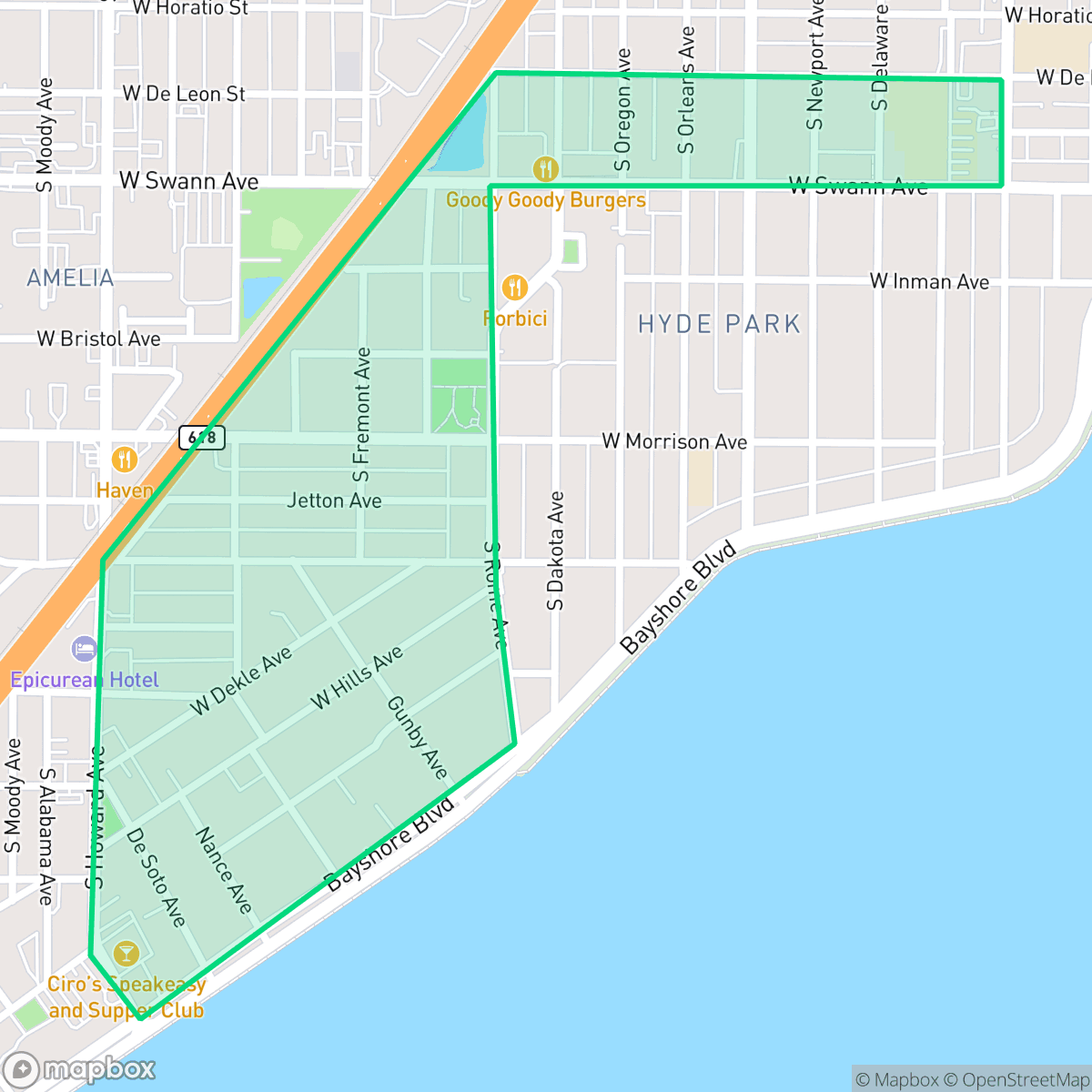
Historic Hyde Park North is a highly walkable neighborhood known for its upscale, scenic streets and vibrant local dining scene. While it offers excellent access to waterfront trails and parks, residents should anticipate significant noise from nearby transit corridors and occasional air quality challenges.
Key Highlights
About Historic Hyde Park North Neighborhood
Historic Hyde Park North, a distinctive residential enclave within Tampa's first western suburb, traces its origins to 1886 when O.H. Platt subdivided the area, naming it after his hometown in Illinois. The neighborhood is defined by its well-preserved architectural stock, featuring a dense concentration of early 20th-century Craftsman, Colonial Revival, and Queen Anne homes. Anchored by signature streets like Snow and Swann Avenues, the area experienced a significant decline during the mid-20th century due to the Great Depression and the construction of the Selmon Expressway. However, a robust 1980s preservation movement, led by local residents and the Hyde Park Preservation Inc., successfully revitalized the neighborhood. Today, it remains a protected historic district, valued for its organic growth, tree-lined avenues, and enduring architectural legacy that bridges Tampa’s Gilded Age history with modern urban living.
The area stands out for its exceptional pedestrian connectivity, featuring a complete grid of sidewalks and frequent marked crossings that make it easy to navigate on foot. Its aesthetic appeal is defined by a blend of manicured landscapes and luxury properties, creating an environment that feels both sophisticated and active. The concentration of wellness studios, local eateries, and cultural venues ensures a lively atmosphere for those who enjoy being in the heart of the city.
Prospective residents should be aware of certain trade-offs, particularly regarding acoustic comfort, as the proximity to major transit routes and highways results in higher noise levels than in more secluded parts of Tampa. While the neighborhood provides ample space for dog owners through its wide green verges and waterfront access, it also faces moderate flood risks and occasional air quality issues. It is best suited for individuals or families who prioritize walkability and an active social life over absolute quiet and who are comfortable with the urban nuances of a historic, central location.
Neighborhood Scores Across 15 Qualities
Housing density is consistent with the city average, offering a mix of tightly packed urban structures and more spacious waterfront estates. According to iHuus data, residents will find varied levels of separation between neighbors depending on their proximity to the inland grid or the water.
Pedestrian access is exceptional due to a complete sidewalk grid, frequent marked crossings, and a scenic waterfront trail. This connectivity significantly surpasses the Tampa average for ease of navigating on foot.
Manicured landscapes, large waterfront estates, and private amenities create a highly aesthetic environment that is notably more visually pleasing than the Tampa average. According to iHuus data, the presence of luxury properties and well-maintained homes contributes to a premium streetscape.
Wide green verges, street trees, and waterfront trails provide ample space for pet owners. According to iHuus data, the availability of connected park-like spaces here is notably higher than the Tampa average.
This area features a blend of medium-density residential and commercial structures, presenting a slightly more developed landscape than the typical Tampa environment. According to iHuus data, the neighborhood maintains a balance between compact urban blocks and accessible open spaces.
A high density of local dining, wellness studios, and cultural venues creates a much more energetic atmosphere than the typical Tampa residential area. This activity is concentrated around walkable corridors near the coastline and historic districts, according to iHuus data.
Frequent disruptions from nearby heavy traffic and transit corridors are common in this area. According to iHuus data, acoustic comfort levels are significantly lower than the Tampa average.
Frequent unhealthy air quality levels pose a significant risk to sensitive groups. According to iHuus data, conditions in this area are notably worse than the Tampa average.
Primarily residential with very little heavy industry, though a major highway corridor and a nearby storage facility introduce localized traffic and noise. This area remains notably more free of industrial activity than the Tampa average, according to iHuus data.
Health insurance enrollment among residents is notably higher than the Tampa average, according to iHuus data.
Political leanings in this area are split fairly evenly between conservative and liberal residents, reflecting a balance similar to the broader Tampa area.
Residents will find a balanced mix of young adults, families, and seniors living in the area. This demographic distribution is roughly in line with the broader Tampa population.
Flood risk in this area is slightly above the Tampa average, though official FEMA studies for this specific zone remain incomplete. According to iHuus data, residents should exercise standard precautions typical of coastal Florida regions.
Address-Level Insights for Historic Hyde Park North Neighborhood


iHuus Neighborhood Intelligence Insights
Get address-level neighborhood insights for Historic Hyde Park North Neighborhood
- Street-level scores — see how individual blocks compare, not just neighborhood averages
- Micro-zone boundaries — identify quiet pockets, flood boundaries, and walkable clusters before you visit
- 15 dimensions in full — walkability, noise, air quality, school quality, insurance coverage, population age profile, urban/rural index, and more
- Boundary risk alerts — know if your address sits near a block boundary where scores drop, the kind of detail no listing will ever mention
- School insights — individual school ratings and insights, not just district-level data
- Compare before you commit — side-by-side data across neighborhoods, down to block precision
No credit card required
Compare with Any Neighborhood
| Dimension | Historic Hyde Park North Neighborhood | Arbor Greene |
|---|---|---|
| 🚶 Walkabilityavg 6.08 | ||
| 🔊 Acoustic Comfortavg 2.94 | ||
| 🤫 Privacy Indexavg 5.25 | ||
| 🎨 Visual Appealavg 5.82 | ||
| 🐕 Dog Friendlinessavg 5.48 | ||
| 🗺️ Urban-Rural Indexavg 6.28 | ||
| ✨ Neighborhood Vibeavg 3.39 | ||
| 🏥 Health Insurance Coverageavg 5.93 | ||
| 🌿 Air Qualityavg 1.36 | ||
| 🏭 Industrial Proximityavg 6.63 | ||
| 🌊 Flood Safetyavg 4.98 | ||
| 🗳️ Ideological Leanavg 5.57 | ||
| 👥 Population Age Profileavg 4.16 | ||
| 🔥 Fire Safety | ||
| 🏫 School Quality |
Historic Hyde Park North Neighborhood Rankings
School Districts Serving Historic Hyde Park North Neighborhood
School Insights for Historic Hyde Park North Neighborhood
Below average outcomes; significant attendance and academic challenges.
School Insights
See what's really behind every school rating near Historic Hyde Park North Neighborhood
- Individual school ratings — each school's own score with outcome context, not just a district average
- Enrollment & class size data — student-to-teacher ratio and how it compares to the state average
- Full demographics breakdown — ethnicity and gender composition for every school in the enrollment zone
- Every school in the district — all schools within the enrollment boundary ranked by rating, not just the closest one
- Grade levels & benchmarks — elementary through high school, with below/above state-average flags
No credit card required