East Ybor, Tampa
Updated · 1,877 residents
East Ybor serves as a functional, residential extension of Tampa's historic cigar district, offering a more subdued atmosphere than the nearby entertainment corridors. While the area provides a diverse demographic mix, residents often navigate challenges related to high traffic noise, limited walkability, and a higher vulnerability to flooding.
Key Highlights
About East Ybor
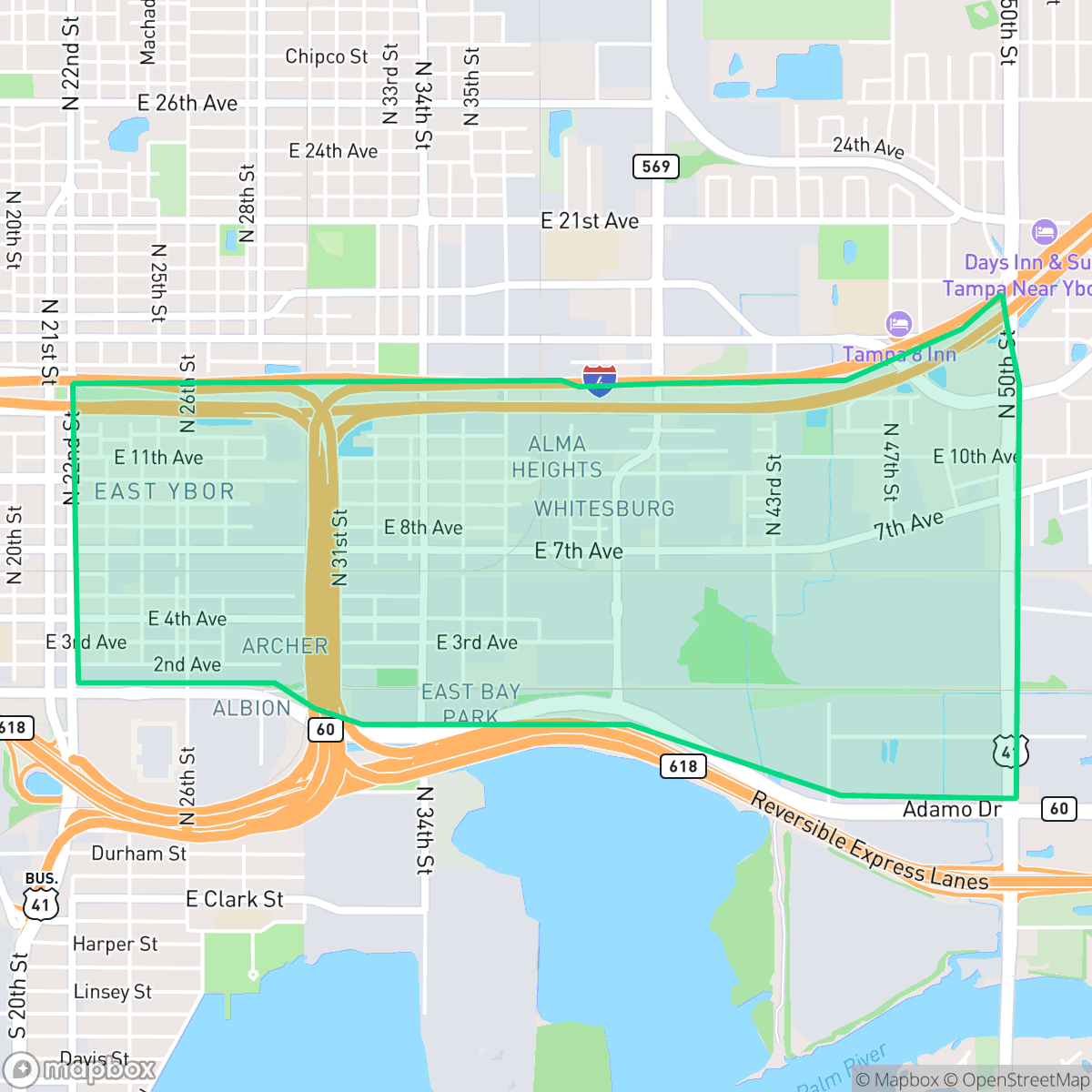
East Ybor is a distinct neighborhood in Tampa, Florida, situated directly east of the historic Ybor City district. Defined by boundaries including Interstate 4 to the north, Adamo Drive to the south, and 39th Street to the east, the area historically served as a residential and industrial extension of the original cigar-manufacturing hub. While Ybor City is renowned for its National Historic Landmark status and 19th-century cigar factory architecture, East Ybor developed as a quieter, residential counterpart. The neighborhood has maintained a unique character through its evolution, transitioning from its early role supporting the cigar industry to becoming a diverse community. Today, it remains a separate entity from the high-traffic entertainment corridor of 7th Avenue, characterized by its own local civic associations and a more residential, suburban-adjacent atmosphere.
The neighborhood functions as a distinct residential pocket characterized by a dense grid of low-rise housing interspersed with light industrial services and storage facilities. Unlike the high-energy entertainment hubs to the west, the area maintains a quiet, functional vibe. Its location near major transit routes and industrial zones contributes to a landscape that prioritizes utility over ornamental aesthetics, resulting in a community that feels balanced but distinctly utilitarian.
Prospective residents should consider that the area presents several practical trade-offs. According to iHuus data, the neighborhood experiences significant noise from nearby rail lines and heavy traffic, and the local infrastructure makes pedestrian travel difficult. Furthermore, the area sits within a 100-year floodplain, which often necessitates flood insurance. While the community benefits from a diverse population and a liberal political leaning, the lack of extensive green space and limited health insurance coverage among residents are important factors for those evaluating the area's long-term livability.
Neighborhood Scores Across 15 Qualities
Residential spacing varies across the neighborhood, featuring closely packed homes along a traditional grid that offers slightly less separation than the Tampa average. According to iHuus data, some areas present higher density with minimal buffers between adjacent properties.
Heavy traffic and a massive multi-lane highway interchange make pedestrian travel uncomfortable. While residential streets feature many sidewalks, the neighborhood is significantly less walkable than the Tampa average according to iHuus data.
Residential lots are characterized by modest, high-density housing with minimal private greenery or luxury amenities. This area presents a significantly less manicured landscape than the average Tampa neighborhood, according to iHuus data.
Sparse greenery and narrow sidewalks make for limited walking opportunities with pets. According to iHuus data, the neighborhood lacks the green verges found more commonly across Tampa.
Residential streets and green spaces are distributed in roughly equal measure. This area features a more suburban character than the typical Tampa neighborhood, characterized by a dense grid of low-rise housing and paved infrastructure.
Activity levels are slightly above the city average, offering a mix of quiet residential stretches and pockets of high energy near local landmarks. While some areas feel car-dependent, others feature lively dining and walkable nodes centered around museums and transit hubs.
Frequent disruptions from nearby railroad tracks and heavy traffic are common in this area. According to iHuus data, acoustic comfort in East Ybor is significantly lower than the Tampa average.
Frequent unhealthy air quality levels pose a significant risk to sensitive groups. According to iHuus data, conditions in this area are slightly worse than the Tampa average.
Frequent encounters with commercial transit, utility odors, and heavy freight activity characterize this area. According to iHuus data, the level of industrial and commercial proximity is notably lower than the Tampa average, as residential pockets are interspersed with light industrial services and storage facilities.
Health insurance access is significantly lower in this area than the Tampa average. According to iHuus data, a small minority of local residents are covered by health insurance plans.
Political leanings in this area skew more liberal than the Tampa average. Residents may find a community with a modest opposing presence, according to iHuus data.
Residents inhabit a demographic landscape ranging from young professionals to older adults. This age distribution remains relatively consistent with the broader Tampa area, according to iHuus data.
Property locations within this area fall inside the 100-year floodplain, which signifies a higher vulnerability to flooding than much of Tampa. According to iHuus data, residents should expect that flood insurance will likely be a requirement for most properties.
Address-Level Insights for East Ybor


iHuus Neighborhood Intelligence Insights
Get address-level neighborhood insights for East Ybor
- Street-level scores — see how individual blocks compare, not just neighborhood averages
- Micro-zone boundaries — identify quiet pockets, flood boundaries, and walkable clusters before you visit
- 15 dimensions in full — walkability, noise, air quality, school quality, insurance coverage, population age profile, urban/rural index, and more
- Boundary risk alerts — know if your address sits near a block boundary where scores drop, the kind of detail no listing will ever mention
- School insights — individual school ratings and insights, not just district-level data
- Compare before you commit — side-by-side data across neighborhoods, down to block precision
No credit card required
Compare with Any Neighborhood
| Dimension | East Ybor | Arbor Greene |
|---|---|---|
| 🚶 Walkabilityavg 6.08 | ||
| 🔊 Acoustic Comfortavg 2.94 | ||
| 🤫 Privacy Indexavg 5.25 | ||
| 🎨 Visual Appealavg 5.82 | ||
| 🐕 Dog Friendlinessavg 5.48 | ||
| 🗺️ Urban-Rural Indexavg 6.28 | ||
| ✨ Neighborhood Vibeavg 3.39 | ||
| 🏥 Health Insurance Coverageavg 5.93 | ||
| 🌿 Air Qualityavg 1.36 | ||
| 🏭 Industrial Proximityavg 6.63 | ||
| 🌊 Flood Safetyavg 4.98 | ||
| 🗳️ Ideological Leanavg 5.57 | ||
| 👥 Population Age Profileavg 4.16 | ||
| 🔥 Fire Safety | ||
| 🏫 School Quality |
East Ybor Rankings
School Districts Serving East Ybor
School Insights for East Ybor
Below average outcomes; significant attendance and academic challenges.
School Insights
See what's really behind every school rating near East Ybor
- Individual school ratings — each school's own score with outcome context, not just a district average
- Enrollment & class size data — student-to-teacher ratio and how it compares to the state average
- Full demographics breakdown — ethnicity and gender composition for every school in the enrollment zone
- Every school in the district — all schools within the enrollment boundary ranked by rating, not just the closest one
- Grade levels & benchmarks — elementary through high school, with below/above state-average flags
No credit card required