East Tampa, Tampa
Updated · 22,722 residents
East Tampa is a historically significant community defined by its mid-century residential character and a steady, active urban rhythm. While the area offers a diverse demographic mix and local dining options, residents should anticipate noise from nearby rail and highway infrastructure alongside challenges with local air quality.
Key Highlights
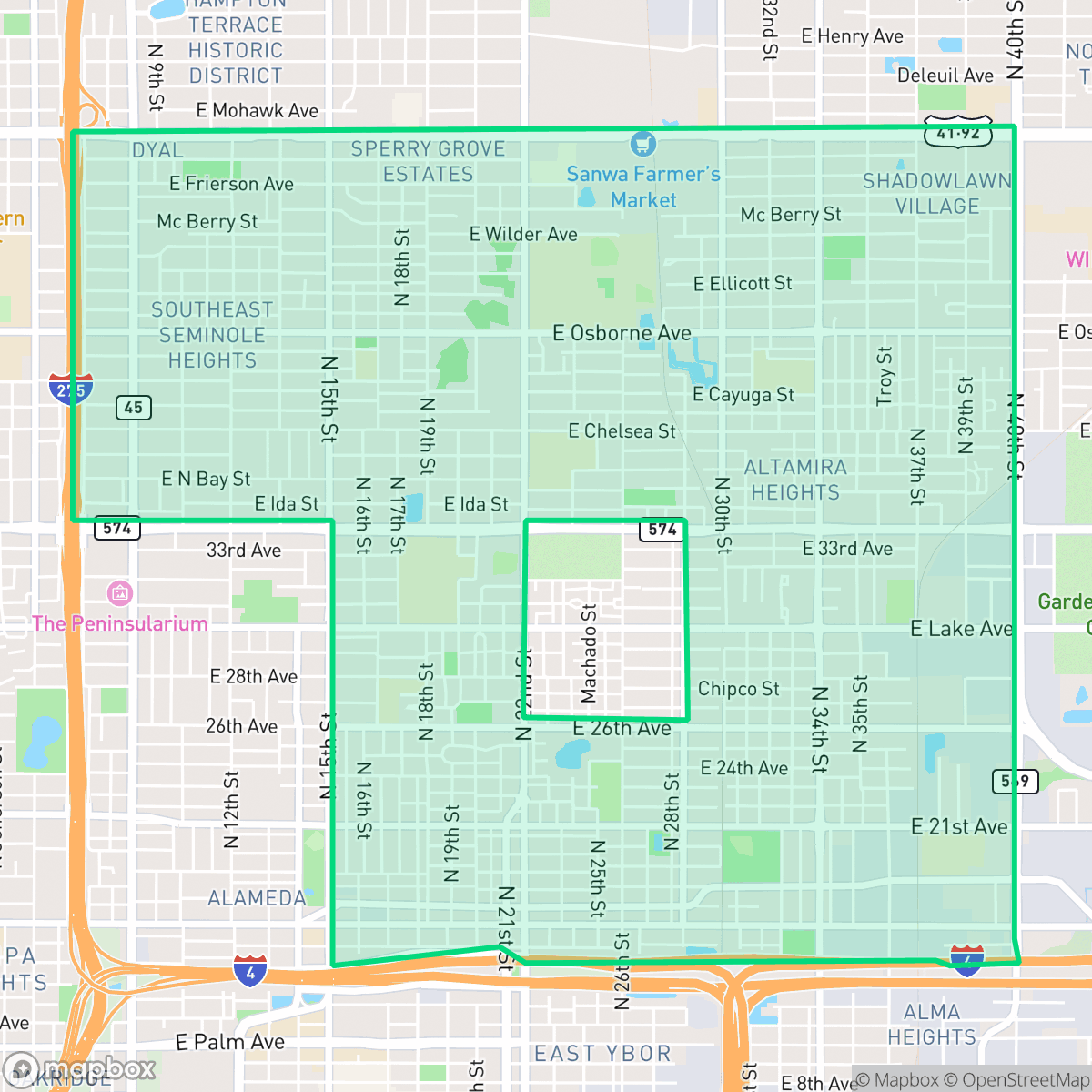
About East Tampa
East Tampa, historically a center for Tampa’s African American community, developed significantly during the early 20th century. The neighborhood encompasses areas like College Hill and Belmont Heights, which became vital hubs for social and economic life during the era of segregation. It played a pivotal role in the local Civil Rights movement, serving as a base for community organizing and activism. The area is defined by its mid-century residential architecture and significant public spaces like Cuscaden Park, which has long served as a community anchor. East Tampa’s identity is deeply rooted in the resilience and cultural contributions of its residents, who established thriving business corridors and institutions that sustained the community through decades of urban transformation and industrial shifts in the surrounding region.
The area functions as a balanced suburban hub where residential grids meet pockets of open land and woodland. The landscape is primarily composed of functional tract housing with modest yards, reflecting a utilitarian aesthetic that prioritizes accessibility over luxury amenities. Residents benefit from a consistent street grid that supports moderate walkability, though connectivity is occasionally hindered by major highway interchanges and busy arterial roads. According to iHuus data, the neighborhood maintains a distinct semi-rural feel through its scattered greenery and open spaces.
Prospective residents should weigh the community's strong progressive identity and diverse age profile against specific environmental factors. The area experiences notable traffic noise and recurring air quality challenges that may impact sensitive groups. While access to healthcare is moderate, the neighborhood remains a practical choice for those seeking a community-oriented environment with a deep connection to local history and a steady, unpretentious pace of life.
Neighborhood Scores Across 15 Qualities
Housing density is slightly higher than the city average, featuring a mix of closely spaced urban lots and standard suburban setbacks. While some areas feature narrow side yards with limited separation, other blocks offer moderate buffers between neighbors.
Residential streets feature a consistent grid and many sidewalks, though connectivity is frequently interrupted by high-traffic arterials and large highway interchanges. Walking remains comparable to the city average due to quiet inner streets and proximity to local amenities.
Standard tract housing dominates the landscape with small yards, simple rooflines, and limited luxury amenities. The area features a more utilitarian aesthetic than the Tampa average, often characterized by closely spaced homes and some industrial presence.
Public areas for pets are somewhat scarce, as most greenery consists of private yards and limited park access. This makes the area less dog-friendly than the broader Tampa average according to iHuus data.
Open land and scattered greenery are slightly more prevalent here than in the rest of Tampa. This creates a suburban landscape defined by pockets of woodland and fields interspersed with residential grids.
A diverse mix of residential streets, warehouses, and local eateries provides a more active atmosphere than the city average. Residents can expect a balanced environment where steady foot traffic and various dining options create an energetic suburban hub.
Frequent sounds from nearby rail lines and major highways characterize the area. According to iHuus data, acoustic disturbance levels are slightly higher than the Tampa average.
Frequent periods of unhealthy air quality pose significant risks to sensitive groups. According to iHuus data, these levels are notably worse than the Tampa city average.
Largely residential in character, this area experiences slightly more industrial activity than the Tampa average due to warehouses and logistics hubs near major highway interchanges. While heavy industrial hazards are absent, residents may encounter intermittent truck traffic and utility-related noise along certain corridors.
Health insurance access is slightly higher than the Tampa average, though a significant portion of the population remains uninsured. According to iHuus data, coverage levels in this area are moderate.
Voting patterns and census indicators show a predominantly liberal political leaning that is significantly more pronounced than the Tampa average. According to iHuus data, this area aligns with strong progressive community values.
Residents live alongside a varied mix of young adults, families, and seniors. This demographic spread is slightly more balanced than the average seen across Tampa.
Residual flood risks exist within the area due to its location in a floodplain; however, this level of safety is notably higher than the Tampa average according to iHuus data.
Address-Level Insights for East Tampa


iHuus Neighborhood Intelligence Insights
Get address-level neighborhood insights for East Tampa
- Street-level scores — see how individual blocks compare, not just neighborhood averages
- Micro-zone boundaries — identify quiet pockets, flood boundaries, and walkable clusters before you visit
- 15 dimensions in full — walkability, noise, air quality, school quality, insurance coverage, population age profile, urban/rural index, and more
- Boundary risk alerts — know if your address sits near a block boundary where scores drop, the kind of detail no listing will ever mention
- School insights — individual school ratings and insights, not just district-level data
- Compare before you commit — side-by-side data across neighborhoods, down to block precision
No credit card required
Compare with Any Neighborhood
| Dimension | East Tampa | Arbor Greene |
|---|---|---|
| 🚶 Walkabilityavg 6.08 | ||
| 🔊 Acoustic Comfortavg 2.94 | ||
| 🤫 Privacy Indexavg 5.25 | ||
| 🎨 Visual Appealavg 5.82 | ||
| 🐕 Dog Friendlinessavg 5.48 | ||
| 🗺️ Urban-Rural Indexavg 6.28 | ||
| ✨ Neighborhood Vibeavg 3.39 | ||
| 🏥 Health Insurance Coverageavg 5.93 | ||
| 🌿 Air Qualityavg 1.36 | ||
| 🏭 Industrial Proximityavg 6.63 | ||
| 🌊 Flood Safetyavg 4.98 | ||
| 🗳️ Ideological Leanavg 5.57 | ||
| 👥 Population Age Profileavg 4.16 | ||
| 🔥 Fire Safety | ||
| 🏫 School Quality |
East Tampa Rankings
School Districts Serving East Tampa
School Insights for East Tampa
Below average outcomes; significant attendance and academic challenges.
School Insights
See what's really behind every school rating near East Tampa
- Individual school ratings — each school's own score with outcome context, not just a district average
- Enrollment & class size data — student-to-teacher ratio and how it compares to the state average
- Full demographics breakdown — ethnicity and gender composition for every school in the enrollment zone
- Every school in the district — all schools within the enrollment boundary ranked by rating, not just the closest one
- Grade levels & benchmarks — elementary through high school, with below/above state-average flags
No credit card required