College Hill, Tampa
Updated · 1,367 residents
College Hill is an established residential enclave in East Tampa known for its grid-based layout and accessible pedestrian paths. The area offers a steady local rhythm with a diverse demographic mix, though residents should expect consistent ambient noise from nearby traffic and varying air quality levels.
Key Highlights
About College Hill
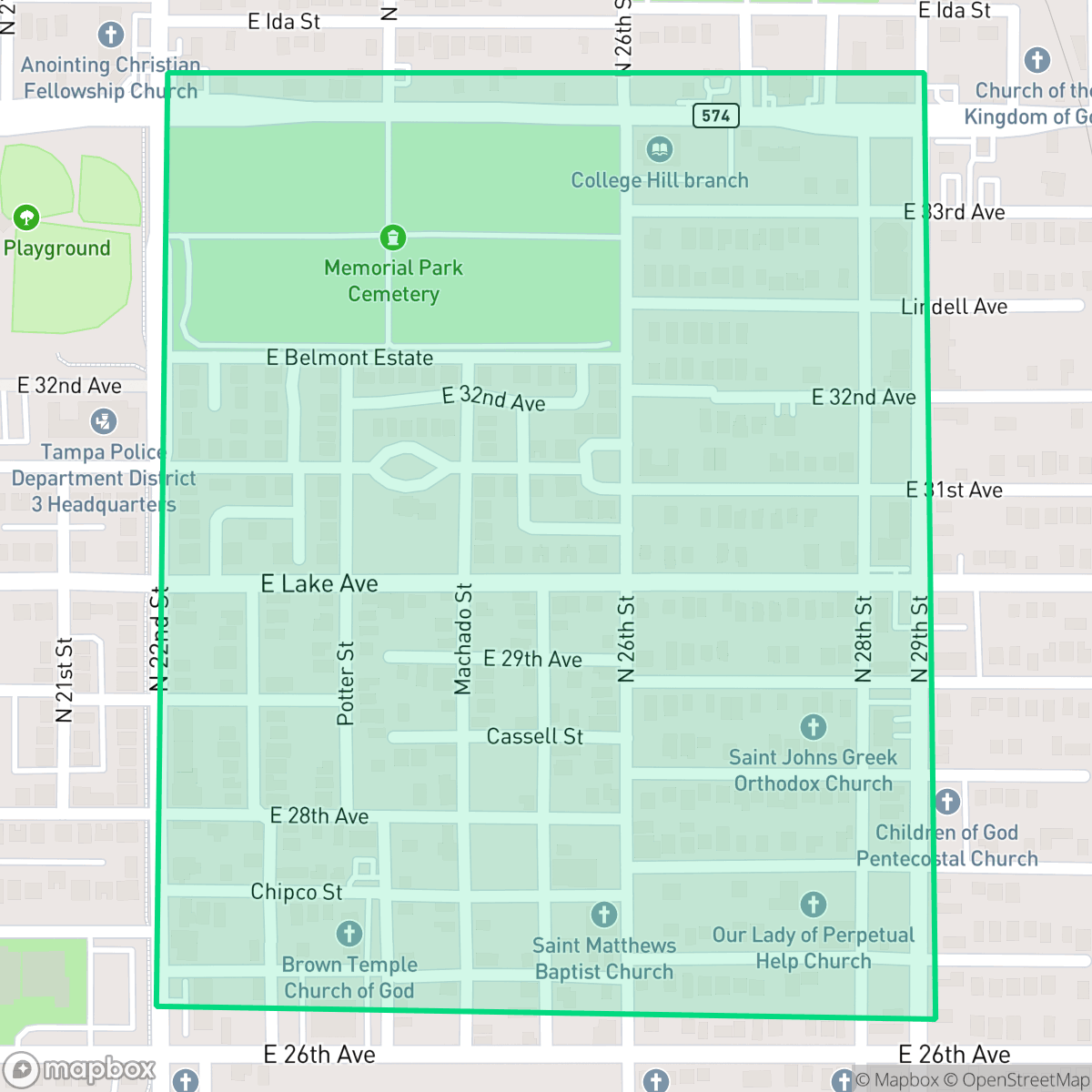
First recorded as A.F. Randall's College Hill Subdivision in 1887, this East Tampa neighborhood emerged as a significant African American enclave. Initially situated outside city limits and lacking basic infrastructure, it became a vital area where Black families could purchase land during the early 20th century. The neighborhood is home to the historic College Hill Cemetery, established in 1889 as one of Tampa's first burial grounds for the Black community. By the mid-20th century, the area became defined by large public housing projects, including College Hill Homes and Ponce de Leon Court, which were later replaced in the early 2000s by the Belmont Heights Estates community. Today, the area is recognized for its deep historical roots in Tampa's Black heritage, often celebrated through local walking tours highlighting its enduring cultural significance.
The neighborhood maintains a suburban openness with a consistent grid layout that supports reliable walking access to local schools and parks. It is a purely residential community, free from industrial sites, which fosters a quiet living environment despite the persistent hum of traffic from surrounding thoroughfares. The area supports a diverse population ranging from young adults to seniors, creating a balanced social fabric that is notably progressive in its political identity. Prospective residents will find a modest housing landscape with uniform, small-scale architecture and moderate privacy between lots. While the neighborhood provides better flood safety than many other parts of the city, those sensitive to air quality should be aware of local environmental data indicating higher pollution levels than the Tampa average. It is well-suited for those seeking a predictable, community-oriented environment with access to essential services and a strong sense of local history.
Neighborhood Scores Across 15 Qualities
Residential lots feature typical suburban spacing with consistent buffers between homes. According to iHuus data, this level of separation provides more privacy than the average area in Tampa.
Sidewalks and a grid layout provide better walkability than the Tampa average, though heavy tree canopy occasionally obscures paths. Low traffic streets and safe crossings offer reliable pedestrian access to local parks and schools.
Housing features uniform, small-scale rooflines and closely spaced lots with limited greenery. This visual landscape is less varied than the typical Tampa neighborhood according to iHuus data.
Access to dedicated pet areas is slightly above the Tampa average due to the presence of a large central grass retention field and wide residential verges. While some parts of the neighborhood feature abundant parks and lakes, other sections have limited public park access or narrow sidewalks.
A mix of established suburban density and open land characterizes the area. This landscape provides slightly more spacious, semi-rural qualities than much of the surrounding Tampa metropolitan area.
Local amenities like cafes, libraries, and small eateries provide a consistent level of activity that is slightly higher than the Tampa average. This suburban grid offers a predictable mix of residential life and essential services without the high energy of a dense urban center.
Steady sound from nearby busy streets creates a constant hum that is notably higher than the average for Tampa. Residents may experience more ambient vehicle noise compared to quieter parts of the city.
Frequent unhealthy air quality levels pose a significant risk to sensitive groups. According to iHuus data, the air pollution in College Hill is notably worse than the Tampa average.
Heavy industry and warehouses are absent from this area, providing a much cleaner environment than the city average. According to iHuus data, the neighborhood consists almost entirely of residential and institutional uses with no detected hazardous sites.
Health insurance accessibility in College Hill is slightly higher than the Tampa average. According to iHuus data, a portion of the resident population remains uninsured.
Voting patterns and census indicators show a significantly more liberal political leaning than the Tampa average. According to iHuus data, this area is characterized by a high concentration of progressive-leaning residents.
Residents live alongside a balanced mix of young adults, families, and seniors. This demographic variety is more diverse than the typical age distribution found across Tampa.
Residual flood risk exists due to the area's location within a 500-year floodplain, though safety levels remain notably higher than the Tampa average according to iHuus data.
Address-Level Insights for College Hill


iHuus Neighborhood Intelligence Insights
Get address-level neighborhood insights for College Hill
- Street-level scores — see how individual blocks compare, not just neighborhood averages
- Micro-zone boundaries — identify quiet pockets, flood boundaries, and walkable clusters before you visit
- 15 dimensions in full — walkability, noise, air quality, school quality, insurance coverage, population age profile, urban/rural index, and more
- Boundary risk alerts — know if your address sits near a block boundary where scores drop, the kind of detail no listing will ever mention
- School insights — individual school ratings and insights, not just district-level data
- Compare before you commit — side-by-side data across neighborhoods, down to block precision
No credit card required
Compare with Any Neighborhood
| Dimension | College Hill | Arbor Greene |
|---|---|---|
| 🚶 Walkabilityavg 6.08 | ||
| 🔊 Acoustic Comfortavg 2.94 | ||
| 🤫 Privacy Indexavg 5.25 | ||
| 🎨 Visual Appealavg 5.82 | ||
| 🐕 Dog Friendlinessavg 5.48 | ||
| 🗺️ Urban-Rural Indexavg 6.28 | ||
| ✨ Neighborhood Vibeavg 3.39 | ||
| 🏥 Health Insurance Coverageavg 5.93 | ||
| 🌿 Air Qualityavg 1.36 | ||
| 🏭 Industrial Proximityavg 6.63 | ||
| 🌊 Flood Safetyavg 4.98 | ||
| 🗳️ Ideological Leanavg 5.57 | ||
| 👥 Population Age Profileavg 4.16 | ||
| 🔥 Fire Safety | ||
| 🏫 School Quality |
College Hill Rankings
School Districts Serving College Hill
School Insights for College Hill
Below average outcomes; significant attendance and academic challenges.
School Insights
See what's really behind every school rating near College Hill
- Individual school ratings — each school's own score with outcome context, not just a district average
- Enrollment & class size data — student-to-teacher ratio and how it compares to the state average
- Full demographics breakdown — ethnicity and gender composition for every school in the enrollment zone
- Every school in the district — all schools within the enrollment boundary ranked by rating, not just the closest one
- Grade levels & benchmarks — elementary through high school, with below/above state-average flags
No credit card required