Beach Park, Tampa
Updated · 4,409 residents
Beach Park is a quiet, upscale neighborhood in Tampa defined by its mature greenery, custom waterfront homes, and a peaceful suburban atmosphere. While the area offers a visually polished environment with low-traffic streets, residents should be aware of potential flood risks and moderate noise levels from surrounding transit routes.
Key Highlights
About Beach Park
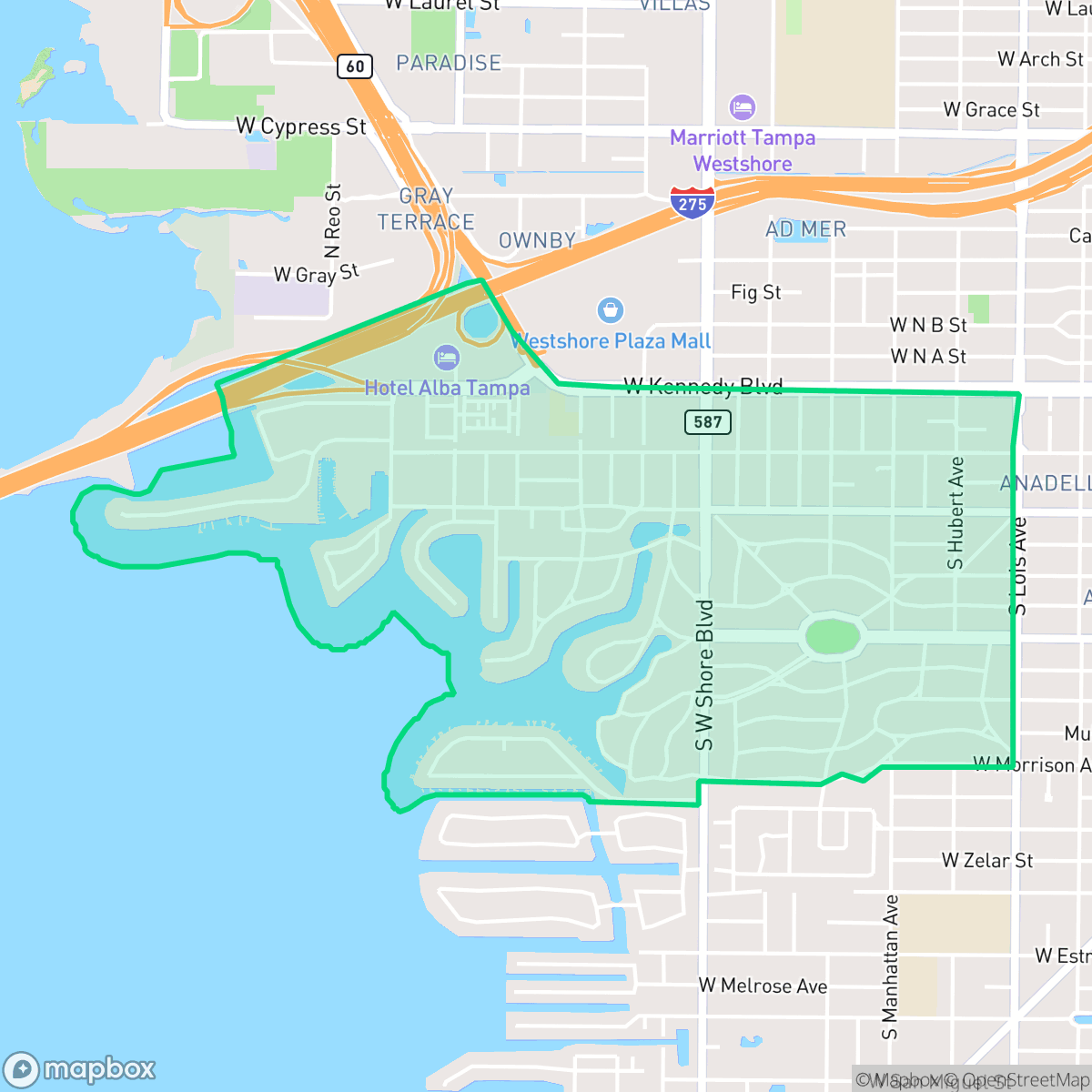
Established during the 1920s Florida Land Boom, Beach Park was developed on land formerly owned by Colonel Harry C. Culbreath, who operated one of the Interbay Peninsula's first orange groves. Developers T. Roy Young and his partners envisioned an exclusive community, platting the area in 1924 with winding streets, man-made canals, and signature entrance gates, remnants of which remain at the intersection of Swann and Lois Avenues. The neighborhood is architecturally distinguished by its original Mediterranean Revival, Spanish Revival, and Italianate estates, designed by notable architects like M. Leo Elliott and Franklin O. Adams. Despite facing high foreclosure rates during the Great Depression, the area matured after World War II, evolving into a prestigious waterfront district known for its grand oak trees and a blend of preserved historic architecture and contemporary luxury estates.
The neighborhood maintains a distinct suburban character characterized by a balanced distribution of residential properties and expansive tree canopies. It is known for its visual appeal, featuring manicured landscapes and private swimming pools that contribute to a polished, high-end residential aesthetic. The area remains largely free of industrial activity, fostering a subdued environment that appeals to those seeking a low-key lifestyle away from the high-density commercial hubs found elsewhere in the city. While the streets are generally quiet and safe for walking, the local pedestrian experience is occasionally affected by natural obstructions from the heavy tree canopy.
Living in this area involves specific trade-offs, particularly regarding environmental factors and infrastructure. The neighborhood is situated within a designated floodplain, which necessitates careful consideration of flood insurance and property protection. Additionally, residents may experience moderate traffic noise and should be mindful of air quality levels, which can occasionally reach unhealthy thresholds. The local population consists primarily of young adults, and the area is served by the Hillsborough County School District, which provides access to notable academic programs. It is best suited for individuals who prioritize privacy and a refined residential setting over high-energy urban amenities.
Neighborhood Scores Across 15 Qualities
Moderate residential density provides a mix of private yards and mature tree buffers between neighbors. According to iHuus data, the level of separation from adjacent properties is roughly in line with the Tampa average.
Low-traffic residential streets and a well-defined grid make for safe walking; however, the overall ease of pedestrian movement is slightly below the Tampa average due to occasional sidewalk obstructions from heavy tree canopy.
Manicured landscapes, large custom homes, and frequent private swimming pools create a visual environment that is more polished than the Tampa average. Many properties feature spacious driveways and mature greenery, according to iHuus data.
Residential streets offer continuous grass verges and shaded sidewalks for walking pets, but the area lacks large designated public parks. According to iHuus data, the availability of dedicated dog-friendly spaces is below the Tampa average.
Residential streets and green spaces are distributed in roughly equal measure, offering a suburban feel that is less dense than the Tampa average. According to iHuus data, the area features a significant tree canopy interspersed with a mix of single-family homes and multi-family apartments.
Subdued residential energy defines this area, which lacks the high-density commercial activity found in more active parts of Tampa. While some pockets near transit hubs or local dining offer unexpected activity, the neighborhood generally functions as a low-key suburban landscape.
Steady hums of local traffic from nearby busy streets are common; however, acoustic levels remain notably higher than the Tampa average according to iHuus data.
Frequent unhealthy air quality levels pose a significant risk to sensitive groups. This neighborhood experiences slightly worse conditions than the Tampa average, according to iHuus data.
Residential and recreational land use dominates the area with very little heavy industry visible. According to iHuus data, the neighborhood remains slightly cleaner of industrial activity than the Tampa average.
Health insurance access in Beach Park is lower than the average seen across Tampa. According to iHuus data, a minority of residents in this area are covered by health insurance plans.
Political leanings in Beach Park are predominantly conservative, which represents a more right-leaning tilt than the average Tampa neighborhood according to iHuus data.
A significant majority of residents are young adults, representing a younger demographic than the Tampa average. This creates a population profile with fewer families and elderly residents compared to other parts of the city.
Significant flood vulnerability exists due to the area's location within a designated floodplain. According to iHuus data, this level of risk is notably higher than the Tampa average and typically necessitates flood insurance.
Address-Level Insights for Beach Park


iHuus Neighborhood Intelligence Insights
Get address-level neighborhood insights for Beach Park
- Street-level scores — see how individual blocks compare, not just neighborhood averages
- Micro-zone boundaries — identify quiet pockets, flood boundaries, and walkable clusters before you visit
- 15 dimensions in full — walkability, noise, air quality, school quality, insurance coverage, population age profile, urban/rural index, and more
- Boundary risk alerts — know if your address sits near a block boundary where scores drop, the kind of detail no listing will ever mention
- School insights — individual school ratings and insights, not just district-level data
- Compare before you commit — side-by-side data across neighborhoods, down to block precision
No credit card required
Compare with Any Neighborhood
| Dimension | Beach Park | Arbor Greene |
|---|---|---|
| 🚶 Walkabilityavg 6.08 | ||
| 🔊 Acoustic Comfortavg 2.94 | ||
| 🤫 Privacy Indexavg 5.25 | ||
| 🎨 Visual Appealavg 5.82 | ||
| 🐕 Dog Friendlinessavg 5.48 | ||
| 🗺️ Urban-Rural Indexavg 6.28 | ||
| ✨ Neighborhood Vibeavg 3.39 | ||
| 🏥 Health Insurance Coverageavg 5.93 | ||
| 🌿 Air Qualityavg 1.36 | ||
| 🏭 Industrial Proximityavg 6.63 | ||
| 🌊 Flood Safetyavg 4.98 | ||
| 🗳️ Ideological Leanavg 5.57 | ||
| 👥 Population Age Profileavg 4.16 | ||
| 🔥 Fire Safety | ||
| 🏫 School Quality |
Beach Park Rankings
School Districts Serving Beach Park
School Insights for Beach Park
Below average outcomes; significant attendance and academic challenges.
School Insights
See what's really behind every school rating near Beach Park
- Individual school ratings — each school's own score with outcome context, not just a district average
- Enrollment & class size data — student-to-teacher ratio and how it compares to the state average
- Full demographics breakdown — ethnicity and gender composition for every school in the enrollment zone
- Every school in the district — all schools within the enrollment boundary ranked by rating, not just the closest one
- Grade levels & benchmarks — elementary through high school, with below/above state-average flags
No credit card required