East Stuart, Stuart
Updated · 568 residents
East Stuart is a vibrant and highly walkable neighborhood known for its active social atmosphere and accessible dining options. While the area offers a semi-rural feel with open woodland and spacious residential lots, residents should be prepared for frequent noise from nearby rail lines and transit corridors.
Key Highlights
About East Stuart
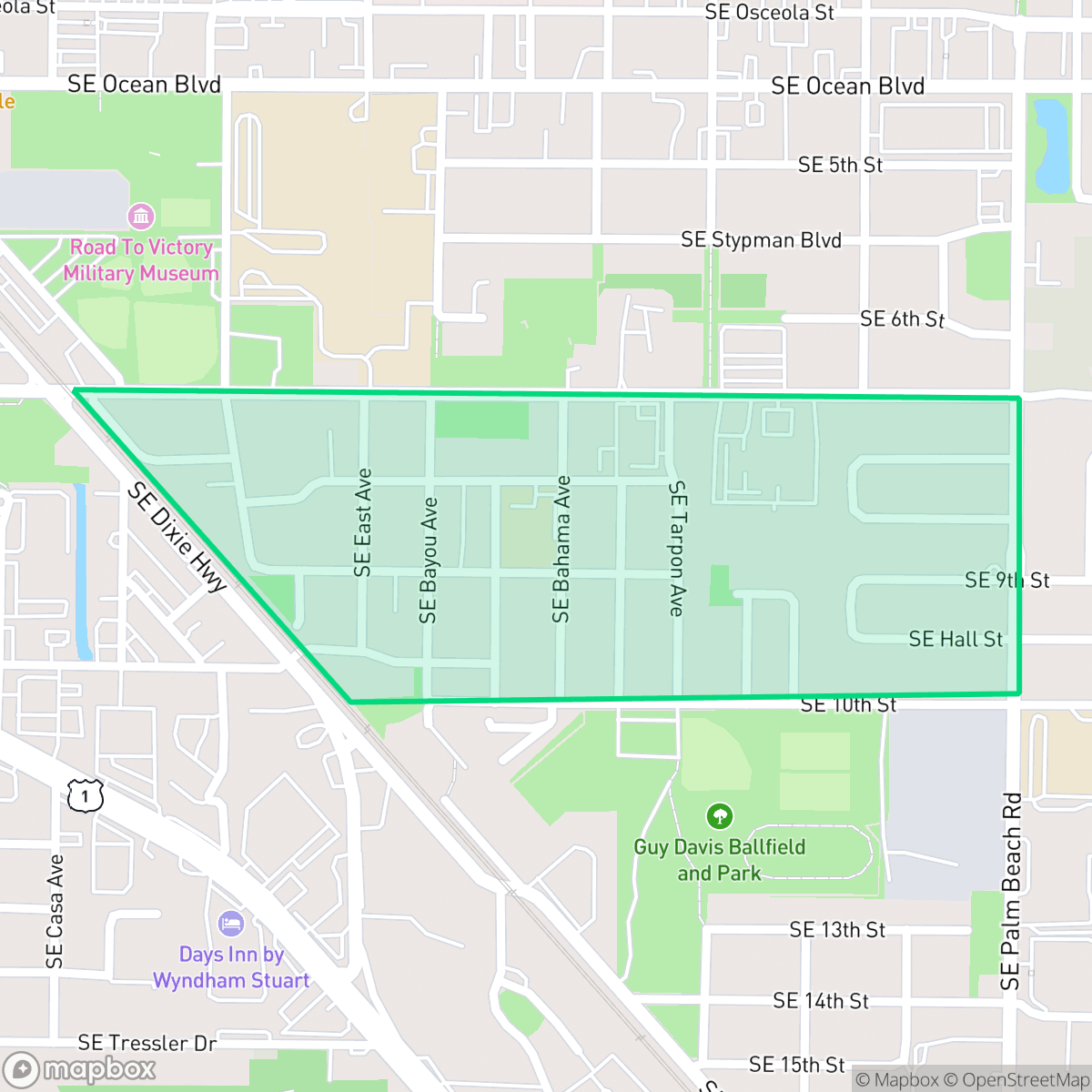
Founded in 1913 as Lincoln Park, East Stuart is the city's most prominent historically Black neighborhood. Originally conceived as a segregated community during the Jim Crow era, it served as the social, religious, and commercial center for Martin County's African American population. The neighborhood, which was also known as Little Dixie in the mid-1920s, was shaped by families descending from the Bahamas and the American South. Key historical landmarks include the former Stuart Training School, which closed in 1964, and several long-standing churches like St. Paul’s A.M.E. and Mt. Calvary Baptist. Today, the area is defined by its rich cultural heritage and ongoing efforts to preserve its architectural history, which includes commercial buildings and residences built between 1913 and 1974, situated between the Florida East Coast Railway tracks and Tarpon Avenue.
The neighborhood functions as a social hub within the city, characterized by a dense concentration of local cafes and hospitality venues that foster an active street life. The layout prioritizes pedestrian access, featuring extensive sidewalks and safe crossings that make navigating the area on foot significantly easier than in many other parts of Stuart. The demographic profile is notably diverse, encompassing a balanced mix of young adults, families, and older residents who contribute to a varied community dynamic.
Prospective residents should consider the trade-offs of living in a mixed-use environment. While the setting provides a moderate level of privacy and a semi-rural landscape, the proximity to industrial activity and major transit lines results in higher levels of ambient traffic noise. Additionally, while the neighborhood benefits from the highly-rated Martin County School District, residents may face challenges regarding health insurance coverage, which is more limited here than in other parts of the city according to iHuus data. The area is best suited for those who prioritize walkability and a community-focused environment over a quiet, secluded setting.
Neighborhood Scores Across 15 Qualities
Residential spacing provides a moderate amount of separation between neighbors; this level of privacy is slightly higher than the Stuart average according to iHuus data.
Sidewalks are available along much of the area and safe crossings are provided. According to iHuus data, this makes navigating the neighborhood on foot significantly easier than in many other parts of Stuart.
Residential vistas feature spacious driveways and large homes, though the overall aesthetic remains slightly below the Stuart average. According to iHuus data, the area lacks the high density of upscale amenities found in more premium parts of the city.
Accessible green spaces and wide paths provide reliable walking routes for pets. According to iHuus data, this area offers more pet-friendly infrastructure than the typical Stuart neighborhood.
Scattered homes and open woodland characterize this area, offering a setting that is slightly less densely developed than the average Stuart neighborhood according to iHuus data.
Active street life and a dense concentration of dining and hospitality options make this area significantly more vibrant than the Stuart average. Residents can access various cafes, bistros, and local transit hubs within a highly walkable suburban environment.
Frequent noise from nearby transit corridors and rail lines impacts the area. According to iHuus data, acoustic comfort in this neighborhood is similar to the broader Stuart area.
Air quality levels are generally acceptable, though occasional days may present concerns for sensitive groups. According to iHuus data, conditions in East Stuart are largely consistent with the average found across Stuart.
Light commercial activities and storage facilities introduce occasional heavy vehicle traffic and loading noise to the area. This level of industrial proximity is slightly higher than the average found throughout Stuart.
Health insurance access among residents is lower than the average seen across Stuart. This indicates a higher proportion of uninsured individuals within the area according to iHuus data.
Political leanings in this area are more evenly distributed than the rest of Stuart. According to iHuus data, residents encounter a balanced mix of conservative and liberal perspectives.
Residents will find a balanced mix of young adults, families, and older populations. This demographic spread is slightly more varied than the typical distribution seen across Stuart.
Residual flood risk exists due to the area's location within a 500-year floodplain, though safety levels remain slightly above the Stuart average according to iHuus data.
Address-Level Insights for East Stuart


iHuus Neighborhood Intelligence Insights
Get address-level neighborhood insights for East Stuart
- Street-level scores — see how individual blocks compare, not just neighborhood averages
- Micro-zone boundaries — identify quiet pockets, flood boundaries, and walkable clusters before you visit
- 15 dimensions in full — walkability, noise, air quality, school quality, insurance coverage, population age profile, urban/rural index, and more
- Boundary risk alerts — know if your address sits near a block boundary where scores drop, the kind of detail no listing will ever mention
- School insights — individual school ratings and insights, not just district-level data
- Compare before you commit — side-by-side data across neighborhoods, down to block precision
No credit card required
Compare with Any Neighborhood
| Dimension | East Stuart | Bessey |
|---|---|---|
| 🚶 Walkabilityavg 6.57 | ||
| 🔊 Acoustic Comfortavg 3.14 | ||
| 🤫 Privacy Indexavg 5.82 | ||
| 🎨 Visual Appealavg 7.01 | ||
| 🐕 Dog Friendlinessavg 5.76 | ||
| 🗺️ Urban-Rural Indexavg 6.66 | ||
| ✨ Neighborhood Vibeavg 4.47 | ||
| 🏥 Health Insurance Coverageavg 6.54 | ||
| 🌿 Air Qualityavg 5.91 | ||
| 🏭 Industrial Proximityavg 6.81 | ||
| 🌊 Flood Safetyavg 6.42 | ||
| 🗳️ Ideological Leanavg 1.96 | ||
| 👥 Population Age Profileavg 5.99 | ||
| 🔥 Fire Safety | ||
| 🏫 School Quality |
East Stuart Rankings
School Districts Serving East Stuart
School Insights for East Stuart
Below average outcomes; significant attendance and academic challenges.
School Insights
See what's really behind every school rating near East Stuart
- Individual school ratings — each school's own score with outcome context, not just a district average
- Enrollment & class size data — student-to-teacher ratio and how it compares to the state average
- Full demographics breakdown — ethnicity and gender composition for every school in the enrollment zone
- Every school in the district — all schools within the enrollment boundary ranked by rating, not just the closest one
- Grade levels & benchmarks — elementary through high school, with below/above state-average flags
No credit card required