The Allendale Association, St. Petersburg
Updated · 1,162 residents
Allendale is a historic, tree-lined residential enclave known for its diverse architectural styles and quiet, pedestrian-friendly streets. Residents enjoy a peaceful atmosphere with high levels of privacy and a strong sense of community, making it a desirable location for those seeking a tranquil suburban environment within the city.
Key Highlights
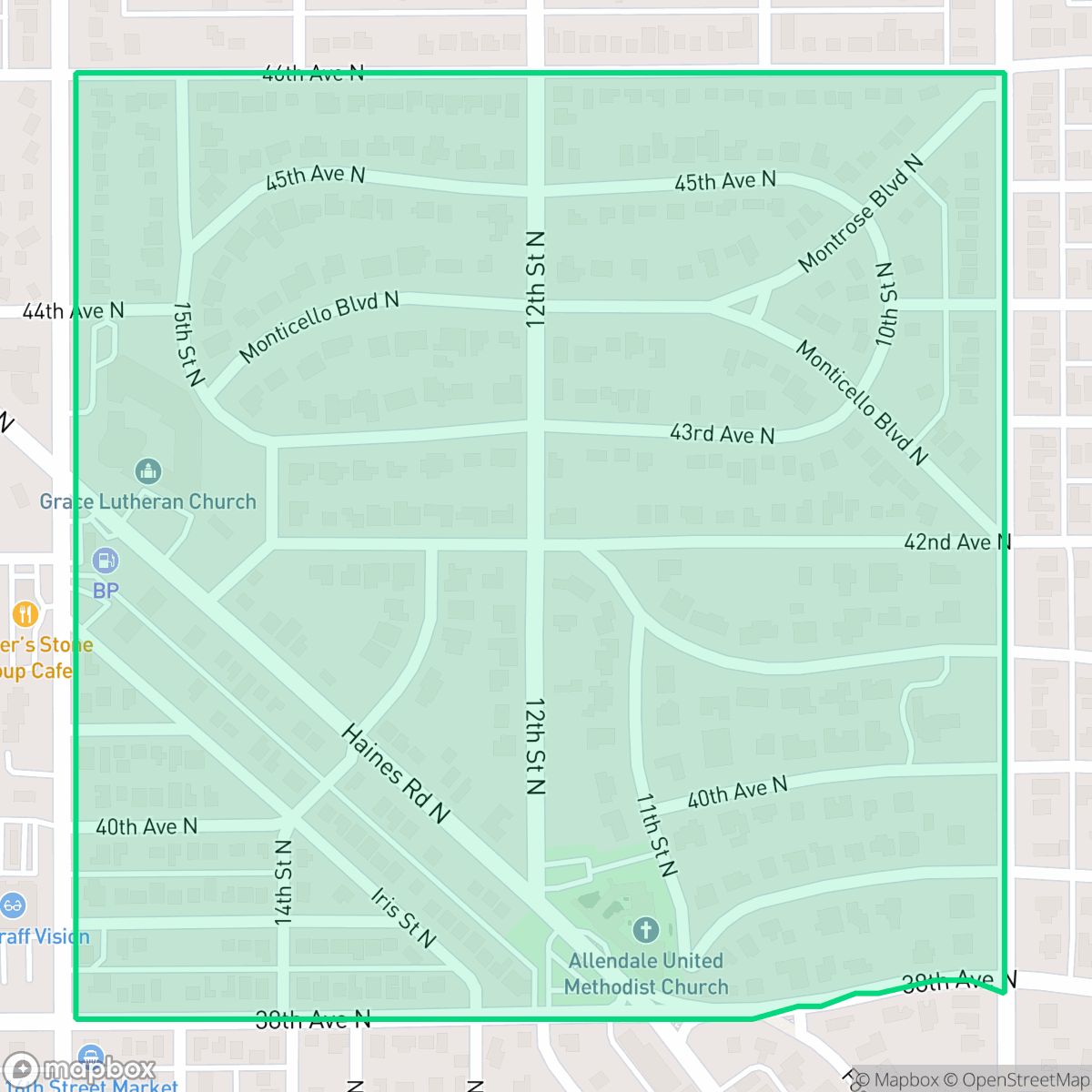
About The Allendale Association
Allendale, represented by The Allendale Association, was established in 1922 by developer Cade B. Allen, a former mason and dairy farmer. Situated on one of St. Petersburg’s highest elevations, the neighborhood is distinct for its non-waterfront, premium residential character. Its development is marked by winding streets and a mature canopy of protected live oaks. The architectural landscape is diverse, featuring early 1920s homes built with stone, brick, and stucco, alongside styles ranging from Mission and Mediterranean to Colonial and Tudor Revival. The neighborhood remains defined by its historic garden club influence, which fostered the area's lush, tree-shaded landscaping and well-preserved aesthetic.
The area maintains a distinct, suburban character defined by its mature canopy and well-maintained properties. It offers a high degree of acoustic comfort, as traffic noise is minimal, and the grid system provides excellent walkability for daily errands or leisure. The community benefits from high levels of health insurance coverage and a stable, diverse age demographic, fostering a reliable and supportive environment for its residents.
While the neighborhood provides a serene retreat, prospective residents should be aware of occasional drainage concerns during extreme weather events. The air quality can occasionally reach levels that are challenging for sensitive groups, which is a common trend throughout the broader city. Overall, this location is well-suited for families and individuals who prioritize a quiet, aesthetically pleasing, and pedestrian-friendly setting with strong institutional support from the local school district.
Neighborhood Scores Across 15 Qualities
Residential spacing provides a balanced level of separation between neighbors, offering slightly more seclusion than the typical St. Petersburg density. While some properties feature large, wooded buffers, other lots maintain standard suburban setbacks.
A consistent sidewalk network and a dense grid system make navigating residential streets easy for pedestrians. This area offers better walkability than the St. Petersburg average, particularly due to low-traffic streets and safe crossings on many thoroughfares.
Large homes and manicured properties contribute to a visual environment that is slightly more polished than the St. Petersburg average. Many residences feature private backyard pools and spacious lots according to iHuus data.
Private yards and shaded residential streets offer decent walking options, though access to large public parks and wide green verges is slightly below the St. Petersburg average according to iHuus data.
Largely comprised of mature residential areas with high tree density, this neighborhood feels slightly more open and less urban than the St. Petersburg average. Residents can expect a mix of single-family homes nestled among woodland and scattered fields.
A balanced mix of residential streets and local dining options provides a level of activity that is slightly higher than the St. Petersburg average. While some pockets remain quiet and suburban, others feature walkable access to neighborhood pubs and parks.
Acoustic levels are notably lower than the St. Petersburg average, characterized primarily by infrequent distant traffic or passing trains. Residents can expect a tranquil environment with very little ambient noise.
Frequent unhealthy air quality levels pose a significant risk to sensitive groups in this area. This condition is consistent with the broader St. Petersburg average according to iHuus data.
Industrial activity and hazardous facilities are absent from this area, offering a cleaner environment than the St. Petersburg average. According to iHuus data, land use is strictly residential and institutional with only minor utility impacts from nearby arterial roads.
Health insurance accessibility is notably higher than the St. Petersburg average, according to iHuus data. This indicates a well-covered resident population with reliable access to medical services.
Political leanings in this area are largely liberal, representing a more progressive tilt than the St. Petersburg average according to iHuus data.
Residents live alongside a balanced spread of young adults, families, and older individuals. This demographic distribution is largely consistent with the broader St. Petersburg area.
Flood safety in this area is significantly higher than the St. Petersburg average, though some residual risk remains as portions of the neighborhood sit within a 500-year floodplain. According to iHuus data, residents may still encounter occasional drainage concerns during extreme weather events.
Address-Level Insights for The Allendale Association


iHuus Neighborhood Intelligence Insights
Get address-level neighborhood insights for The Allendale Association
- Street-level scores — see how individual blocks compare, not just neighborhood averages
- Micro-zone boundaries — identify quiet pockets, flood boundaries, and walkable clusters before you visit
- 15 dimensions in full — walkability, noise, air quality, school quality, insurance coverage, population age profile, urban/rural index, and more
- Boundary risk alerts — know if your address sits near a block boundary where scores drop, the kind of detail no listing will ever mention
- School insights — individual school ratings and insights, not just district-level data
- Compare before you commit — side-by-side data across neighborhoods, down to block precision
No credit card required
Compare with Any Neighborhood
| Dimension | The Allendale Association | Albert Whitted Airport |
|---|---|---|
| 🚶 Walkabilityavg 6.61 | ||
| 🔊 Acoustic Comfortavg 3.78 | ||
| 🤫 Privacy Indexavg 5.45 | ||
| 🎨 Visual Appealavg 6.33 | ||
| 🐕 Dog Friendlinessavg 5.45 | ||
| 🗺️ Urban-Rural Indexavg 6.19 | ||
| ✨ Neighborhood Vibeavg 3.5 | ||
| 🏥 Health Insurance Coverageavg 6.88 | ||
| 🌿 Air Qualityavg 1.87 | ||
| 🏭 Industrial Proximityavg 7.55 | ||
| 🌊 Flood Safetyavg 4.61 | ||
| 🗳️ Ideological Leanavg 6.01 | ||
| 👥 Population Age Profileavg 5.11 | ||
| 🔥 Fire Safety | ||
| 🏫 School Quality |
The Allendale Association Rankings
School Districts Serving The Allendale Association
School Insights for The Allendale Association
Below average outcomes; significant attendance and academic challenges.
School Insights
See what's really behind every school rating near The Allendale Association
- Individual school ratings — each school's own score with outcome context, not just a district average
- Enrollment & class size data — student-to-teacher ratio and how it compares to the state average
- Full demographics breakdown — ethnicity and gender composition for every school in the enrollment zone
- Every school in the district — all schools within the enrollment boundary ranked by rating, not just the closest one
- Grade levels & benchmarks — elementary through high school, with below/above state-average flags
No credit card required