Shore Acres, St. Petersburg
Updated · 4,800 residents
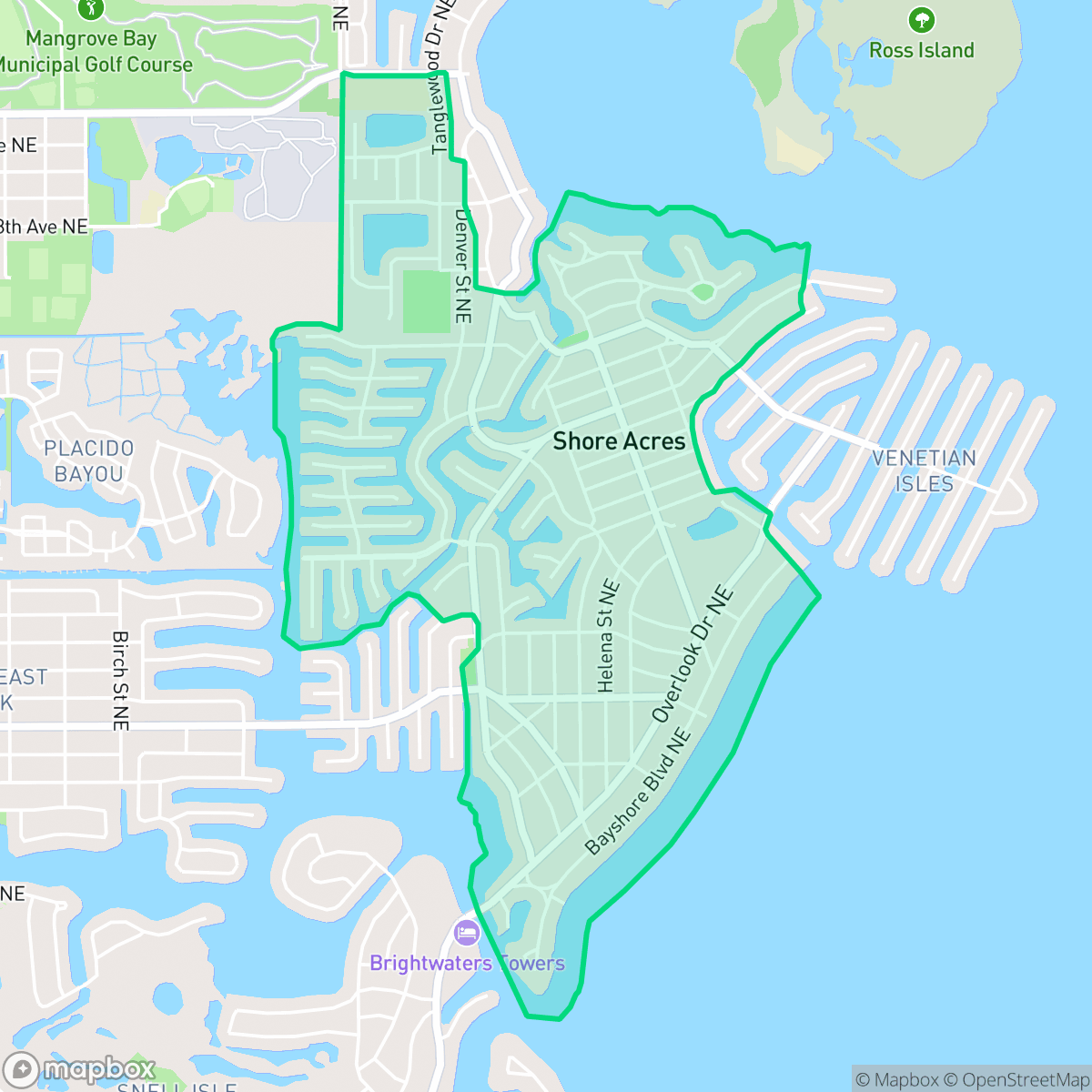
Shore Acres is a quiet, predominantly residential enclave in northeast St. Petersburg defined by its premium waterfront homes and canal-based layout. While the area offers a peaceful, semi-rural atmosphere with walkable streets, residents should be prepared for frequent aircraft noise and a high risk of tidal flooding.
Key Highlights
About Shore Acres
Shore Acres, located in northeast St. Petersburg, was originally platted in 1923 by developer Nathaniel J. Upham on land reclaimed from salt marshes and mangrove swamps. While early development was stalled by the collapse of the 1920s real estate boom, the neighborhood flourished during the post-World War II era. It is architecturally defined by a mix of 1920s-era structures and mid-century modern homes, all laid out in a distinctive, winding maze of streets and dead-end subdivisions that often challenge navigation. Situated just two to seven feet above sea level along the shores of Bayou Grande, Smack's Bayou, and Papy's Bayou, the neighborhood is famously vulnerable to tidal flooding. This low-lying topography has shaped both its suburban character and its modern identity, which is increasingly defined by community resilience and significant municipal investment in coastal flood-mitigation infrastructure.
This tranquil, residential-only community lacks commercial bustle, making it a secluded retreat for those prioritizing privacy and water access. The visual landscape is dominated by upscale properties, many featuring private pools and direct canal access, which creates a premium aesthetic throughout the neighborhood. The street layout encourages pedestrian activity, providing a quiet environment for walking despite the lack of local commercial destinations. According to data, the neighborhood maintains a balanced age demographic, appealing to a mix of families and older residents who value a stable, quiet environment. Prospective residents should consider the environmental and infrastructure realities of the area. The neighborhood experiences frequent aircraft noise and poor air quality, alongside a notable vulnerability to tidal flooding that requires careful consideration. The area is served by the stable Pinellas County School District, which maintains high academic standards despite broader regional enrollment challenges. This community is best suited for those who value a water-focused lifestyle and are comfortable navigating the specific environmental trade-offs associated with living in a low-lying coastal zone.
Neighborhood Scores Across 15 Qualities
Residential structures are separated by yards and canals, providing more spacing than the St. Petersburg average. According to iHuus data, houses maintain a moderate distance from one another with sufficient backyard buffering.
Low-traffic streets and accessible sidewalks provide a pedestrian experience that is slightly better than the St. Petersburg average. Many residential areas feature safe crossings and tree-lined paths suitable for walking.
Large homes featuring private pools and waterfront canal access define this area. According to iHuus data, the visual landscape is notably more premium than the St. Petersburg average.
Private yards are common throughout the area, but residents will find fewer immediate public parks and narrower roadside verges than is typical for St. Petersburg.
Open land and scattered greenery provide a more spacious, semi-rural atmosphere compared to the denser urban layout of the St. Petersburg average; however, certain pockets feature closely packed single-family homes along canal-based residential layouts.
Very limited commercial activity and a lack of local destinations define this tranquil area. According to iHuus data, the neighborhood offers significantly less street life and fewer points of interest than the St. Petersburg average.
Frequent noise from nearby airport runway operations defines the acoustic environment. This level of disturbance is significantly higher than the St. Petersburg average, according to iHuus data.
Frequent unhealthy air quality levels pose a significant risk to sensitive groups. This area experiences air pollution levels that are slightly worse than the St. Petersburg average, according to iHuus data.
Industrial facilities and warehouses are absent from this area, providing a more tranquil environment than the St. Petersburg average. According to iHuus data, the neighborhood consists of residential streets and waterfront spaces without proximity to heavy industry or hazardous sites.
Health insurance access among residents is exceptionally high, significantly surpassing the St. Petersburg average according to iHuus data.
Conservative values represent a majority in this area, which is notably more conservative than the St. Petersburg average according to iHuus data.
A diverse mix of young adults, families, and older residents characterizes the area. According to iHuus data, this age distribution is slightly more varied than the average found across St. Petersburg.
Significant flood risk exists due to the area's location within a designated floodplain; according to iHuus data, this level of vulnerability is notably higher than the St. Petersburg average.
Address-Level Insights for Shore Acres


iHuus Neighborhood Intelligence Insights
Get address-level neighborhood insights for Shore Acres
- Street-level scores — see how individual blocks compare, not just neighborhood averages
- Micro-zone boundaries — identify quiet pockets, flood boundaries, and walkable clusters before you visit
- 15 dimensions in full — walkability, noise, air quality, school quality, insurance coverage, population age profile, urban/rural index, and more
- Boundary risk alerts — know if your address sits near a block boundary where scores drop, the kind of detail no listing will ever mention
- School insights — individual school ratings and insights, not just district-level data
- Compare before you commit — side-by-side data across neighborhoods, down to block precision
No credit card required
Compare with Any Neighborhood
| Dimension | Shore Acres | Albert Whitted Airport |
|---|---|---|
| 🚶 Walkabilityavg 6.61 | ||
| 🔊 Acoustic Comfortavg 3.78 | ||
| 🤫 Privacy Indexavg 5.45 | ||
| 🎨 Visual Appealavg 6.33 | ||
| 🐕 Dog Friendlinessavg 5.45 | ||
| 🗺️ Urban-Rural Indexavg 6.19 | ||
| ✨ Neighborhood Vibeavg 3.5 | ||
| 🏥 Health Insurance Coverageavg 6.88 | ||
| 🌿 Air Qualityavg 1.87 | ||
| 🏭 Industrial Proximityavg 7.55 | ||
| 🌊 Flood Safetyavg 4.61 | ||
| 🗳️ Ideological Leanavg 6.01 | ||
| 👥 Population Age Profileavg 5.11 | ||
| 🔥 Fire Safety | ||
| 🏫 School Quality |
Shore Acres Rankings
School Districts Serving Shore Acres
School Insights for Shore Acres
Below average outcomes; significant attendance and academic challenges.
School Insights
See what's really behind every school rating near Shore Acres
- Individual school ratings — each school's own score with outcome context, not just a district average
- Enrollment & class size data — student-to-teacher ratio and how it compares to the state average
- Full demographics breakdown — ethnicity and gender composition for every school in the enrollment zone
- Every school in the district — all schools within the enrollment boundary ranked by rating, not just the closest one
- Grade levels & benchmarks — elementary through high school, with below/above state-average flags
No credit card required