Ponce De Leon, St. Petersburg
Updated · 1,583 residents
Ponce De Leon is a residential neighborhood in St. Petersburg defined by its suburban grid and a mix of mid-century architecture. While the area offers a lively atmosphere with accessible local dining and retail, residents should be aware of challenges regarding air quality and limited public green space.
Key Highlights
About Ponce De Leon
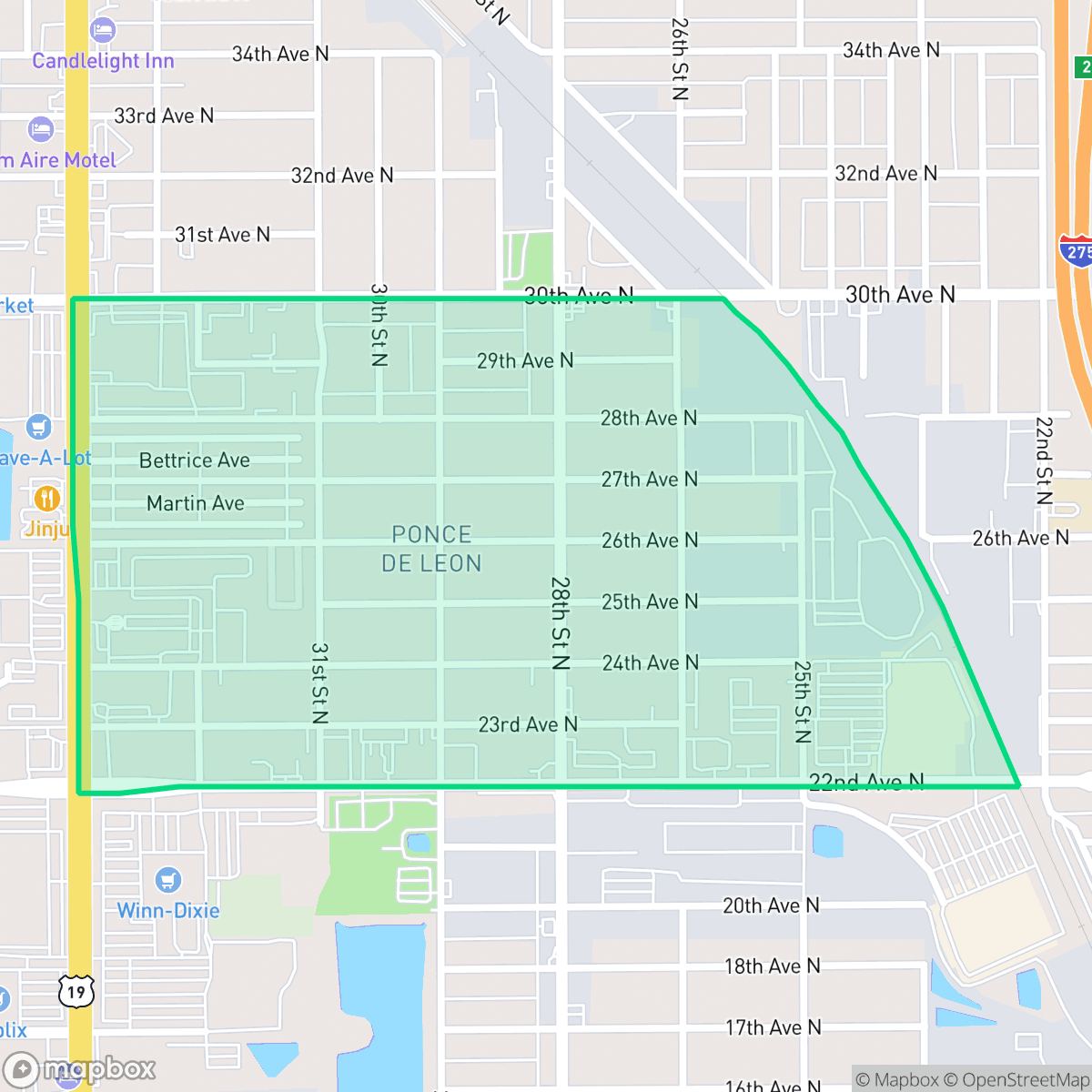
The Ponce de Leon neighborhood in St. Petersburg, bounded by 25th to 31st Street North and 22nd to 30th Avenues North, is a residential area whose name is considered a historical misnomer, as the official Ponce de Leon Park subdivision lies outside its boundaries. Established as an association in 1993, the neighborhood features housing developed primarily in two phases: the late 1940s to early 1950s, and a later expansion from the late 1950s through the 1970s. The area is characterized by a lack of sidewalks, prevalent carports, and a transition from asbestos-shingled homes in the east to larger masonry structures in the west. Historically surrounded by light industry, the neighborhood has long maintained a functional connection to local businesses, including long-standing establishments like Tinney Rug Cleaners, which dates back to 1920.
The neighborhood features a dense suburban grid that provides better pedestrian connectivity than much of the city. It functions as a vibrant local hub, offering residents convenient access to fitness studios, independent shops, and diverse eateries. The housing stock consists of modest single-family homes that provide a moderate level of privacy, though the visual landscape is largely uniform across the residential blocks.
This area is best suited for those who prioritize proximity to local commerce over expansive outdoor space. Potential residents should consider that air quality can occasionally be poor, and the proximity to light industrial zones and arterial roads results in a steady hum of traffic. While the neighborhood is safer from flooding than many parts of the city, the lack of public parks makes it less ideal for pet owners seeking immediate outdoor recreation.
Neighborhood Scores Across 15 Qualities
Residential spacing provides a moderate level of seclusion with some buffer between neighbors. According to iHuus data, this density remains slightly above the St. Petersburg average due to varying lot sizes and mixed housing types.
Sidewalks and safe crossings are widely available along residential streets, offering slightly better pedestrian connectivity than the St. Petersburg average. While many interior roads are easy to navigate on foot, major arterial roads create some separation within the grid.
Modest tract housing and dense mobile home parks characterize the landscape, which offers slightly less visual variety than the St. Petersburg average. Residential lots are typically small with simple rooflines and limited private greenery.
Minimal public park access and narrow sidewalks make it difficult to find open walking areas for pets. Most green space in this area consists of private backyards, which is below the city average for accessible pet-friendly infrastructure.
Residential layouts consist primarily of a dense suburban grid featuring single-family homes and commercial corridors. This area offers slightly more open land than the typical St. Petersburg urban landscape, according to iHuus data.
Active dining options and varied retail amenities make this area significantly more lively than the St. Petersburg average. Residents can find a dense mix of fitness studios, independent shops, and diverse eateries within walkable suburban pockets.
Moderate levels of street noise persist due to local traffic from nearby thoroughfares, though this remains slightly quieter than the city average according to iHuus data.
Frequent unhealthy air quality levels pose a significant risk to sensitive groups; according to iHuus data, conditions in this area are slightly worse than the St. Petersburg average.
Light industrial facilities and a diagonal rail corridor introduce moderate truck traffic and occasional noise. This level of commercial activity is lower than the city average, as the area primarily consists of retail and storage units rather than heavy manufacturing.
Health insurance enrollment among residents is lower than the St. Petersburg average, according to iHuus data.
Political leanings in this area trend more liberal than the St. Petersburg average, according to iHuus data.
A diverse mix of young adults, families, and older residents characterizes the area. This demographic spread is largely consistent with the broader St. Petersburg average according to iHuus data.
Residual flood risks exist within this area, though the neighborhood remains significantly safer from flooding than the St. Petersburg average according to iHuus data.
Address-Level Insights for Ponce De Leon


iHuus Neighborhood Intelligence Insights
Get address-level neighborhood insights for Ponce De Leon
- Street-level scores — see how individual blocks compare, not just neighborhood averages
- Micro-zone boundaries — identify quiet pockets, flood boundaries, and walkable clusters before you visit
- 15 dimensions in full — walkability, noise, air quality, school quality, insurance coverage, population age profile, urban/rural index, and more
- Boundary risk alerts — know if your address sits near a block boundary where scores drop, the kind of detail no listing will ever mention
- School insights — individual school ratings and insights, not just district-level data
- Compare before you commit — side-by-side data across neighborhoods, down to block precision
No credit card required
Compare with Any Neighborhood
| Dimension | Ponce De Leon | Albert Whitted Airport |
|---|---|---|
| 🚶 Walkabilityavg 6.61 | ||
| 🔊 Acoustic Comfortavg 3.78 | ||
| 🤫 Privacy Indexavg 5.45 | ||
| 🎨 Visual Appealavg 6.33 | ||
| 🐕 Dog Friendlinessavg 5.45 | ||
| 🗺️ Urban-Rural Indexavg 6.19 | ||
| ✨ Neighborhood Vibeavg 3.5 | ||
| 🏥 Health Insurance Coverageavg 6.88 | ||
| 🌿 Air Qualityavg 1.87 | ||
| 🏭 Industrial Proximityavg 7.55 | ||
| 🌊 Flood Safetyavg 4.61 | ||
| 🗳️ Ideological Leanavg 6.01 | ||
| 👥 Population Age Profileavg 5.11 | ||
| 🔥 Fire Safety | ||
| 🏫 School Quality |
Ponce De Leon Rankings
School Districts Serving Ponce De Leon
School Insights for Ponce De Leon
Below average outcomes; significant attendance and academic challenges.
School Insights
See what's really behind every school rating near Ponce De Leon
- Individual school ratings — each school's own score with outcome context, not just a district average
- Enrollment & class size data — student-to-teacher ratio and how it compares to the state average
- Full demographics breakdown — ethnicity and gender composition for every school in the enrollment zone
- Every school in the district — all schools within the enrollment boundary ranked by rating, not just the closest one
- Grade levels & benchmarks — elementary through high school, with below/above state-average flags
No credit card required