Placido Bayou, St. Petersburg
Updated · 1,098 residents
Placido Bayou is a gated residential community in northeast St. Petersburg known for its lush, preserve-style landscape and quiet, upscale aesthetic. The neighborhood features high walkability and excellent access to green spaces, though it experiences consistent noise from nearby aircraft and faces potential flood risks.
Key Highlights
About Placido Bayou
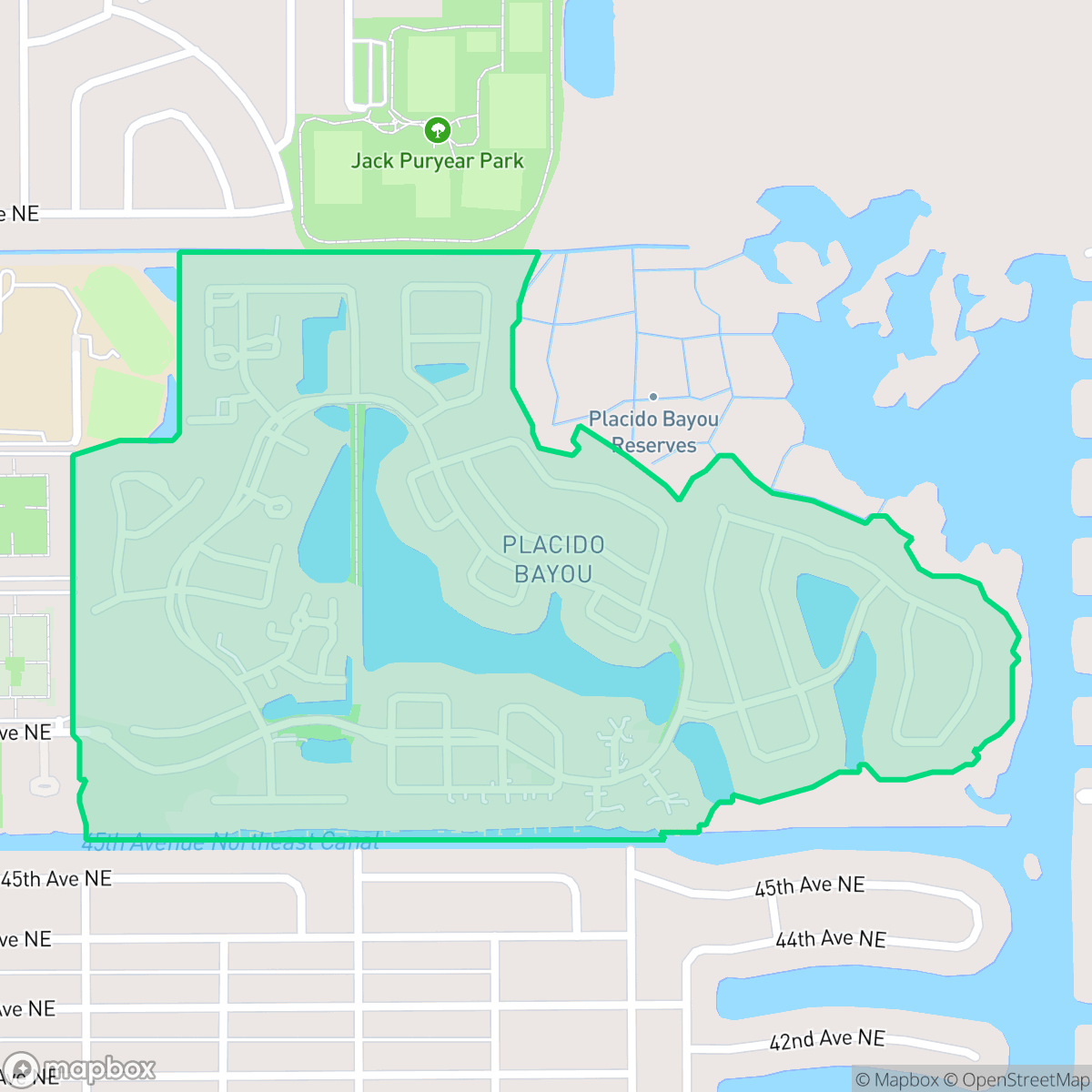
Placido Bayou is a gated residential community in northeast St. Petersburg, developed in the early 1980s on the last significant tract of privately owned waterfront land in the city. Originally owned by the Crisp family, the site was transformed into a residential enclave despite initial resistance from local preservationists, which resulted in modified development plans. Following a financial default by the original partnership, developer Walter Larson acquired the project in 1986. Named after the Italian word for tranquil, the neighborhood is distinct for its preserve-style layout, which integrates ten retention ponds and preserved natural vegetation, including pines, oaks, and mangroves. Today, the community serves as a deed-restricted residential area characterized by its lush, natural setting and proximity to the bayou that separates it from the Shore Acres neighborhood.
The area is defined by its manicured properties and semi-rural atmosphere, offering a distinct sense of seclusion within the city. Residents benefit from extensive sidewalk networks and connected natural areas, including numerous retention ponds and mature vegetation, which create an environment well-suited for walking and outdoor recreation. According to iHuus data, the community maintains a balanced demographic profile, attracting a mix of professionals and families who value privacy and a well-maintained residential setting. The neighborhood remains entirely residential, with no industrial activity or heavy commercial zones nearby. Prospective residents should consider local environmental factors, as the neighborhood is situated in a designated flood zone and experiences significant noise levels due to its proximity to the airport. While the area offers high health insurance coverage and a stable, quiet environment, the limited commercial activity means residents typically travel outside the immediate gates for daily services. It is best suited for those who prioritize a peaceful, manicured living space and are prepared to manage specific environmental considerations.
Neighborhood Scores Across 15 Qualities
Housing density remains moderate with a mix of detached single-family homes and townhome clusters. Residents experience more separation between neighbors than the typical St. Petersburg area, according to iHuus data.
Extensive sidewalk networks on both sides of major and residential streets provide safer pedestrian access than the St. Petersburg average. Low traffic volumes in cul-de-sacs further enhance the ease of walking throughout the area.
Large homes, private pools, and well-maintained properties characterize this area, which offers a more polished aesthetic than the St. Petersburg average. According to iHuus data, the presence of spacious driveways and premium amenities contributes to a high level of visual quality.
Large lakes, wooded edges, and nearby sports parks provide ample space for pets. According to iHuus data, these connected green spaces offer significantly more walking opportunities than the St. Petersburg average.
Open land and woodland areas provide a more spread out, semi-rural feel compared to the denser urban environment found across much of St. Petersburg.
Primarily comprised of established housing blocks, this area offers a calm atmosphere with limited commercial activity. According to iHuus data, the level of local energy and social vibrancy is lower than the St. Petersburg average.
Constant aircraft noise from the nearby airport runway affects this area, making it significantly noisier than the St. Petersburg average.
Frequent unhealthy air quality levels pose a significant risk to sensitive groups. According to iHuus data, the atmosphere in this area remains slightly worse than the St. Petersburg average.
Industrial activity and heavy warehouses are absent from this area. According to iHuus data, the landscape consists exclusively of residential streets and green spaces, making it significantly clearer of industrial zones than the St. Petersburg average.
Health insurance access is exceptionally high among residents, significantly surpassing the St. Petersburg average according to iHuus data.
Political views in this area are split fairly evenly between conservative and liberal leanings. This community presents a more moderate ideological profile than the St. Petersburg average, according to iHuus data.
Residents live alongside a varied mix of young professionals, families, and seniors. This demographic spread is notably more balanced than the typical age distribution found across St. Petersburg.
Properties in this area are located within a designated flood zone, which means residents may face significantly higher flood risks than the St. Petersburg average. According to iHuus data, homeowners in this neighborhood should prepare for potential requirements for flood insurance.
Address-Level Insights for Placido Bayou


iHuus Neighborhood Intelligence Insights
Get address-level neighborhood insights for Placido Bayou
- Street-level scores — see how individual blocks compare, not just neighborhood averages
- Micro-zone boundaries — identify quiet pockets, flood boundaries, and walkable clusters before you visit
- 15 dimensions in full — walkability, noise, air quality, school quality, insurance coverage, population age profile, urban/rural index, and more
- Boundary risk alerts — know if your address sits near a block boundary where scores drop, the kind of detail no listing will ever mention
- School insights — individual school ratings and insights, not just district-level data
- Compare before you commit — side-by-side data across neighborhoods, down to block precision
No credit card required
Compare with Any Neighborhood
| Dimension | Placido Bayou | Albert Whitted Airport |
|---|---|---|
| 🚶 Walkabilityavg 6.61 | ||
| 🔊 Acoustic Comfortavg 3.78 | ||
| 🤫 Privacy Indexavg 5.45 | ||
| 🎨 Visual Appealavg 6.33 | ||
| 🐕 Dog Friendlinessavg 5.45 | ||
| 🗺️ Urban-Rural Indexavg 6.19 | ||
| ✨ Neighborhood Vibeavg 3.5 | ||
| 🏥 Health Insurance Coverageavg 6.88 | ||
| 🌿 Air Qualityavg 1.87 | ||
| 🏭 Industrial Proximityavg 7.55 | ||
| 🌊 Flood Safetyavg 4.61 | ||
| 🗳️ Ideological Leanavg 6.01 | ||
| 👥 Population Age Profileavg 5.11 | ||
| 🔥 Fire Safety | ||
| 🏫 School Quality |
Placido Bayou Rankings
School Districts Serving Placido Bayou
School Insights for Placido Bayou
Below average outcomes; significant attendance and academic challenges.
School Insights
See what's really behind every school rating near Placido Bayou
- Individual school ratings — each school's own score with outcome context, not just a district average
- Enrollment & class size data — student-to-teacher ratio and how it compares to the state average
- Full demographics breakdown — ethnicity and gender composition for every school in the enrollment zone
- Every school in the district — all schools within the enrollment boundary ranked by rating, not just the closest one
- Grade levels & benchmarks — elementary through high school, with below/above state-average flags
No credit card required