Patrician Point, St. Petersburg
Updated · 576 residents
Patrician Point is a quiet, upscale waterfront community in northeast St. Petersburg defined by its canal-front homes and private boating access. While the area offers a serene, semi-rural atmosphere with visually appealing landscapes, residents should be aware of the notable traffic noise from nearby transit corridors and the elevated risk of flooding.
Key Highlights
About Patrician Point
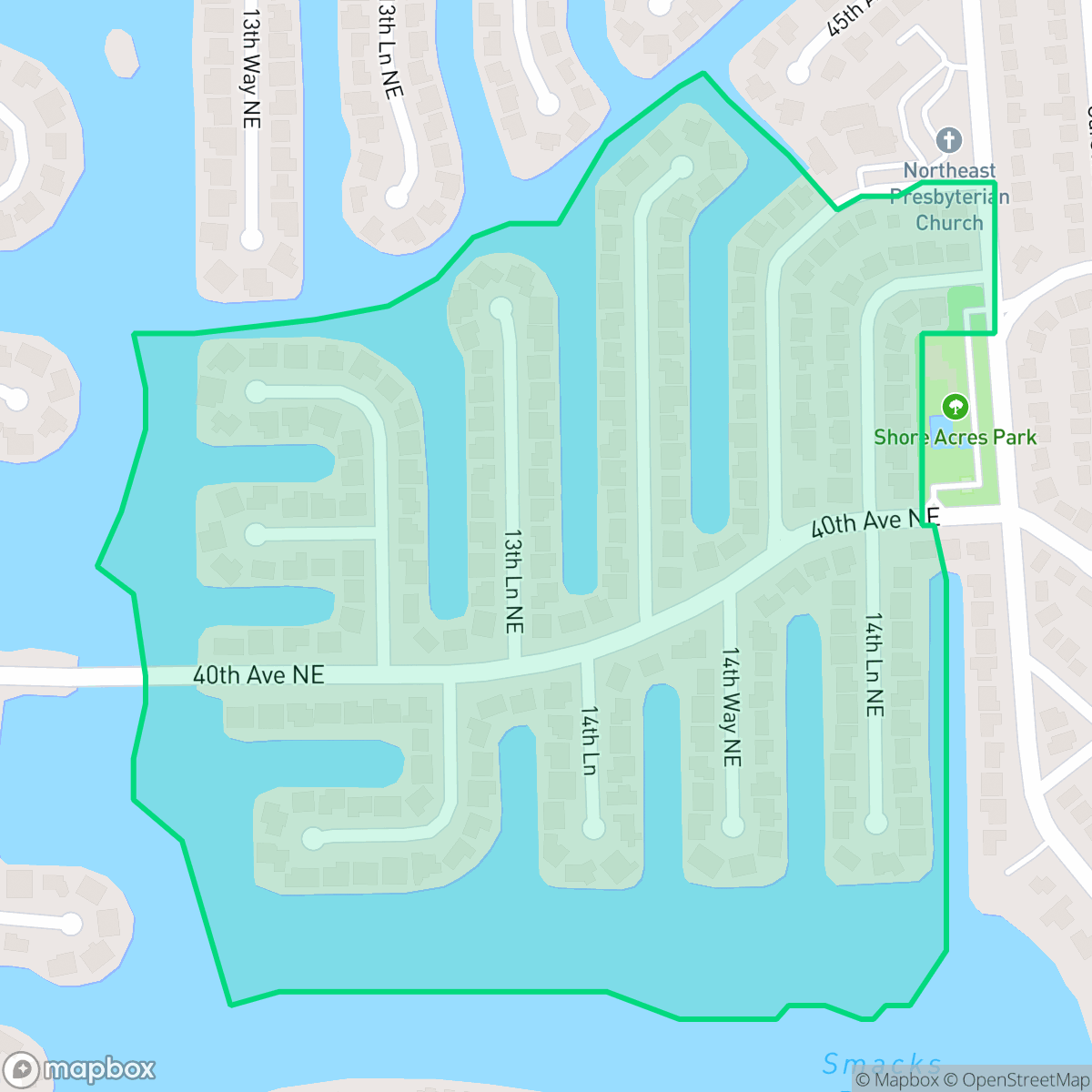
Patrician Point is a mid-century waterfront neighborhood in northeast St. Petersburg, developed in the early 1960s by the Charles K. Cheezem organization. The community was intentionally designed as an upscale, all-waterfront residential enclave, with its development facilitated by the construction of the 40th Avenue Bridge. The neighborhood’s name and branding were inspired by a Roman thematic, intended to evoke a philosophy of refined, leisure-oriented living. Comprising approximately 235 homes, the neighborhood is notable for its extensive canal system, which allows for direct boat access to Tampa Bay from most properties. Today, it remains a deed-restricted community defined by its quiet streets, mature landscaping, and a character centered on boating and coastal lifestyle, maintaining a distinct identity within the broader Shore Acres area.
This neighborhood functions as a purely residential enclave, entirely free from industrial activity, which fosters a peaceful and low-density environment. The layout prioritizes privacy, with homes set back along canals that provide direct access to the water. The demographic profile is balanced, featuring a mix of families and older residents who appreciate the mature landscaping and the polished, coastal aesthetic that characterizes the area.
The community is best suited for those who prioritize boating and a quiet residential lifestyle over walkability or proximity to urban social hubs. Prospective residents should consider the practical realities of the location, including the need for flood insurance and the presence of ambient noise from nearby traffic arteries. According to iHuus data, health insurance coverage is nearly universal among the local population, reflecting a stable and secure community. While the neighborhood lacks extensive public park space or pet-friendly amenities, its semi-rural character provides a distinct alternative to the denser urban core of St. Petersburg.
Neighborhood Scores Across 15 Qualities
Houses feature a balanced level of separation through yards and canals, providing more personal buffer than the typical St. Petersburg neighborhood according to iHuus data.
Low-traffic residential streets provide a calm environment for walking, though the lack of continuous sidewalks makes it slightly less walkable than the St. Petersburg average.
Large homes with private swimming pools and waterfront canal access define the landscape, providing a visual environment that is notably more polished than the St. Petersburg average.
Private yards are common, but narrow roadside verges and a lack of nearby public parks make this area less dog friendly than the St. Petersburg average. Residents may find fewer opportunities for outdoor exercise within the immediate vicinity.
Open land and wooded areas are frequently interspersed with scattered homes, providing a slightly more rural feel than the typical St. Petersburg landscape. Residents can expect a mix of dense suburban residential pockets and canal-based layouts according to iHuus data.
Very little commercial activity or social energy exists within this area, as it remains significantly more tranquil than the St. Petersburg average. Residents will find a sparse selection of local destinations and a landscape focused primarily on residential canals and quiet streets.
Frequent noise from nearby transit corridors and heavy traffic characterizes the area. According to iHuus data, acoustic comfort levels in this neighborhood are notably lower than the St. Petersburg average.
Frequent unhealthy air quality levels pose significant risks to sensitive groups; according to iHuus data, conditions in this area are slightly worse than the St. Petersburg average.
Industrial presence is nonexistent in this area, providing a quiet environment with no warehouses or hazard sites. This absence of heavy industry is significantly better than the St. Petersburg average.
Health insurance enrollment is nearly universal among residents, significantly outpacing the St. Petersburg average according to iHuus data.
Conservative viewpoints hold a majority in this area, representing a more right-leaning political leaning than the St. Petersburg average according to iHuus data.
Residents live in a community with a balanced spread of young adults, families, and older individuals. This age distribution is slightly more varied than the average found across St. Petersburg.
Located within a designated floodplain, this area faces significant flood risks that are notably higher than the St. Petersburg average. According to iHuus data, residents should prepare for potential water inundation and likely need flood insurance.
Address-Level Insights for Patrician Point


iHuus Neighborhood Intelligence Insights
Get address-level neighborhood insights for Patrician Point
- Street-level scores — see how individual blocks compare, not just neighborhood averages
- Micro-zone boundaries — identify quiet pockets, flood boundaries, and walkable clusters before you visit
- 15 dimensions in full — walkability, noise, air quality, school quality, insurance coverage, population age profile, urban/rural index, and more
- Boundary risk alerts — know if your address sits near a block boundary where scores drop, the kind of detail no listing will ever mention
- School insights — individual school ratings and insights, not just district-level data
- Compare before you commit — side-by-side data across neighborhoods, down to block precision
No credit card required
Compare with Any Neighborhood
| Dimension | Patrician Point | Albert Whitted Airport |
|---|---|---|
| 🚶 Walkabilityavg 6.61 | ||
| 🔊 Acoustic Comfortavg 3.78 | ||
| 🤫 Privacy Indexavg 5.45 | ||
| 🎨 Visual Appealavg 6.33 | ||
| 🐕 Dog Friendlinessavg 5.45 | ||
| 🗺️ Urban-Rural Indexavg 6.19 | ||
| ✨ Neighborhood Vibeavg 3.5 | ||
| 🏥 Health Insurance Coverageavg 6.88 | ||
| 🌿 Air Qualityavg 1.87 | ||
| 🏭 Industrial Proximityavg 7.55 | ||
| 🌊 Flood Safetyavg 4.61 | ||
| 🗳️ Ideological Leanavg 6.01 | ||
| 👥 Population Age Profileavg 5.11 | ||
| 🔥 Fire Safety | ||
| 🏫 School Quality |
Patrician Point Rankings
School Districts Serving Patrician Point
School Insights for Patrician Point
Below average outcomes; significant attendance and academic challenges.
School Insights
See what's really behind every school rating near Patrician Point
- Individual school ratings — each school's own score with outcome context, not just a district average
- Enrollment & class size data — student-to-teacher ratio and how it compares to the state average
- Full demographics breakdown — ethnicity and gender composition for every school in the enrollment zone
- Every school in the district — all schools within the enrollment boundary ranked by rating, not just the closest one
- Grade levels & benchmarks — elementary through high school, with below/above state-average flags
No credit card required