Palmetto Park, St. Petersburg
Updated · 1,811 residents
Palmetto Park is a vibrant, highly walkable neighborhood known for its 1920s architecture and proximity to the creative energy of the Warehouse Arts District. While it offers an active atmosphere with local cafes and social spots, residents should expect higher noise levels from nearby transit corridors and occasional air quality concerns.
Key Highlights
About Palmetto Park
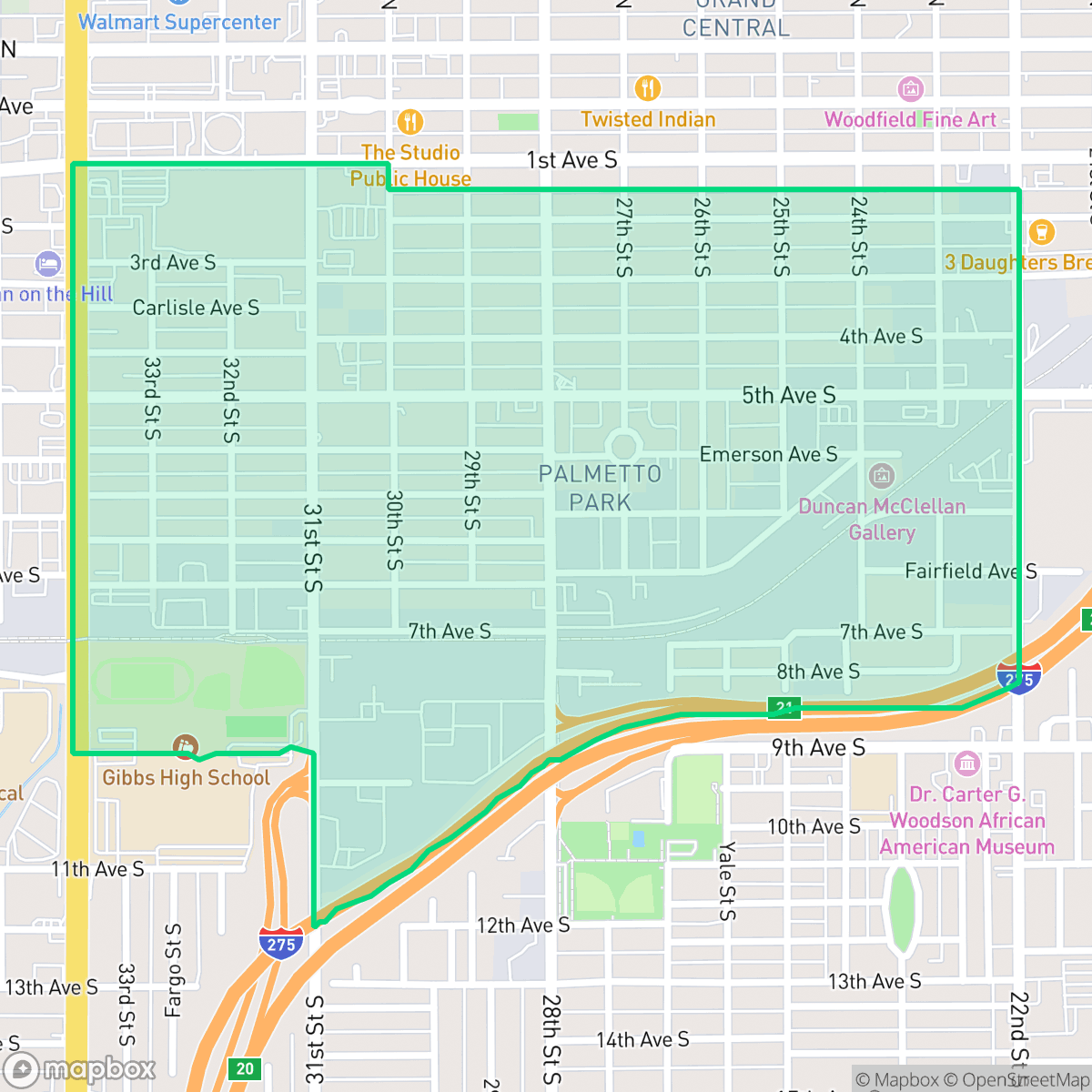
Palmetto Park is a historically significant neighborhood in South St. Petersburg, recognized for its community-driven preservation efforts and status within the South St. Petersburg Community Redevelopment Area. The neighborhood features a distinct stock of residential architecture, including 1920s Craftsman bungalows that reflect its early development. A cornerstone of its local identity is its proximity to the historic Gibbs High School, established in 1927 as the first secondary school for African-American students in Pinellas County. Today, the area is characterized by a strong sense of community, anchored by a long-standing neighborhood association and a communal garden. Its location serves as a gateway to the city’s creative corridor, bordering the Warehouse Arts District and maintaining a unique cultural identity shaped by its rich history and ongoing revitalization.
The area functions as a gateway to the city’s creative pulse, blending a semi-rural feel with an active, urban social scene. Residents benefit from a consistent sidewalk grid that makes navigating the neighborhood easy, even as the landscape remains defined by its modest, uniform residential housing. The community maintains a strong liberal identity and benefits from relatively stable flood safety compared to the broader city, providing a reliable environment for its diverse population of families and young professionals.
Prospective residents should weigh the neighborhood's high walkability and cultural energy against its acoustic profile, as the area experiences frequent noise from heavy traffic and nearby transit routes. While the local school district remains a stable and well-funded institution, families may note that the area lacks expansive public parks, relying instead on smaller communal green spaces. It is an ideal location for those who prioritize accessibility to arts and dining over quiet, secluded living.
Neighborhood Scores Across 15 Qualities
Residential structures feature a mixed density with typical urban spacing; according to iHuus data, this provides slightly more separation between neighbors than the St. Petersburg average.
Pedestrian movement is easy through the neighborhood's consistent sidewalk grid and safe crossings. This connectivity is notably better than the St. Petersburg average, though proximity to the adjacent highway interchange can introduce some barriers for walkers.
Dense lot coverage and modest yard sizes characterize this area. The visual landscape is slightly less varied than the St. Petersburg average, consisting primarily of uniform tract housing with boxy rooflines.
Green verges between sidewalks and nearby school fields offer decent space for walks, though this area ranks slightly below the St. Petersburg average for pet-friendly infrastructure. According to iHuus data, some residential sectors lack large public parks or wide grassy buffers.
Frequent open land and scattered greenery provide a slightly more rural feel than the typical St. Petersburg urban core. This area features a mix of low-density residential grids and larger institutional or commercial structures, according to iHuus data.
Local hubs, dining, and cultural institutions create a significantly more vibrant atmosphere than the St. Petersburg average. Residents can find a dense collection of breweries, cafes, and walkable social spots within this lively suburban grid.
Frequent noise from nearby transit corridors and heavy traffic is common in this area. According to iHuus data, acoustic comfort levels are lower than the St. Petersburg average.
Frequent unhealthy air quality levels pose a significant risk to sensitive groups in this area. According to iHuus data, the atmospheric conditions are slightly worse than the St. Petersburg average.
Residential life remains undisturbed by heavy industry, as the area consists primarily of housing, parks, and light commercial uses. Occasional transit traffic and utility odors may be present near service-oriented businesses like gas stations or breweries, though this level of activity is consistent with the city average.
Health insurance enrollment among residents is consistent with the St. Petersburg average. According to iHuus data, most members of the community have access to medical coverage.
Voting patterns and census indicators show a significantly more liberal political leaning than the St. Petersburg average, according to iHuus data.
Residents live alongside a varied mix of young adults, families, and seniors. This age distribution is slightly more concentrated toward the middle of the spectrum than in other parts of St. Petersburg, according to iHuus data.
Residual flood risk exists within this area as it sits partially within a 500-year floodplain. However, flood safety levels in Palmetto Park are notably higher than the St. Petersburg city average, according to iHuus data.
Address-Level Insights for Palmetto Park


iHuus Neighborhood Intelligence Insights
Get address-level neighborhood insights for Palmetto Park
- Street-level scores — see how individual blocks compare, not just neighborhood averages
- Micro-zone boundaries — identify quiet pockets, flood boundaries, and walkable clusters before you visit
- 15 dimensions in full — walkability, noise, air quality, school quality, insurance coverage, population age profile, urban/rural index, and more
- Boundary risk alerts — know if your address sits near a block boundary where scores drop, the kind of detail no listing will ever mention
- School insights — individual school ratings and insights, not just district-level data
- Compare before you commit — side-by-side data across neighborhoods, down to block precision
No credit card required
Compare with Any Neighborhood
| Dimension | Palmetto Park | Albert Whitted Airport |
|---|---|---|
| 🚶 Walkabilityavg 6.61 | ||
| 🔊 Acoustic Comfortavg 3.78 | ||
| 🤫 Privacy Indexavg 5.45 | ||
| 🎨 Visual Appealavg 6.33 | ||
| 🐕 Dog Friendlinessavg 5.45 | ||
| 🗺️ Urban-Rural Indexavg 6.19 | ||
| ✨ Neighborhood Vibeavg 3.5 | ||
| 🏥 Health Insurance Coverageavg 6.88 | ||
| 🌿 Air Qualityavg 1.87 | ||
| 🏭 Industrial Proximityavg 7.55 | ||
| 🌊 Flood Safetyavg 4.61 | ||
| 🗳️ Ideological Leanavg 6.01 | ||
| 👥 Population Age Profileavg 5.11 | ||
| 🔥 Fire Safety | ||
| 🏫 School Quality |
Palmetto Park Rankings
School Districts Serving Palmetto Park
School Insights for Palmetto Park
Below average outcomes; significant attendance and academic challenges.
School Insights
See what's really behind every school rating near Palmetto Park
- Individual school ratings — each school's own score with outcome context, not just a district average
- Enrollment & class size data — student-to-teacher ratio and how it compares to the state average
- Full demographics breakdown — ethnicity and gender composition for every school in the enrollment zone
- Every school in the district — all schools within the enrollment boundary ranked by rating, not just the closest one
- Grade levels & benchmarks — elementary through high school, with below/above state-average flags
No credit card required