Pacido Bayou, St. Petersburg
Updated · 1,308 residents
Placido Bayou is a gated residential community in Northeast St. Petersburg known for its polished, upscale aesthetic and integrated natural surroundings. While the area offers a serene, semi-rural atmosphere with excellent walkability, residents should be aware of persistent aircraft noise and potential flood risks.
Key Highlights
About Pacido Bayou
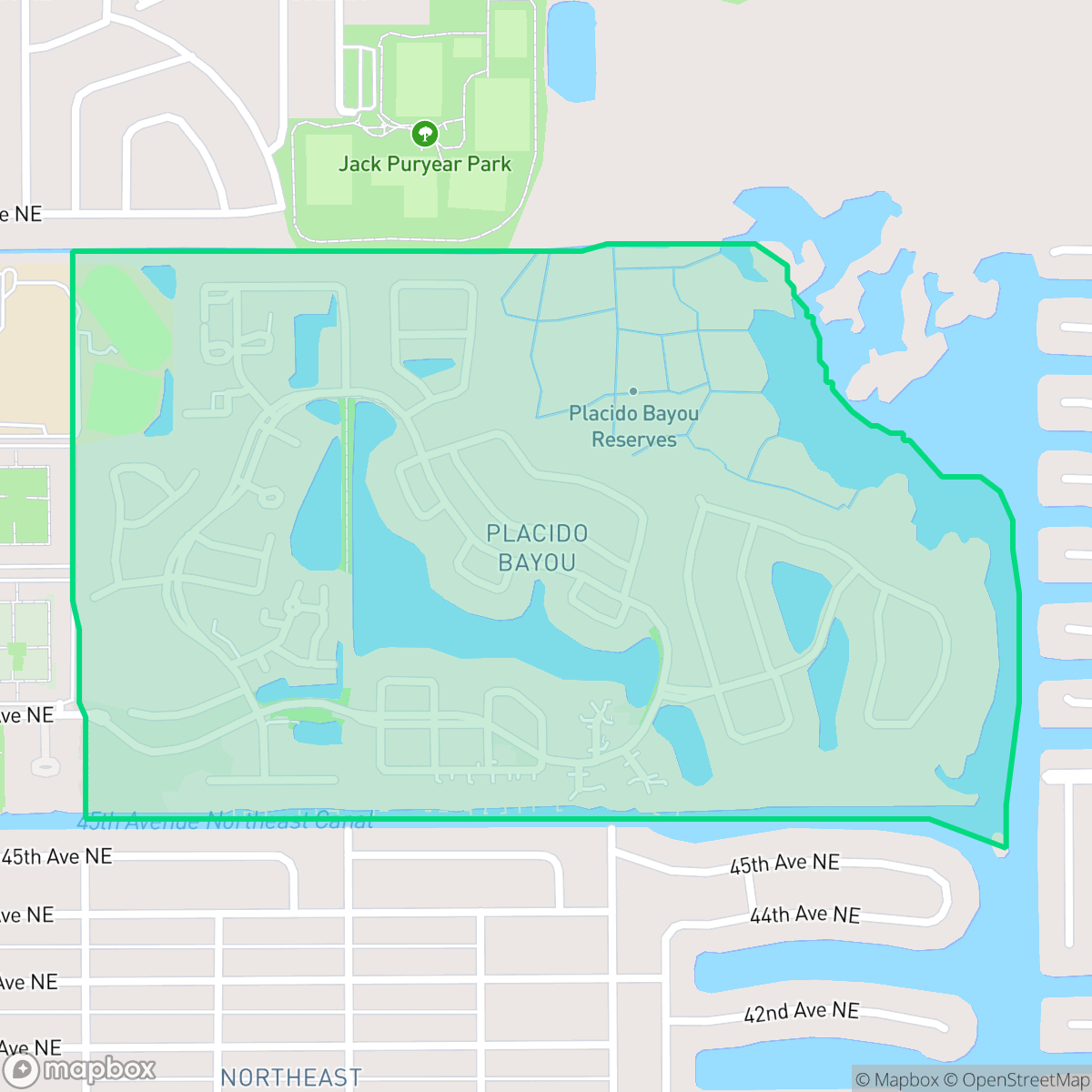
Placido Bayou is a gated residential community in Northeast St. Petersburg, developed during the 1980s on what was previously one of the city's last remaining large tracts of privately owned waterfront land. Originally consisting of mangroves and wetlands, the area’s name derives from the Italian word for 'tranquil.' The project faced significant local opposition from preservationists during its initial planning phases. Development began in 1984 under a partnership that later defaulted on loans, leading to the project's acquisition by developer Walter Larson in 1986. Today, the neighborhood is characterized by its deed-restricted, guard-gated status, mature oak-lined streets, and integration of preserved natural areas, serving as a distinct example of late 20th-century suburban waterfront development in St. Petersburg.
The community features a mix of detached single-family homes and townhome clusters set against a backdrop of mature trees and water features. It functions as a quiet, residential enclave that prioritizes privacy and aesthetic maintenance. The layout encourages pedestrian activity through a comprehensive network of sidewalks, making it easy to navigate the neighborhood on foot. Residents benefit from high levels of health insurance coverage and a diverse demographic mix that spans young professionals to seniors. According to iHuus data, the area is purely residential with no industrial activity, contributing to a clean environment.
Potential residents should consider that the area experiences higher levels of aircraft noise than much of the city, and the local air quality occasionally reaches unhealthy levels. As the neighborhood is situated within a designated floodplain, flood insurance is a necessary consideration for property owners. Despite these factors, the community remains a stable environment for those seeking a quiet, dog-friendly setting with access to the broader Pinellas County School District, which maintains high academic standards despite current shifts in enrollment.
Neighborhood Scores Across 15 Qualities
Residential spacing offers a varied balance of detached single-family homes and denser townhome clusters. This layout provides slightly more separation between neighbors than the average St. Petersburg area, according to iHuus data.
Pedestrians benefit from a comprehensive sidewalk network on both major and residential streets, which provides more accessible routes than the St. Petersburg average. Low-traffic cul-de-sacs and safe crossings make navigating the area on foot reliable according to iHuus data.
Manicured properties and large homes with private amenities contribute to a visual landscape that is more aesthetically pleasing than the St. Petersburg average. According to iHuus data, the area features well-maintained estates and frequent upscale residential features.
Abundant green buffers, wooded edges, and large lakes provide ample space for pets. According to iHuus data, these connected natural areas and nearby sports parks make this area significantly more dog friendly than the St. Petersburg average.
Frequent open land and scattered homes amid woodlands provide a more semi-rural atmosphere than the St. Petersburg average. According to iHuus data, the area features a mix of planned residential density with integrated water features and significant tree canopy.
This area offers a calm, suburban atmosphere with very little commercial activity or nightlife. According to iHuus data, the level of social energy and local amenities is lower than the St. Petersburg average.
Continuous aircraft noise from a nearby airport runway makes this area significantly louder than the St. Petersburg average. Residents should expect persistent acoustic disruptions throughout the day.
Frequent periods of unhealthy air levels pose significant risks to sensitive groups. According to iHuus data, these conditions are slightly more prevalent in this area than the St. Petersburg average.
Industrial activity and heavy warehouses are absent from this area, providing a cleaner environment than the St. Petersburg average. According to iHuus data, the neighborhood consists primarily of residential and recreational land uses with no detected hazardous sites.
Health insurance access among residents is exceptionally high, significantly exceeding the St. Petersburg average according to iHuus data.
Political leanings in this area are split relatively evenly between conservative and liberal perspectives. This represents a more moderate distribution than the broader St. Petersburg area, according to iHuus data.
A balanced mix of young professionals, families, and seniors characterizes the area. This demographic variety is more widespread than the average found across St. Petersburg.
Properties in this area are located within a designated floodplain, which may necessitate flood insurance. According to iHuus data, the level of flood vulnerability here is significantly higher than the St. Petersburg average.
Address-Level Insights for Pacido Bayou


iHuus Neighborhood Intelligence Insights
Get address-level neighborhood insights for Pacido Bayou
- Street-level scores — see how individual blocks compare, not just neighborhood averages
- Micro-zone boundaries — identify quiet pockets, flood boundaries, and walkable clusters before you visit
- 15 dimensions in full — walkability, noise, air quality, school quality, insurance coverage, population age profile, urban/rural index, and more
- Boundary risk alerts — know if your address sits near a block boundary where scores drop, the kind of detail no listing will ever mention
- School insights — individual school ratings and insights, not just district-level data
- Compare before you commit — side-by-side data across neighborhoods, down to block precision
No credit card required
Compare with Any Neighborhood
| Dimension | Pacido Bayou | Albert Whitted Airport |
|---|---|---|
| 🚶 Walkabilityavg 6.61 | ||
| 🔊 Acoustic Comfortavg 3.78 | ||
| 🤫 Privacy Indexavg 5.45 | ||
| 🎨 Visual Appealavg 6.33 | ||
| 🐕 Dog Friendlinessavg 5.45 | ||
| 🗺️ Urban-Rural Indexavg 6.19 | ||
| ✨ Neighborhood Vibeavg 3.5 | ||
| 🏥 Health Insurance Coverageavg 6.88 | ||
| 🌿 Air Qualityavg 1.87 | ||
| 🏭 Industrial Proximityavg 7.55 | ||
| 🌊 Flood Safetyavg 4.61 | ||
| 🗳️ Ideological Leanavg 6.01 | ||
| 👥 Population Age Profileavg 5.11 | ||
| 🔥 Fire Safety | ||
| 🏫 School Quality |
Pacido Bayou Rankings
School Districts Serving Pacido Bayou
School Insights for Pacido Bayou
Below average outcomes; significant attendance and academic challenges.
School Insights
See what's really behind every school rating near Pacido Bayou
- Individual school ratings — each school's own score with outcome context, not just a district average
- Enrollment & class size data — student-to-teacher ratio and how it compares to the state average
- Full demographics breakdown — ethnicity and gender composition for every school in the enrollment zone
- Every school in the district — all schools within the enrollment boundary ranked by rating, not just the closest one
- Grade levels & benchmarks — elementary through high school, with below/above state-average flags
No credit card required