Mobel Americana, St. Petersburg
Updated · 976 residents
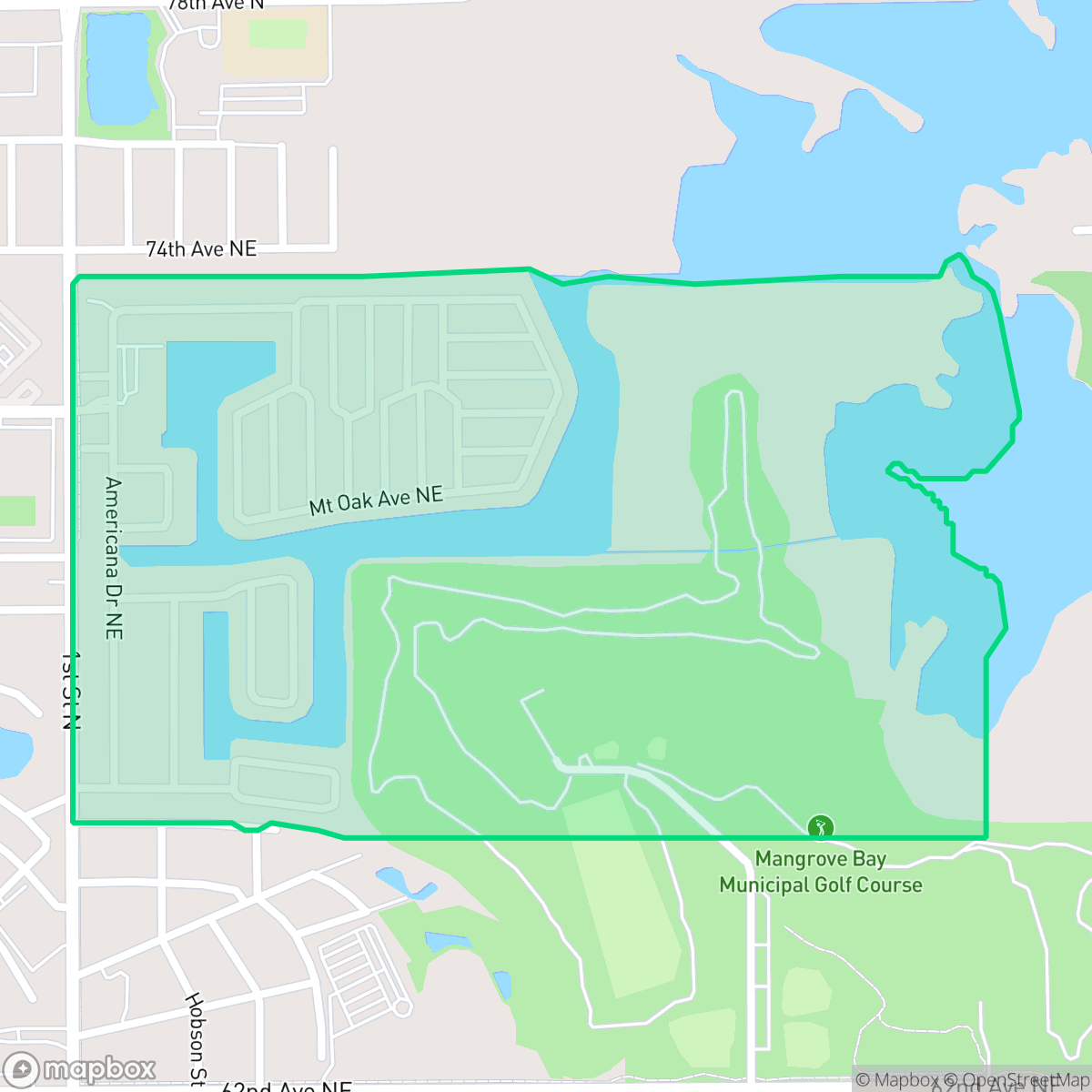
Mobel Americana, widely known as Americana Cove, offers a quiet, semi-rural atmosphere characterized by a mix of suburban yards and established residential enclaves. Residents benefit from a dog-friendly environment with accessible walking paths, though the area faces challenges regarding flood risk and proximity to high-traffic transit routes.
Key Highlights
About Mobel Americana
Established in 1961, Mobel Americana—now widely known as Americana Cove—was once the largest mobile home park in Pinellas County. Its founding reflected the mid-century rise of Florida as a premier retirement destination for 'winter-weary Northerners.' Developers originally marketed the term 'mobel' to the industry as a designation for mobile home motels, though the term never gained widespread traction. The community became a significant social hub for retirees, featuring extensive amenities like shuffleboard and organized social clubs. Throughout the 1970s, the neighborhood gained local prominence for its residents' collective activism against rising lot rents, a struggle that helped define the community's long-standing identity as a self-organized cooperative. The neighborhood's history has been notably preserved through detailed accounts authored by long-term residents, documenting its evolution from a 1960s development into an established residential enclave.
The neighborhood maintains a distinct semi-rural character, defined by open land and greenery that stands out against the denser urban landscape of St. Petersburg. Its visual appeal is bolstered by a mix of larger homes and established residential pockets, creating a suburban aesthetic that remains largely free from heavy industrial activity. Residents enjoy a relatively calm environment, supported by a structured grid of streets that provides safe, quiet paths for local walking and dog exercise.
Prospective residents should consider specific environmental trade-offs when evaluating the area. The neighborhood is situated within a designated floodplain, necessitating careful consideration of insurance requirements. Additionally, the proximity to major transit infrastructure results in higher levels of road traffic noise and occasional air quality concerns. Despite these factors, the community remains a stable choice for a diverse, multi-generational population that benefits from high rates of health insurance coverage and a balanced political landscape. The area is well-suited for those seeking a peaceful, residential enclave who are comfortable navigating the realities of living in a coastal, transit-proximate region.
Neighborhood Scores Across 15 Qualities
Residential spacing varies across the area, with some multi-family units sharing common grounds and parking lots. According to iHuus data, privacy levels are slightly lower than the St. Petersburg average due to closely packed housing in certain sections.
Main roads and low-traffic residential streets feature consistent sidewalks that allow for safe pedestrian movement. While the area is slightly less walkable than the St. Petersburg average, the grid system provides structured paths for local strolls.
Larger homes and upscale amenities contribute to a visual landscape that sits above the St. Petersburg average. Some pockets of the area feature higher density housing and mobile home parks alongside more traditional suburban yards.
Grassy verges along residential streets and nearby pond areas offer more reliable walking space than the city average. According to iHuus data, while some sections feature narrower paths, the area remains significantly more dog friendly than much of St. Petersburg.
Open land and wooded areas are more frequent here than in the rest of St. Petersburg; this provides a suburban layout with scattered homes and greenery.
Low levels of commercial activity and minimal street life create a calm, semi-rural atmosphere. This area is less active than the St. Petersburg average, offering a peaceful residential environment with few nearby points of interest.
Frequent noise from nearby major transit routes and infrastructure impacts the area, making it noisier than much of St. Petersburg. Residents may experience consistent auditory disturbances due to proximity to busy roadways and rail lines.
Frequent unhealthy air quality levels pose significant risks to sensitive groups. This area experiences air quality that is slightly worse than the St. Petersburg average, according to iHuus data.
Primarily residential in character, this area features very little industrial activity and remains comparable to the St. Petersburg average. Small-scale commercial services may introduce occasional low-level operational noise, but there are no heavy industrial zones nearby according to iHuus data.
Health insurance accessibility is notably higher in this area than the St. Petersburg average, according to iHuus data. Most residents in the neighborhood maintain active health coverage.
Political leanings in this area are split almost evenly between conservative and liberal residents. This represents a more moderate ideological landscape than the average for St. Petersburg, according to iHuus data.
A diverse range of age groups resides here, featuring a more even distribution of young adults, families, and seniors than the St. Petersburg average.
Properties in this area are located within a designated floodplain, which means flood insurance is typically required. According to iHuus data, the risk of flooding in Mobel Americana is notably higher than the St. Petersburg average.
Address-Level Insights for Mobel Americana


iHuus Neighborhood Intelligence Insights
Get address-level neighborhood insights for Mobel Americana
- Street-level scores — see how individual blocks compare, not just neighborhood averages
- Micro-zone boundaries — identify quiet pockets, flood boundaries, and walkable clusters before you visit
- 15 dimensions in full — walkability, noise, air quality, school quality, insurance coverage, population age profile, urban/rural index, and more
- Boundary risk alerts — know if your address sits near a block boundary where scores drop, the kind of detail no listing will ever mention
- School insights — individual school ratings and insights, not just district-level data
- Compare before you commit — side-by-side data across neighborhoods, down to block precision
No credit card required
Compare with Any Neighborhood
| Dimension | Mobel Americana | Albert Whitted Airport |
|---|---|---|
| 🚶 Walkabilityavg 6.61 | ||
| 🔊 Acoustic Comfortavg 3.78 | ||
| 🤫 Privacy Indexavg 5.45 | ||
| 🎨 Visual Appealavg 6.33 | ||
| 🐕 Dog Friendlinessavg 5.45 | ||
| 🗺️ Urban-Rural Indexavg 6.19 | ||
| ✨ Neighborhood Vibeavg 3.5 | ||
| 🏥 Health Insurance Coverageavg 6.88 | ||
| 🌿 Air Qualityavg 1.87 | ||
| 🏭 Industrial Proximityavg 7.55 | ||
| 🌊 Flood Safetyavg 4.61 | ||
| 🗳️ Ideological Leanavg 6.01 | ||
| 👥 Population Age Profileavg 5.11 | ||
| 🔥 Fire Safety | ||
| 🏫 School Quality |
Mobel Americana Rankings
School Districts Serving Mobel Americana
School Insights for Mobel Americana
Below average outcomes; significant attendance and academic challenges.
School Insights
See what's really behind every school rating near Mobel Americana
- Individual school ratings — each school's own score with outcome context, not just a district average
- Enrollment & class size data — student-to-teacher ratio and how it compares to the state average
- Full demographics breakdown — ethnicity and gender composition for every school in the enrollment zone
- Every school in the district — all schools within the enrollment boundary ranked by rating, not just the closest one
- Grade levels & benchmarks — elementary through high school, with below/above state-average flags
No credit card required