Methodist Town, St. Petersburg
Updated · 653 residents
Methodist Town is a historically significant area in St. Petersburg that functions as a vibrant, walkable urban hub. While it offers convenient access to local dining and services, residents should be prepared for higher noise levels from nearby transit and occasional air quality concerns.
Key Highlights
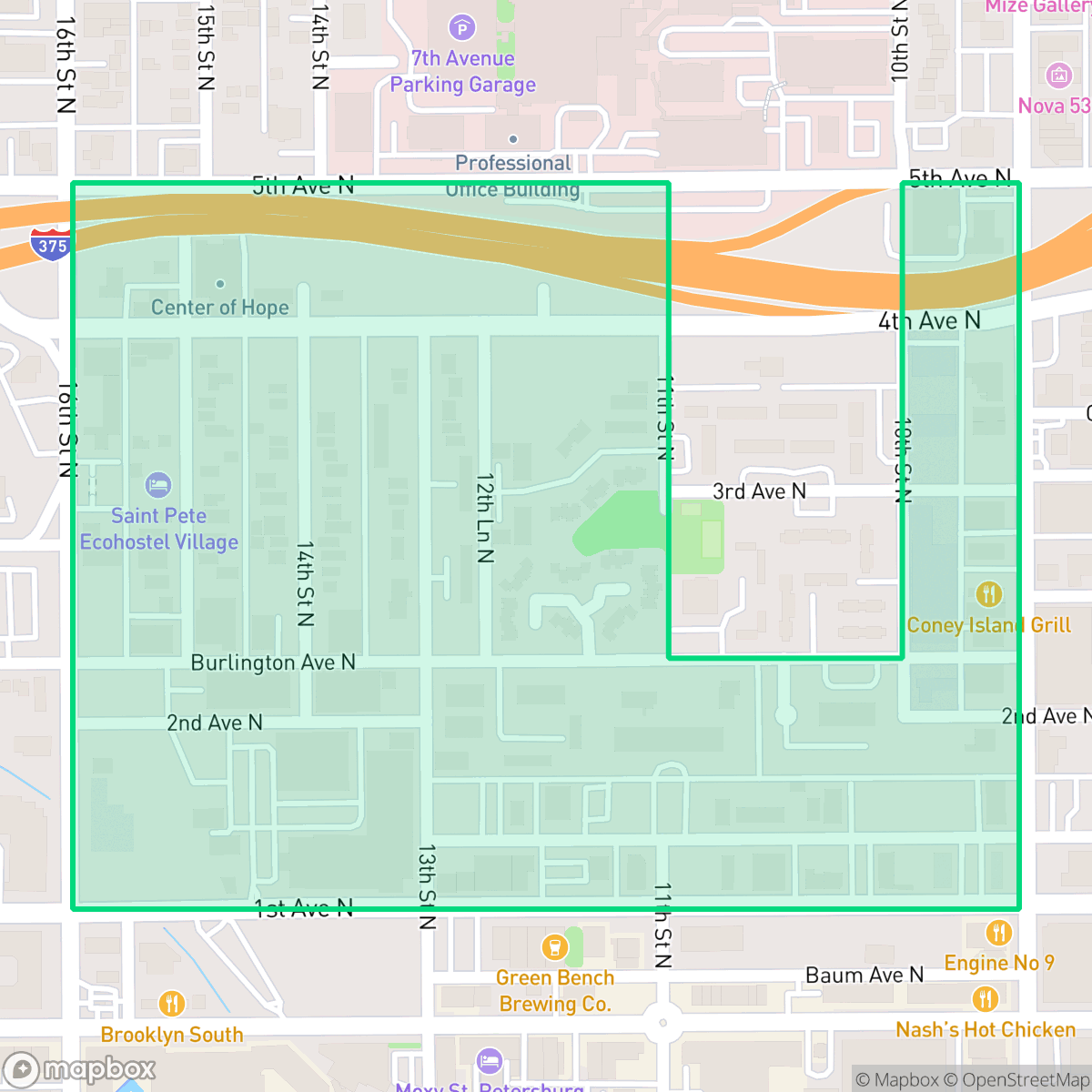
About Methodist Town
Methodist Town was established in 1894 in St. Petersburg, Florida, growing around the historic Bethel African Methodist Episcopal (AME) Church on Third Avenue North. As one of the city’s earliest African American communities, it served as a vital residential and business hub, hosting dozens of local enterprises during the early 20th century. The neighborhood faced significant transformation in the 1970s due to urban renewal initiatives, which resulted in the demolition of many original homes and the relocation of hundreds of families. In 1974, the area was renamed "renamed" Jamestown to honor Chester James Sr., a prominent local activist and community leader who advocated for improved housing and civil rights. Today, the legacy of Methodist Town is preserved through community archives and heritage projects that document its foundational role in the city’s Black history.
Methodist Town is characterized by a dense urban environment that serves as a central hub for commercial activity, including various breweries and local service businesses. The neighborhood features a highly walkable street grid, allowing residents to easily navigate to nearby amenities on foot. This area maintains a functional urban aesthetic, with a mix of residential and commercial blocks that provide a convenient, albeit modest, living experience for its diverse population.
Living in the area involves several trade-offs, particularly regarding environmental and acoustic comfort. According to iHuus data, the neighborhood experiences higher noise levels due to proximity to transit infrastructure and busy roadways. Additionally, sensitive groups should be aware of occasional air quality challenges and limited health insurance coverage in the immediate vicinity. The neighborhood is best suited for individuals who prioritize a walkable, central lifestyle and access to city services over the quiet and privacy typically found in suburban settings.
Neighborhood Scores Across 15 Qualities
Residential spacing in Methodist Town offers some buffer between neighbors, though certain areas feature higher density with buildings positioned close together. According to iHuus data, this level of separation is slightly lower than the St. Petersburg average.
Pedestrian navigation is supported by a dense grid of sidewalks and crosswalks, which is slightly better than the St. Petersburg average. While a major multi-lane highway limits southern movement, much of the neighborhood remains accessible for those traveling on foot.
Standard tract housing and apartment complexes define the area, which offers a more modest visual landscape than much of St. Petersburg. According to iHuus data, the scenery consists primarily of utilitarian rooftops and small yards without significant greenery or luxury estates.
Public park access and wide walking paths vary by street, with some areas offering lakefront trails while others feature heavy pavement and narrow verges. According to iHuus data, overall dog friendliness is slightly below the St. Petersburg average.
Residential streets and green spaces are balanced with commercial blocks, making this area less dense than the St. Petersburg average. According to iHuus data, the neighborhood offers a mix of single-family homes and medium-sized commercial developments.
Dense commercial corridors and walkable urban pockets offer a high concentration of dining, nightlife, and wellness services. This level of activity and destination variety is significantly higher than the St. Petersburg city average, according to iHuus data.
Frequent disturbances from nearby transit infrastructure, such as railroad lines or busy roadways, characterize the area. This level of acoustic disruption is higher than the typical experience found throughout St. Petersburg.
Frequent unhealthy air quality levels pose significant risks to sensitive groups. According to iHuus data, these conditions are slightly worse than the average seen across St. Petersburg.
Occasional light commercial activity, such as a brewery and printing service, introduces intermittent loading noise and low-level operational hum. This level of industrial proximity is slightly higher than the St. Petersburg average due to nearby storage facilities and transit infrastructure.
Health insurance accessibility in this area is significantly lower than the St. Petersburg average, according to iHuus data. Residents may face challenges regarding healthcare access and affordability.
Political leanings in this area are notably more liberal than the St. Petersburg average, according to iHuus data.
A diverse demographic of young adults, families, and older residents resides here; this age distribution is largely in line with the St. Petersburg average according to iHuus data.
Residual flood risk exists within this area as it sits inside a 500-year floodplain, though safety levels remain significantly higher than the St. Petersburg average according to iHuus data.
Address-Level Insights for Methodist Town


iHuus Neighborhood Intelligence Insights
Get address-level neighborhood insights for Methodist Town
- Street-level scores — see how individual blocks compare, not just neighborhood averages
- Micro-zone boundaries — identify quiet pockets, flood boundaries, and walkable clusters before you visit
- 15 dimensions in full — walkability, noise, air quality, school quality, insurance coverage, population age profile, urban/rural index, and more
- Boundary risk alerts — know if your address sits near a block boundary where scores drop, the kind of detail no listing will ever mention
- School insights — individual school ratings and insights, not just district-level data
- Compare before you commit — side-by-side data across neighborhoods, down to block precision
No credit card required
Compare with Any Neighborhood
| Dimension | Methodist Town | Albert Whitted Airport |
|---|---|---|
| 🚶 Walkabilityavg 6.61 | ||
| 🔊 Acoustic Comfortavg 3.78 | ||
| 🤫 Privacy Indexavg 5.45 | ||
| 🎨 Visual Appealavg 6.33 | ||
| 🐕 Dog Friendlinessavg 5.45 | ||
| 🗺️ Urban-Rural Indexavg 6.19 | ||
| ✨ Neighborhood Vibeavg 3.5 | ||
| 🏥 Health Insurance Coverageavg 6.88 | ||
| 🌿 Air Qualityavg 1.87 | ||
| 🏭 Industrial Proximityavg 7.55 | ||
| 🌊 Flood Safetyavg 4.61 | ||
| 🗳️ Ideological Leanavg 6.01 | ||
| 👥 Population Age Profileavg 5.11 | ||
| 🔥 Fire Safety | ||
| 🏫 School Quality |
Methodist Town Rankings
School Districts Serving Methodist Town
School Insights for Methodist Town
Below average outcomes; significant attendance and academic challenges.
School Insights
See what's really behind every school rating near Methodist Town
- Individual school ratings — each school's own score with outcome context, not just a district average
- Enrollment & class size data — student-to-teacher ratio and how it compares to the state average
- Full demographics breakdown — ethnicity and gender composition for every school in the enrollment zone
- Every school in the district — all schools within the enrollment boundary ranked by rating, not just the closest one
- Grade levels & benchmarks — elementary through high school, with below/above state-average flags
No credit card required