Melrose Mercy - Pine Acres, St. Petersburg
Updated · 2,186 residents
Melrose Mercy - Pine Acres is a historically significant area defined by its deep cultural roots and a semi-rural atmosphere characterized by mature tree canopies and open spaces. Residents benefit from a reliable, walkable grid system, though the neighborhood experiences consistent ambient noise from nearby traffic and occasional air quality challenges.
Key Highlights
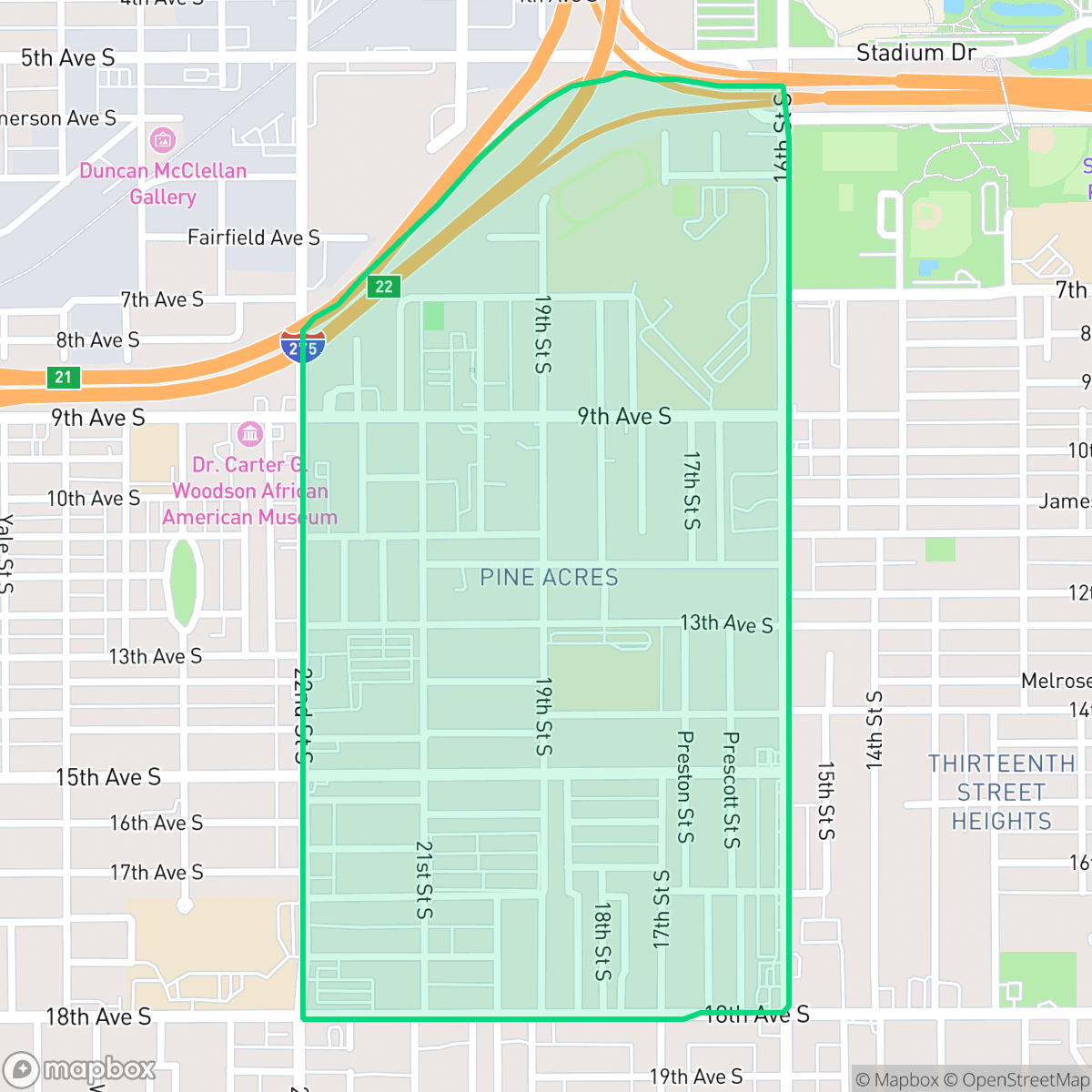
About Melrose Mercy - Pine Acres
The Melrose-Mercy neighborhood is deeply rooted in the history of St. Petersburg's African American community, serving as an essential cultural and professional hub during the era of Jim Crow segregation. Its identity is inextricably linked to the nearby 22nd Street South Corridor, historically known as 'The Deuces,' which functioned as a vibrant center for Black commerce and social life. A significant landmark is the Melrose Clubhouse, dedicated in 1942 as the headquarters for the City Federation of Colored Women's Clubs. For decades, this site provided a vital space for civic engagement, youth recreation, and local chapters of organizations like the NAACP. Today, the area is part of the South St. Petersburg Community Redevelopment Area, reflecting a complex legacy of resilience, institutional importance, and ongoing efforts to preserve its distinct cultural fabric amidst modern urban revitalization.
The neighborhood offers a distinct blend of quiet, tree-lined residential streets and proximity to the energetic dining and cultural hubs near Tropicana Field. The landscape is primarily composed of modest, single-family homes with dense lot coverage, creating a sense of community that feels more secluded than typical urban settings. With its established grid and accessible grass verges, the area provides a functional environment for pedestrians and pet owners alike.
Prospective residents should consider that while the area offers a strong sense of community and a progressive political environment, it faces challenges such as consistent traffic noise and occasional air quality concerns. The local school district maintains high academic standards and financial stability, though it is currently undergoing consolidation efforts to address enrollment trends. This neighborhood is well-suited for those who value a blend of cultural history, a semi-rural aesthetic, and convenient access to central St. Petersburg amenities.
Neighborhood Scores Across 15 Qualities
Residential structures are positioned with mixed spacing and typical urban grid density, providing slightly more separation between neighbors than the St. Petersburg average.
Pedestrian access is generally reliable due to an established grid system with mature tree shade, though some residential streets lack dedicated paths and proximity to the highway introduces noise barriers. According to iHuus data, walkability in this area sits slightly above the St. Petersburg average.
Standard tract housing with simple rooflines and small yards defines the local landscape. This area features dense lot coverage and fewer private amenities than the St. Petersburg average, according to iHuus data.
Wide grass verges between sidewalks and roads provide sufficient space for walking dogs throughout the neighborhood. This area offers slightly better amenities for pet owners than the St. Petersburg average due to nearby public parks with courts and pools.
Open land and scattered homes among woodland create a slightly more rural atmosphere than the typical St. Petersburg urban landscape. Residents can expect a mix of single-family residences and mature tree canopies throughout the area.
Local activity levels are notably higher than the St. Petersburg average, featuring a blend of energetic dining hubs near Tropicana Field and quieter, tree-lined residential streets. Residents can access a variety of amenities ranging from cultural venues and coffee shops to more subdued suburban pockets.
Ongoing vehicle noise from nearby busy streets provides a consistent ambient sound. This level of acoustic activity is slightly higher than the St. Petersburg average, according to iHuus data.
Frequent unhealthy air quality levels pose significant risks to sensitive groups. According to iHuus data, conditions in this area are slightly worse than the St. Petersburg average.
Residents can expect a primarily residential environment with only light commercial activity and no heavy manufacturing or hazardous facilities. This lack of industrial density is slightly better than the St. Petersburg average, according to iHuus data.
Health insurance accessibility in this area is slightly below the St. Petersburg average, according to iHuus data.
Voting patterns and census indicators reflect a much more progressive political landscape than the St. Petersburg average, according to iHuus data.
A balanced mix of young adults, families, and seniors characterizes the local community. This demographic spread is slightly lower than the average seen across St. Petersburg.
Residual flood risk exists within the area, though safety levels are notably higher than the St. Petersburg average according to iHuus data.
Address-Level Insights for Melrose Mercy - Pine Acres


iHuus Neighborhood Intelligence Insights
Get address-level neighborhood insights for Melrose Mercy - Pine Acres
- Street-level scores — see how individual blocks compare, not just neighborhood averages
- Micro-zone boundaries — identify quiet pockets, flood boundaries, and walkable clusters before you visit
- 15 dimensions in full — walkability, noise, air quality, school quality, insurance coverage, population age profile, urban/rural index, and more
- Boundary risk alerts — know if your address sits near a block boundary where scores drop, the kind of detail no listing will ever mention
- School insights — individual school ratings and insights, not just district-level data
- Compare before you commit — side-by-side data across neighborhoods, down to block precision
No credit card required
Compare with Any Neighborhood
| Dimension | Melrose Mercy - Pine Acres | Albert Whitted Airport |
|---|---|---|
| 🚶 Walkabilityavg 6.61 | ||
| 🔊 Acoustic Comfortavg 3.78 | ||
| 🤫 Privacy Indexavg 5.45 | ||
| 🎨 Visual Appealavg 6.33 | ||
| 🐕 Dog Friendlinessavg 5.45 | ||
| 🗺️ Urban-Rural Indexavg 6.19 | ||
| ✨ Neighborhood Vibeavg 3.5 | ||
| 🏥 Health Insurance Coverageavg 6.88 | ||
| 🌿 Air Qualityavg 1.87 | ||
| 🏭 Industrial Proximityavg 7.55 | ||
| 🌊 Flood Safetyavg 4.61 | ||
| 🗳️ Ideological Leanavg 6.01 | ||
| 👥 Population Age Profileavg 5.11 | ||
| 🔥 Fire Safety | ||
| 🏫 School Quality |
Melrose Mercy - Pine Acres Rankings
School Districts Serving Melrose Mercy - Pine Acres
School Insights for Melrose Mercy - Pine Acres
Below average outcomes; significant attendance and academic challenges.
School Insights
See what's really behind every school rating near Melrose Mercy - Pine Acres
- Individual school ratings — each school's own score with outcome context, not just a district average
- Enrollment & class size data — student-to-teacher ratio and how it compares to the state average
- Full demographics breakdown — ethnicity and gender composition for every school in the enrollment zone
- Every school in the district — all schools within the enrollment boundary ranked by rating, not just the closest one
- Grade levels & benchmarks — elementary through high school, with below/above state-average flags
No credit card required