Meadowlawn, St. Petersburg
Updated · 5,341 residents
Meadowlawn offers a quiet and functional atmosphere characterized by well-established sidewalk networks and a semi-rural feel. Residents benefit from a diverse age mix and a politically balanced environment, making it a stable choice for those seeking a residential-focused community.
Key Highlights
About Meadowlawn
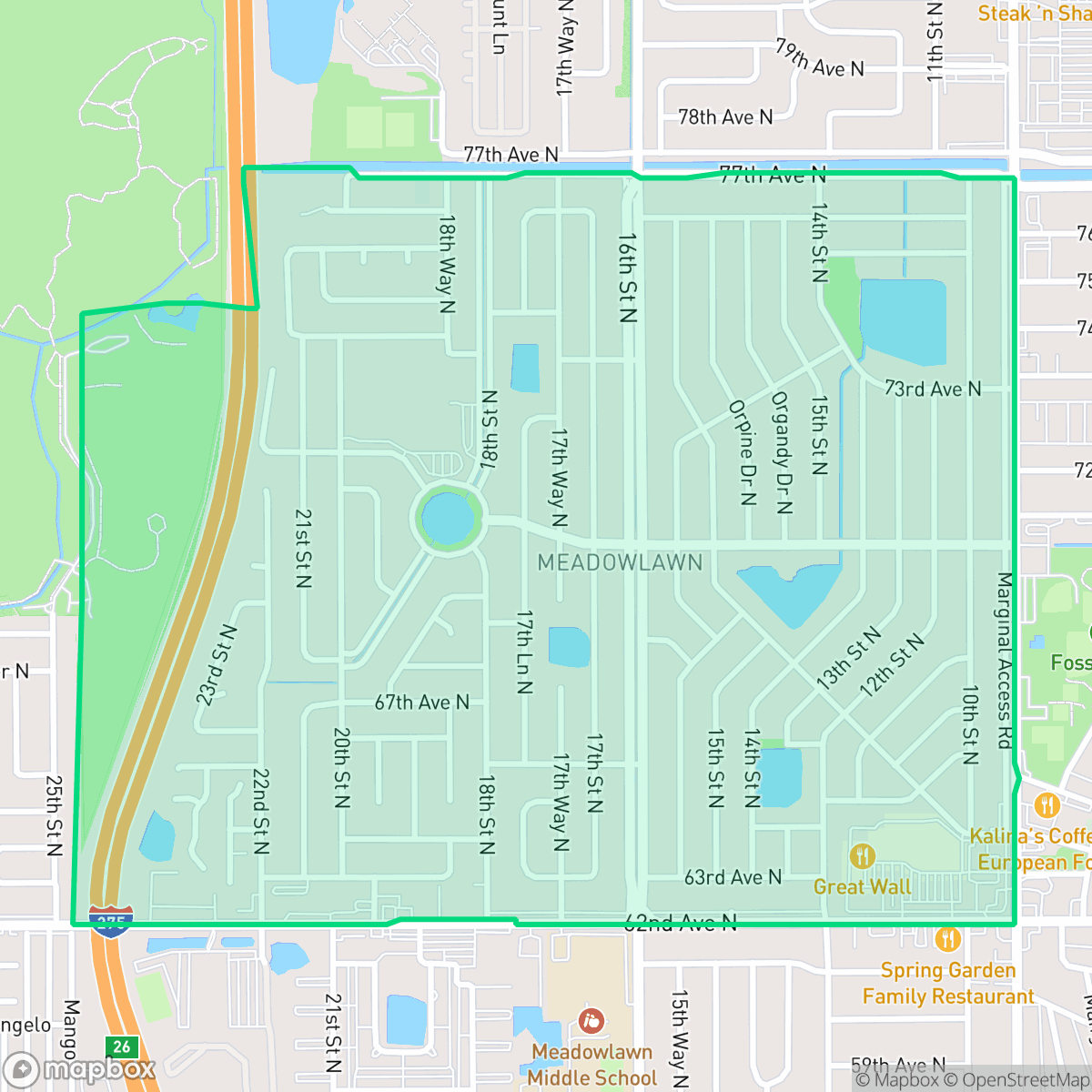
Developed in the 1950s by John Thea Haynsworth Jr., Meadowlawn stands as one of the largest residential projects in Florida Gulf Coast history. Originally characterized by bog and wetlands used for cattle grazing, the area underwent significant transformation to become a planned suburban community. To mitigate flooding, developers excavated six man-made lakes—including Lake Laguna, Lynch Lake, and Viking Lake—using the displaced soil to elevate residential lots. This mid-century development is defined by its classic ranch-style homes and the central Meadowlawn Park, which was donated by Haynsworth. Today, the neighborhood remains a stable, residential-focused community that retains its mid-century character, offering a distinct contrast to the more tourist-centric areas of St. Petersburg.
The neighborhood provides a low-key living experience defined by its simple suburban layout and a mix of open land and wooded areas. The area is primarily residential, offering a sense of privacy that exceeds many other parts of the city. Pedestrian connectivity is a standout feature, as the established sidewalk network allows for easy movement along residential streets and arterial roads, even while the surrounding environment maintains a semi-rural character. The community is well-suited for those who prefer a predictable, quiet setting over the density of commercial or nightlife-heavy districts.
Prospective residents should consider that the area experiences moderate traffic noise from nearby streets and faces air quality challenges consistent with the broader St. Petersburg region. While the neighborhood is served by the highly-regarded Pinellas County School District, families should note that the district is currently navigating campus consolidations due to shifting enrollment trends. The community is best suited for individuals and families who value a stable, functional environment and a diverse demographic mix over high-intensity urban amenities.
Neighborhood Scores Across 15 Qualities
Residential spacing varies across the area, ranging from tight clusters in multi-family units to more buffered single-family homes. This level of privacy is slightly higher than the St. Petersburg average.
Sidewalk networks are well-established along residential streets and main arterial roads, providing better pedestrian connectivity than the St. Petersburg average. Low traffic volumes on interior streets offer safe walking conditions, though some areas near highway interchanges lack continuous pathways.
Standard tract housing and mobile home parks define the landscape, offering a functional but modest aesthetic that sits slightly below the St. Petersburg average.
Walking opportunities for pets vary by street, as some areas offer accessible lakefront parks and green verges while others are limited to private yards. According to iHuus data, the availability of dedicated public park space is roughly in line with the St. Petersburg average.
Open land and wooded areas are frequently interspersed with residential plots, offering a slightly more rural character than the typical St. Petersburg landscape. According to iHuus data, the area features a mix of scattered homes and denser suburban clusters near highway corridors.
Daily activity remains relatively subdued, offering a low-key atmosphere that is slightly less active than the St. Petersburg average. Most areas prioritize residential privacy and access to parks over dense commercial or nightlife hubs.
Steady sounds from nearby busy streets are present, though levels remain comparable to the rest of St. Petersburg.
Frequent periods of unhealthy air levels pose a significant risk to sensitive groups. This level of pollution is roughly consistent with the broader St. Petersburg area according to iHuus data.
Heavy industrial activity and manufacturing hazards are absent from the area, making it much quieter than the St. Petersburg average. Residents may encounter light commercial retail and some traffic noise from nearby highway corridors, but the landscape remains overwhelmingly residential and institutional.
Health insurance enrollment among Meadowlawn residents is slightly lower than the St. Petersburg average, according to iHuus data.
Political views in this area are evenly distributed between conservative and liberal leanings. This makes the local landscape slightly more moderate than the broader St. Petersburg average, according to iHuus data.
Residents live alongside a balanced variety of young adults, families, and seniors. This demographic spread is slightly more varied than the average seen across St. Petersburg.
Flood risk in this area remains difficult to assess because FEMA has not yet completed a detailed study for these specific zones. According to iHuus data, the level of risk is roughly comparable to the St. Petersburg average.
Address-Level Insights for Meadowlawn


iHuus Neighborhood Intelligence Insights
Get address-level neighborhood insights for Meadowlawn
- Street-level scores — see how individual blocks compare, not just neighborhood averages
- Micro-zone boundaries — identify quiet pockets, flood boundaries, and walkable clusters before you visit
- 15 dimensions in full — walkability, noise, air quality, school quality, insurance coverage, population age profile, urban/rural index, and more
- Boundary risk alerts — know if your address sits near a block boundary where scores drop, the kind of detail no listing will ever mention
- School insights — individual school ratings and insights, not just district-level data
- Compare before you commit — side-by-side data across neighborhoods, down to block precision
No credit card required
Compare with Any Neighborhood
| Dimension | Meadowlawn | Albert Whitted Airport |
|---|---|---|
| 🚶 Walkabilityavg 6.61 | ||
| 🔊 Acoustic Comfortavg 3.78 | ||
| 🤫 Privacy Indexavg 5.45 | ||
| 🎨 Visual Appealavg 6.33 | ||
| 🐕 Dog Friendlinessavg 5.45 | ||
| 🗺️ Urban-Rural Indexavg 6.19 | ||
| ✨ Neighborhood Vibeavg 3.5 | ||
| 🏥 Health Insurance Coverageavg 6.88 | ||
| 🌿 Air Qualityavg 1.87 | ||
| 🏭 Industrial Proximityavg 7.55 | ||
| 🌊 Flood Safetyavg 4.61 | ||
| 🗳️ Ideological Leanavg 6.01 | ||
| 👥 Population Age Profileavg 5.11 | ||
| 🔥 Fire Safety | ||
| 🏫 School Quality |
Meadowlawn Rankings
School Districts Serving Meadowlawn
School Insights for Meadowlawn
Below average outcomes; significant attendance and academic challenges.
School Insights
See what's really behind every school rating near Meadowlawn
- Individual school ratings — each school's own score with outcome context, not just a district average
- Enrollment & class size data — student-to-teacher ratio and how it compares to the state average
- Full demographics breakdown — ethnicity and gender composition for every school in the enrollment zone
- Every school in the district — all schools within the enrollment boundary ranked by rating, not just the closest one
- Grade levels & benchmarks — elementary through high school, with below/above state-average flags
No credit card required